

Archive position — measured, not model output
1 like on Devpost
505 of the 7,850 archived projects have more likes, and 1,758 share exactly 1 — so this project's #671 place in the like-ranked listing is a tie-break inside that group, not a ranking.
Projects (log scale)
Likes on Devpost. ▲ marks this project's group.
Show the figures
| Likes | Projects | Share of archive |
|---|---|---|
| 0 | 5,587 | 71.2% |
| 1 | 1,758 | 22.4% |
| 2 | 284 | 3.6% |
| 3–4 | 132 | 1.7% |
| 5–9 | 75 | 1.0% |
| 10+ | 14 | 0.2% |
 User Stories BotA demo video on every pull request
Get a demo video on every new feature
GitHub App that watches your pull requests and records a narrated, captioned demo.
Save time on demo prep and make informed decisions faster with a video walkthrough of every new feature.
Executive Summary
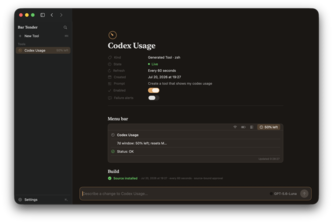
What the company appears to be: Bar Tender is a self-reported macOS menu bar utility that allows users to generate native menu bar tools using natural language prompts. The tool integrates with local AI CLI tools (Codex, Claude, Grok) and enables users to describe desired functionality, which then gets translated into executable code that runs in the menu bar.
What changed: The project description indicates a shift from conceptualizing an idea ("what if anyone could describe the menu bar utility they need and have it created immediately?") to building a working native macOS application with AI integration.
The single most important open question: Is there any evidence of user adoption, revenue, or traction beyond the author's own account?
Analysis basis: This report is based entirely on the self-reported description provided by the project author. No independent verification, archived data, or third-party sources are available. All claims in this document are stated by the author and not independently confirmed.
What The Product Actually Is
The description states that Bar Tender is a native macOS app built with Swift, SwiftUI, and AppKit. It turns natural-language requests into live menu bar tools using local AI CLI integrations (Codex, Claude, Grok).
- The app uses existing Codex, Claude, or Grok CLIs without requiring users to copy API keys.
- Generated tools are validated before execution and must be explicitly approved by the user.
- Once approved, tools become live menu bar items.
- Users can revise tools through conversation with the AI provider.
- Tools are stored under Application Support and restored on app launch.
Inference: The product is described as a desktop application that bridges natural language input with executable code generation for macOS menu bars. It is not a web-based or cloud-hosted service.
Positioning & Claim Evolution
The author states that Bar Tender started from the question: “what if anyone could describe the menu bar utility they need and have it created immediately?”
- The core claim is that users can generate menu bar tools using natural language.
- It positions itself as a way to avoid building separate apps for each task.
- The app emphasizes user control, transparency (source code review), and safety (approval required before execution).
- It also mentions future ambitions such as community libraries, richer layouts, and more AI providers.
Claim vs Fact: These are self-reported claims about intent and functionality. There is no evidence of actual market positioning or competitive differentiation beyond the author’s own words.
Target Customer & ICP
The description does not clearly identify a specific customer segment or ideal customer profile (ICP). It implies that anyone who wants to create simple menu bar utilities might use it, but there are no stated demographics, job functions, or user personas.
Not evidenced: No explicit target audience or buyer persona is defined in the project write-up.
Business Model & Pricing Evidence
There is no mention of pricing, monetization strategy, or business model in the description. The app is described as open-source and tested, but there’s no indication of how it would be sold or whether it has any commercial revenue streams.
Not evidenced: No evidence of a business model, pricing structure, or monetization plan.
Technical & Delivery Signals
The project is built natively on macOS using Swift, SwiftUI, and AppKit. It integrates with local AI CLIs (Codex, Claude, Grok) via structured JSON schemas.
Key technical features include:
- Native macOS menu bar integration
- Support for launch at login
- Library import/export functionality
- Diagnostics export and update checks
- Universal packaging for Apple Silicon and Intel Macs
Inference: The app is technically sophisticated for a hackathon project, with attention to UI/UX design, code validation, and system-level integration.
Traction & Maturity Signals
The description does not provide any evidence of traction or user adoption. It mentions that the app was submitted to an OpenAI 2026 hackathon, but no data on downloads, usage, or customer feedback is included.
Not evidenced: No signs of product-market fit, revenue, or user engagement beyond the author's own account.
Competitive Context
No mention of competitors or competitive landscape is provided in the description. The author does not reference similar tools or platforms that might offer comparable functionality.
Not evidenced: No information about existing or potential competitors.
Open Questions & Risks
Several risks and open questions are implied by the lack of evidence:
- No traction or revenue: The app is described as a hackathon submission with no commercial activity.
- Limited scope: It only supports macOS and local AI CLIs, limiting its reach.
- Dependency on AI providers: Reliance on Codex, Claude, and Grok may create fragility if those services change or become unavailable.
- User control vs usability trade-off: While the approval workflow ensures safety, it could also reduce ease of use.
Inference: Without external validation or usage metrics, this remains a speculative product with unclear commercial viability.
Questions the description leaves open
- What is your current user base or adoption rate?
- How do you plan to monetize the product?
- Are there any existing customers or pilot users?
- What are the technical challenges in scaling this beyond a single developer’s use case?
- How do you intend to support additional AI providers or platforms?
- Is there an existing roadmap for features like community libraries or sharing mechanisms?
Note: These questions aim to uncover whether the self-reported claims reflect real-world traction or just conceptual ambition.
Overall Assessment
There is no evidence of revenue, customers, or significant traction beyond the author's own description. The project appears to be a proof-of-concept or hackathon submission with limited commercial viability at this stage.
Assessment: Not ready for investment or partnership consideration without further evidence of product-market fit, user adoption, or monetization strategy.
User Stories BotA demo video on every pull request
Get a demo video on every new feature
GitHub App that watches your pull requests and records a narrated, captioned demo.
Save time on demo prep and make informed decisions faster with a video walkthrough of every new feature.
Source
Submitted to the OpenAI 2026 hackathon on Devpost. Project home on Devpost. Back to the full gallery on Devpost.
This competitive analysis was produced by top-founders.com (opens in a new tab)
Generated by a language model from this project's public Devpost page — its tagline, the author's own write-up and any built-with tags listed there — as captured in August 2026. Short quotations are the author's words. It is an opinion on the idea as a business, not on the people behind it, and it reflects the description as published then. If the project has moved on, request a correction below. The analysis is not independent research and contains no verified traction, revenue or customer data.
An independent guide by KFG International LLC — not affiliated with, endorsed by, or connected to Devpost or OpenAI.