

Archive position — measured, not model output
0 likes on Devpost
2,263 of the 7,850 archived projects have more likes, and 5,587 share exactly 0 — so this project's #2,861 place in the like-ranked listing is a tie-break inside that group, not a ranking.
Projects (log scale)
Likes on Devpost. ▲ marks this project's group.
Show the figures
| Likes | Projects | Share of archive |
|---|---|---|
| 0 | 5,587 | 71.2% |
| 1 | 1,758 | 22.4% |
| 2 | 284 | 3.6% |
| 3–4 | 132 | 1.7% |
| 5–9 | 75 | 1.0% |
| 10+ | 14 | 0.2% |
 User Stories BotA demo video on every pull request
Get a demo video on every new feature
GitHub App that watches your pull requests and records a narrated, captioned demo.
Save time on demo prep and make informed decisions faster with a video walkthrough of every new feature.
Executive Summary
What the company appears to be
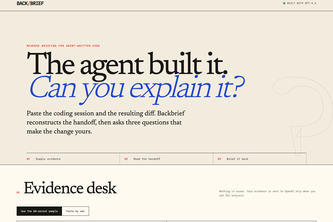
Backbrief is a self-reported tool built for the OpenAI 2026 hackathon that uses GPT-5.6 to process agent sessions and git diffs, generating structured handoffs with intent, implementation, and consequences columns. It includes interactive evidence references and a three-question coaching loop to help developers understand changes made by AI agents.
What changed
The project is presented as a hackathon submission with no evidence of prior development or commercial traction. It was built in a short timeframe using Next.js, TypeScript, and GPT-5.6, with no database or persistent user accounts.
The single most important open question
Does Backbrief have any evidence of developer adoption or usage beyond the hackathon context? The description states it is "not independently verified" and lacks any data on actual users, revenue, or product-market fit.
What The Product Actually Is
The description states that Backbrief:
- Accepts two artifacts: agent sessions and resulting git diffs
- Uses GPT-5.6 to generate a grounded handoff with intent, implementation, and consequences columns
- Includes interactive evidence references that open original session or diff lines in an audit plate
- Runs a three-question reverse brief process where developers answer in their own words
- Generates a self-contained HTML receipt containing the thesis, cited claims, explanations, and coaching takeaways
- Is built as a Next.js and TypeScript app with two stateless API routes powered by GPT-5.6
- Uses Zod Structured Outputs to constrain initial handoff and each coaching note
- Has no database, account system, analytics, or raw-input logging
Positioning & Claim Evolution
The description states that Backbrief was inspired by the idea that "coding agents can produce a working change faster than a developer can form a durable mental model of it." It positions itself as asking a more human ownership question: whether someone inheriting the change can explain what the agent intended, what it actually changed, and which consequences they now own.
The project claims to have evolved from a focus on "human ownership" rather than code quality review. It states that existing review tools ask whether generated code is good, while Backbrief asks about ownership and understanding.
Target Customer & ICP
The description does not clearly identify a specific target customer or ideal customer profile (ICP). It mentions that the tool is designed for developers who inherit changes made by AI agents, but does not specify:
- What size organizations use it
- Whether it targets individual developers or teams
- What development workflows it addresses specifically
- What technical expertise level it serves
Business Model & Pricing Evidence
The description states that Backbrief:
- Includes a public app with a fictional email-queue example so judges can complete the full flow without an account, repository, API key, or local installation
- Has no database, account system, analytics, or raw-input logging
- Is described as "free" in the context of the hackathon submission
- Does not provide any pricing information or commercial model details
Technical & Delivery Signals
The description states that Backbrief:
- Is a Next.js and TypeScript app with two stateless API routes powered by GPT-5.6
- Makes four OpenAI Responses API requests: one grounded analysis and three coaching turns
- Uses Zod Structured Outputs to constrain the initial handoff and each coaching note
- Adds stable S1…Sn and D1…Dn references before analysis
- Validates and size-bounds every boundary
- Requests store: false and returns generic errors that never echo private evidence
- Has no database, account system, analytics, or raw-input logging
- Was built with Codex as the primary development partner from blank repo to production
- Includes edge-enforced rate limiting in front of anonymous paid model routes
- Has twenty-eight passing behavioral tests plus lint, typecheck, and production build
- Has zero Semgrep findings and no detected lethal-trifecta co-location
- Was verified on desktop and mobile flows on the production deployment
Traction & Maturity Signals
The description states that Backbrief:
- Is a hackathon submission to the OpenAI 2026 hackathon
- Has no evidence of revenue, customers, or traction beyond the hackathon context
- Has no database, account system, analytics, or raw-input logging
- Was built in a short timeframe with no prior development history
- Does not mention any user base, usage metrics, or product-market fit data
Competitive Context
The description does not provide evidence of competitive analysis or positioning against existing tools. It mentions that "existing review tools mostly ask whether generated code is good" but does not name specific competitors or describe the broader market landscape.
Open Questions & Risks
The description indicates several potential risks:
- The project is a hackathon submission with no evidence of commercial traction
- No database, account system, analytics, or raw-input logging suggests limited product maturity
- The tool is described as "not independently verified" and lacks any revenue or customer data
- The focus on educational and non-gating features may limit monetization potential
- The use of GPT-5.6 with no persistent data storage raises questions about scalability and long-term viability
Questions the description leaves open
- What specific developer workflows does Backbrief address that existing tools don't?
- How does the team plan to transition from a hackathon prototype to a commercial product?
- What evidence do you have of developer interest or demand beyond the hackathon context?
- How will you handle privacy and data security concerns with agent session data?
- What are your plans for scaling beyond the current GPT-5.6 implementation?
- How do you plan to monetize this tool given its educational focus?
Overall Assessment
The description states that Backbrief is a hackathon submission with no evidence of commercial traction, revenue, or customer adoption. The project appears to be an experimental prototype built for a single competition context. There is no evidence of:
- Revenue generation
- Customer base
- Product-market fit
- Commercial viability
- Any sustainable business model
The tool's educational focus and non-gating approach may limit its commercial potential, while the lack of persistent data storage and user accounts suggests limited product maturity for investment consideration.
User Stories BotA demo video on every pull request
Get a demo video on every new feature
GitHub App that watches your pull requests and records a narrated, captioned demo.
Save time on demo prep and make informed decisions faster with a video walkthrough of every new feature.
Source
Submitted to the OpenAI 2026 hackathon on Devpost. Project home on Devpost. Back to the full gallery on Devpost.
This competitive analysis was produced by top-founders.com (opens in a new tab)
Generated by a language model from this project's public Devpost page — its tagline, the author's own write-up and any built-with tags listed there — as captured in August 2026. Short quotations are the author's words. It is an opinion on the idea as a business, not on the people behind it, and it reflects the description as published then. If the project has moved on, request a correction below. The analysis is not independent research and contains no verified traction, revenue or customer data.
An independent guide by KFG International LLC — not affiliated with, endorsed by, or connected to Devpost or OpenAI.