

Archive position — measured, not model output
1 like on Devpost
505 of the 7,850 archived projects have more likes, and 1,758 share exactly 1 — so this project's #642 place in the like-ranked listing is a tie-break inside that group, not a ranking.
Projects (log scale)
Likes on Devpost. ▲ marks this project's group.
Show the figures
| Likes | Projects | Share of archive |
|---|---|---|
| 0 | 5,587 | 71.2% |
| 1 | 1,758 | 22.4% |
| 2 | 284 | 3.6% |
| 3–4 | 132 | 1.7% |
| 5–9 | 75 | 1.0% |
| 10+ | 14 | 0.2% |
 User Stories BotA demo video on every pull request
Get a demo video on every new feature
GitHub App that watches your pull requests and records a narrated, captioned demo.
Save time on demo prep and make informed decisions faster with a video walkthrough of every new feature.
Executive Summary
What the company appears to be
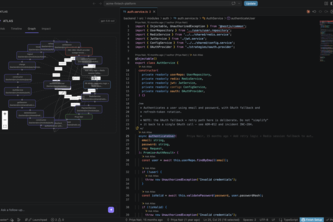
Atlas: Engineering Memory Engine is a developer tool that answers "why does this code exist?" by reconstructing engineering intent from repository history — including incidents, ADRs, PRs and Slack threads — within VS Code.
What changed
The author describes building a system that indexes engineering artifacts into a knowledge graph, then reasons over it to explain code behavior. It uses a hybrid retrieval approach combining semantic similarity, graph proximity and recency, with GPT-5.6 for reasoning under strict JSON constraints.
Single most important open question
Does Atlas actually work as described in practice, or is this a proof-of-concept that fails at scale?
What The Product Actually Is
The description states that Atlas is a VS Code extension that allows developers to highlight code and ask "why does this exist?" It returns explanations grounded in repository history including commits, PRs, incidents, ADRs and Slack threads.
It builds an engineering-memory knowledge graph from git history, ADRs, incident write-ups, PR bodies and Slack exports using GitPython, tree-sitter and parsers. The system retrieves evidence across three signals: similarity, proximity (graph-based), and recency.
The reasoning engine is a LangGraph StateGraph with steps for collecting, traversing, reasoning and synthesizing, using GPT-5.6 under strict JSON contracts to prevent embellishment.
Frontend is a React webview talking to a FastAPI backend, with storage abstracted behind an interface (in-memory by default, Postgres + pgvector for production).
The system is designed to be self-contained: a single .vsix install and one command bootstraps the demo with no API keys or databases needed.
Evidence The author's own write-up.
Inference This appears to be a developer tool built for VS Code, using AI and graph-based reasoning to explain code intent.
Positioning & Claim Evolution
The description states that Atlas answers "why does this code exist?" — a gap the author claims exists between tools like Copilot (how do I write), GitHub (what changed) and nothing (why does this exist).
It positions itself as solving the problem of scattered engineering knowledge, where information lives in five systems but developers are working in one.
The author also claims it's not plain RAG, because "the answer usually lives one or two hops away" — implying a more sophisticated approach than simple search.
Evidence The author's own write-up.
Inference Atlas positions itself as a tool to reduce onboarding time and outages by making historical engineering decisions discoverable within the developer workflow.
Target Customer & ICP
The description states that Atlas is for engineers who open unfamiliar functions and find them "wrong" — too defensive, with retry loops or redundant caches. These are likely developers working in legacy systems or large monorepos where context is hard to find.
It targets developers who need to understand why code exists before touching it, especially those who have experienced outages caused by removing code that was previously fixed.
Evidence The author's own write-up.
Inference The ICP appears to be senior engineers working in complex software environments with long histories and scattered documentation.
Business Model & Pricing Evidence
Not evidenced.
The description does not mention any pricing model, revenue streams or monetization strategy. It focuses entirely on the technical implementation and demo experience.
Evidence None provided.
Inference No commercial model is evident from the self-reported description.
Technical & Delivery Signals
Atlas uses GitPython for commit history, tree-sitter for symbol extraction, parsers for ADRs/incidents/PRs/Slack exports, and reference extraction to build graph edges. It employs a hybrid retrieval approach combining similarity, graph proximity and recency.
The reasoning engine is a LangGraph StateGraph with steps for collecting, traversing, reasoning and synthesizing, using GPT-5.6 under strict JSON contracts.
Frontend is built with React (Vite, Tailwind, Framer Motion) and talks to a FastAPI backend. Storage abstraction allows in-memory or Postgres + pgvector backends.
The system ships as a VS Code extension (.vsix), with a prebuilt Docker image containing the demo repo and pre-indexed data.
It supports offline determinism via mock mode that simulates answers from real evidence without network access.
Evidence The author's own write-up.
Inference The technical stack suggests a developer-focused tool built on modern AI/ML infrastructure, with attention to deployment and user experience.
Traction & Maturity Signals
Not evidenced.
There is no mention of users, customers, revenue, adoption rates or any traction metrics. The description focuses entirely on the demo and implementation details.
Evidence None provided.
Inference No signs of product-market fit or real-world usage are evident from the self-reported description.
Competitive Context
The author states that existing tools like Copilot (how do I write) and GitHub (what changed) don't answer "why does this exist?" — positioning Atlas as filling a gap in the developer tooling landscape.
It implies that current solutions fail to surface historical context embedded in engineering artifacts, which leads to onboarding delays and outages.
Evidence The author's own write-up.
Inference Atlas competes with general-purpose AI coding assistants and version control systems by focusing specifically on intent reconstruction from repository history.
Open Questions & Risks
- Unproven scalability: The demo works with a pre-indexed repo, but there is no evidence of how it scales to large monorepos or teams.
- No commercial traction: No users, customers or revenue data are provided — the tool remains untested in real-world environments.
- Demo-centric design: Features like Replay and Impact were broken due to poor discoverability (command palette only), suggesting potential UX issues at scale.
- Dependency on AI quality: Reliance on GPT-5.6 under strict contracts may not translate well to production use cases without further validation.
- Limited source support: Only mentions Git, ADRs, incidents, PRs and Slack; no evidence of integration with Jira, Linear or other tools.
Evidence The author's own write-up.
Inference While technically impressive, the lack of real-world testing and commercial viability raises concerns about product maturity.
Questions the description leaves open
- How does Atlas handle incremental indexing for large monorepos?
- What are the performance implications of graph traversal at scale?
- Has the tool been tested beyond the demo environment with actual engineering teams?
- Are there plans to integrate with Jira, Linear or other issue trackers?
- What is the roadmap for team-level deployment and authentication?
- How does Atlas handle conflicting or incomplete historical data?
- Can you demonstrate how it handles edge cases like code that lacks clear provenance?
Evidence The author's own write-up.
Inference These questions aim to probe beyond the demo into real-world applicability, scalability and integration challenges.
Overall Assessment
Not evidenced.
There is no evidence of funding rounds, valuations, or any investment activity. The project appears to be a hackathon submission with no indication of commercialization plans or partnerships.
Evidence None provided.
Inference Without traction, revenue or investor interest, there is no basis for an investment or partnership assessment at this stage.
User Stories BotA demo video on every pull request
Get a demo video on every new feature
GitHub App that watches your pull requests and records a narrated, captioned demo.
Save time on demo prep and make informed decisions faster with a video walkthrough of every new feature.
Source
Submitted to the OpenAI 2026 hackathon on Devpost. Project home on Devpost. Back to the full gallery on Devpost.
This competitive analysis was produced by top-founders.com (opens in a new tab)
Generated by a language model from this project's public Devpost page — its tagline, the author's own write-up and any built-with tags listed there — as captured in August 2026. Short quotations are the author's words. It is an opinion on the idea as a business, not on the people behind it, and it reflects the description as published then. If the project has moved on, request a correction below. The analysis is not independent research and contains no verified traction, revenue or customer data.
An independent guide by KFG International LLC — not affiliated with, endorsed by, or connected to Devpost or OpenAI.