

Archive position — measured, not model output
0 likes on Devpost
2,263 of the 7,850 archived projects have more likes, and 5,587 share exactly 0 — so this project's #2,749 place in the like-ranked listing is a tie-break inside that group, not a ranking.
Projects (log scale)
Likes on Devpost. ▲ marks this project's group.
Show the figures
| Likes | Projects | Share of archive |
|---|---|---|
| 0 | 5,587 | 71.2% |
| 1 | 1,758 | 22.4% |
| 2 | 284 | 3.6% |
| 3–4 | 132 | 1.7% |
| 5–9 | 75 | 1.0% |
| 10+ | 14 | 0.2% |
 User Stories BotA demo video on every pull request
Get a demo video on every new feature
GitHub App that watches your pull requests and records a narrated, captioned demo.
Save time on demo prep and make informed decisions faster with a video walkthrough of every new feature.
Executive Summary
What the company appears to be
Ask is a desktop assistant tool built by one developer (Maximus Adeola) that allows users to select any content on their screen, ask a question about it, and receive a concise answer without leaving their current workflow. It uses AI vision models to interpret selected screen elements and delivers responses in a compact always-on-top window.
What changed
The project evolved from a personal research tool into a self-contained desktop application with a focus on minimal interaction and context-free AI assistance. It was built entirely through AI agents, using prompt engineering as the primary development methodology.
Single most important open question
Is there any evidence of user adoption or market demand beyond the author's own usage? The description states no revenue, customers or traction data exist beyond the author's personal experience.
What The Product Actually Is
The description states that Ask is a desktop assistant that:
- Lives in the system tray until invoked
- Uses a global shortcut (Alt+?) to freeze screen and allow selection
- Provides a slim annotation rail with quick actions (Explain this, Summarize, Translate) or custom questions
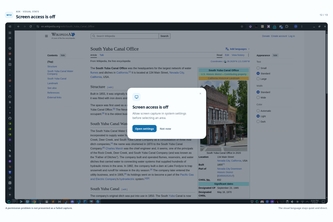
- Streams answers via SSE into a frameless always-on-top window
- Works across multiple platforms (research papers, code editors, terminals, UI, video subtitles)
- Uses Electron, React, TypeScript for implementation
- Integrates with OpenAI-compatible vision endpoints
The product is described as a single-question, single-answer tool that avoids chat history, accounts, and permanent feeds. It was built using AI agents including Codex and Claude Code.
Positioning & Claim Evolution
The description states the author's inspiration came from needing to understand research papers without signing up for services or using screenshots. The positioning evolved from a personal research tool into a general-purpose desktop assistant that "just works" with anything on screen.
The claim evolution shows:
- Original intent: solve personal problem of understanding complex text
- Evolution: create a tool that works across multiple content types (papers, code, UI)
- Current positioning: minimal interaction desktop assistant with AI vision capabilities
Target Customer & ICP
Not evidenced. The description does not identify specific customer segments or target personas beyond the author's own use case.
Business Model & Pricing Evidence
Not evidenced. The description makes no claims about pricing, monetization, or business model.
Technical & Delivery Signals
The description states:
- Built with Electron, React, TypeScript
- Four-layer architecture (main process, renderer, shared utilities, proxy backend)
- Uses desktopCapturer for screen capture
- Implements SVG luminance mask for selection overlay
- Streams responses via SSE into frameless always-on-top window
- Includes DPI-aware coordinate normalization
- Uses AI agents for development including Codex and Claude Code
- Built entirely through AI agent handoffs with structured prompt engineering
Traction & Maturity Signals
Not evidenced. The description states no revenue, customers or traction data exist beyond the author's personal experience.
Competitive Context
Not evidenced. The description does not mention competitors or market positioning relative to existing tools.
Open Questions & Risks
- Single-person development team (1 person)
- No evidence of user adoption or market traction
- Self-reported only, no independent verification
- Product is described as a personal tool with no commercial validation
- AI agent development approach may not scale to complex product requirements
- Naming concerns noted by author ("Ask is awful for SEO")
- No evidence of monetization strategy or business model
Questions the description leaves open
- What specific user problems are you solving that existing tools don't address?
- Have you conducted any user research or testing beyond your own usage?
- How do you plan to validate market demand for this tool?
- What is your go-to-market strategy and how will you acquire users?
- Are there any technical limitations or scalability concerns with the current architecture?
- What are your plans for monetization and revenue generation?
- How do you intend to scale beyond a single developer?
- What metrics would indicate product-market fit for this tool?
Overall Assessment
Not evidenced. The description provides no information about funding rounds, valuations, or investment status. No evidence exists of commercial traction, revenue, or customer adoption that would support an investment or partnership decision. The project appears to be a personal development effort with no demonstrated market validation or business metrics.
User Stories BotA demo video on every pull request
Get a demo video on every new feature
GitHub App that watches your pull requests and records a narrated, captioned demo.
Save time on demo prep and make informed decisions faster with a video walkthrough of every new feature.
Source
Submitted to the OpenAI 2026 hackathon on Devpost. Project home on Devpost. Back to the full gallery on Devpost.
This competitive analysis was produced by top-founders.com (opens in a new tab)
Generated by a language model from this project's public Devpost page — its tagline, the author's own write-up and any built-with tags listed there — as captured in August 2026. Short quotations are the author's words. It is an opinion on the idea as a business, not on the people behind it, and it reflects the description as published then. If the project has moved on, request a correction below. The analysis is not independent research and contains no verified traction, revenue or customer data.
An independent guide by KFG International LLC — not affiliated with, endorsed by, or connected to Devpost or OpenAI.