

Archive position — measured, not model output
1 like on Devpost
505 of the 7,850 archived projects have more likes, and 1,758 share exactly 1 — so this project's #625 place in the like-ranked listing is a tie-break inside that group, not a ranking.
Projects (log scale)
Likes on Devpost. ▲ marks this project's group.
Show the figures
| Likes | Projects | Share of archive |
|---|---|---|
| 0 | 5,587 | 71.2% |
| 1 | 1,758 | 22.4% |
| 2 | 284 | 3.6% |
| 3–4 | 132 | 1.7% |
| 5–9 | 75 | 1.0% |
| 10+ | 14 | 0.2% |
 User Stories BotA demo video on every pull request
Get a demo video on every new feature
GitHub App that watches your pull requests and records a narrated, captioned demo.
Save time on demo prep and make informed decisions faster with a video walkthrough of every new feature.
Executive Summary
What the company appears to be
Argus is an AI-powered third-party risk management tool designed for mid-market companies and AI-first organizations that lack dedicated GRC analysts. It automates vendor due diligence by deploying a crew of specialized AI agents to assess vendors across compliance, security posture, and AI-specific risks.
What changed
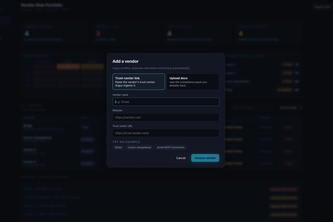
The project was submitted as part of the OpenAI 2026 hackathon. The author describes building a runnable product that uses multi-agent AI workflows to automate tasks like vendor intake, discovery, compliance mapping, questionnaire completion, risk scoring, negotiation, monitoring, and executive reporting — all within a dashboard interface.
Single most important open question
Is there any evidence of traction or commercial adoption beyond the hackathon submission? The description contains no data on revenue, customers, usage, or product-market fit beyond self-reported claims.
Note: This analysis is based entirely on the author’s own description. No external verification, funding history, customer list, or performance metrics are available. All statements reflect what the author states, not necessarily what is true.
What The Product Actually Is
The description states that Argus is an AI agent crew that autonomously assesses and monitors vendors including AI tools, agents, and MCP servers. It includes nine specialized agents performing tasks such as:
- Intake and tiering of vendors
- Discovery via web research using Bright Data
- Compliance mapping to frameworks (SOC 2, ISO 27001, GDPR, etc.)
- Auto-completion of questionnaires (SIG Lite, CAIQ)
- AI-vendor risk module covering prompt injection, permissions, retention, and autonomous actions
- Risk scoring with explainability
- Negotiation routing to human approvers
- Continuous monitoring for changes in vendor status
- Executive reporting
The system renders results in a polished dashboard with real-time activity feeds and visualizations.
Inference: The product appears to be a self-contained, multi-agent workflow built around LLMs, structured as a SaaS-like interface. It is not described as a platform or API for integration but rather as an end-user tool.
Positioning & Claim Evolution
The author positions Argus as a solution for teams without security analysts — particularly those dealing with AI vendors who lack traditional TPRM playbooks.
Key claims:
- “Teams with no security analyst get enterprise-grade vendor due diligence in minutes.”
- “Traditional third-party risk management (TPRM) has no playbook for prompt injection, tool permissions, data retention/training, or autonomous actions.”
- “We built Argus to be the vendor-risk department these teams never had.”
The evolution of positioning seems to be:
- From generic TPRM to AI-specific vendor risk.
- From manual spreadsheets and emails to an automated AI-driven workflow.
- From isolated assessments to shared Trust Passport network effect.
Claim vs Fact: These are self-reported claims about intent and value proposition, not proof of traction or adoption.
Target Customer & ICP
The description states that Argus targets:
- Mid-market companies
- AI-first organizations
- Teams without dedicated GRC analysts
- Engineers or ops leads who currently handle vendor vetting manually
It also implies a need for enterprise-grade security assessments in environments where such roles are absent.
Inference: The ICP likely includes small to mid-sized tech firms using many SaaS and AI vendors, especially those operating in regulated industries (e.g., healthcare, finance), where compliance is critical but resources limited.
Business Model & Pricing Evidence
No pricing information or business model details are provided in the description. The author does not state whether Argus will be sold as a SaaS subscription, a one-time license, or via partnerships.
Not evidenced: There is no mention of monetization strategy, customer acquisition cost, or revenue streams.
Technical & Delivery Signals
The system is built with:
- Backend: Python + FastAPI, SQLAlchemy (SQLite by default, Postgres-ready)
- Frontend: Next.js + React + TypeScript
- Reasoning engine: OpenAI GPT-5.6 or Google Gemini
- Tools: Bright Data for discovery, PDF/text parser, Codex for rapid prototyping
Key delivery signals:
- Structured JSON outputs and deterministic fallbacks
- Offline capability with curated vendor knowledge base
- Model flexibility via environment switch
- SSE-friendly activity feed
- Multi-agent orchestration
Inference: The architecture suggests a lightweight, modular system designed to run reliably even without external APIs. It is not described as scalable or enterprise-ready beyond demo-level functionality.
Traction & Maturity Signals
The description does not include any evidence of traction:
- No customer base
- No revenue figures
- No usage metrics
- No product roadmap beyond the hackathon submission
It is described as a “coherent, runnable product” but lacks data on adoption or performance post-hackathon.
Absence of evidence: There is no indication that Argus has moved beyond prototype or demo stage in any meaningful way.
Competitive Context
The author mentions:
- Traditional TPRM tools have no playbook for AI vendors
- No incumbent treats prompt injection, tool permissions, retention, or autonomous actions as core risks
- The product maps AI vendor risk toward ISO 42001 — a relatively new governance framework
This suggests a niche in the AI vendor risk space, distinct from traditional TPRM vendors.
Inference: Argus may be positioned to address a gap in AI-specific vendor risk management, but no competitive landscape or market positioning data is provided.
Open Questions & Risks
- Unverified claims: All descriptions are self-reported and unverifiable.
- No traction evidence: No customers, revenue, or usage data.
- Limited scalability: Built for demos, not production use.
- Dependency on LLMs: Reliance on OpenAI/Gemini may pose risks if access changes or costs rise.
- Trust Passport network effect: Not yet proven to be valuable without real-world adoption.
- Single-person team: The project is built by one individual, raising questions about long-term development and support.
Not evidenced: No evidence of competitive differentiation, market size, or product maturity beyond the hackathon.
Questions the description leaves open
- What specific vendors are you targeting in your initial use cases?
- How do you plan to validate the accuracy of AI-generated compliance mappings and risk scores?
- Are there any existing partnerships or pilot programs with companies using this tool?
- What is your go-to-market strategy post-hackathon?
- How will you scale beyond a single-person development team?
- Have you considered how to handle vendor resistance or access issues (e.g., NDA requests)?
- Is there a plan for integrating with existing GRC platforms or SIEM tools?
Overall Assessment
Not evidenced.
There is no evidence of commercial traction, revenue, or customer validation beyond the hackathon submission. The project is described as a prototype and not yet proven in market.
Confidence level: Low — based on minimal self-reported information and absence of any measurable outcomes.
User Stories BotA demo video on every pull request
Get a demo video on every new feature
GitHub App that watches your pull requests and records a narrated, captioned demo.
Save time on demo prep and make informed decisions faster with a video walkthrough of every new feature.
Source
Submitted to the OpenAI 2026 hackathon on Devpost. Project home on Devpost. Back to the full gallery on Devpost.
This competitive analysis was produced by top-founders.com (opens in a new tab)
Generated by a language model from this project's public Devpost page — its tagline, the author's own write-up and any built-with tags listed there — as captured in August 2026. Short quotations are the author's words. It is an opinion on the idea as a business, not on the people behind it, and it reflects the description as published then. If the project has moved on, request a correction below. The analysis is not independent research and contains no verified traction, revenue or customer data.
An independent guide by KFG International LLC — not affiliated with, endorsed by, or connected to Devpost or OpenAI.