

Archive position — measured, not model output
0 likes on Devpost
2,263 of the 7,850 archived projects have more likes, and 5,587 share exactly 0 — so this project's #2,625 place in the like-ranked listing is a tie-break inside that group, not a ranking.
Projects (log scale)
Likes on Devpost. ▲ marks this project's group.
Show the figures
| Likes | Projects | Share of archive |
|---|---|---|
| 0 | 5,587 | 71.2% |
| 1 | 1,758 | 22.4% |
| 2 | 284 | 3.6% |
| 3–4 | 132 | 1.7% |
| 5–9 | 75 | 1.0% |
| 10+ | 14 | 0.2% |
 User Stories BotA demo video on every pull request
Get a demo video on every new feature
GitHub App that watches your pull requests and records a narrated, captioned demo.
Save time on demo prep and make informed decisions faster with a video walkthrough of every new feature.
Executive Summary
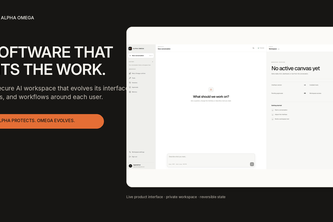
What the company appears to be: Alpha Omega is a self-reported AI workspace platform that allows users to describe desired software capabilities in natural language and have them built, tested, installed, and executed within secure sandboxes. The system is described as having two core components: "Alpha" (trust and control) and "Omega" (creation and evolution). It is presented as an experimental project submitted to the OpenAI 2026 hackathon.
What changed: The author states that during a Build Week event, they significantly expanded and hardened the platform's capabilities, particularly around authentication, orchestration, sandbox security, and workspace lifecycle management. This work was reportedly completed in a short timeframe (a "hackathon") and deployed to production at alphaomega.ink.
The single most important open question: Is there any evidence of actual user adoption or commercial traction beyond the author's own development efforts? The description contains no data on revenue, customers, usage metrics, or market validation — only self-reported claims about technical architecture and functionality.
What The Product Actually Is
The description states that Alpha Omega is a customizable AI workspace where users can describe what they want in natural language. From this request, the system can:
- Design and build a workspace tool
- Generate or modify an interface
- Test the resulting capability
- Request permission before sensitive actions
- Install the tool into the current workspace
- Run it inside a controlled sandbox
- Track its progress through durable events
- Preserve versions and recovery information
- Disable, revoke, or remove capabilities later
- Recover failed requests without silently repeating side effects
The system is described as built around two complementary layers:
- Alpha: The authority layer that enforces trust and control by managing:
- Workspace and tenant isolation
- Explicit permission approvals
- Network and external-action restrictions
- Scoped tool access
- Authentication and recent-auth checks
- Row-level database security
- Revocation and uninstall rules
- Sandboxed execution boundaries
- Audit evidence and safe recovery paths
- Omega: The engineering layer that turns user requests into durable development runs covering:
- Planning, implementation, testing, validation, and activation of workspace changes
- Persistence of runs, progress restoration, failure visibility, and successful change tracking
The system is described as not just another chatbot but a sandboxed environment where conversation can become real tools, interfaces, automations, and persistent workspace capabilities.
Positioning & Claim Evolution
The author states that the project began with a simple question: "What if you could describe the software you need, and your workspace could safely build it, test it, install it, and evolve itself?"
This positions Alpha Omega as an alternative to fixed-interface AI products — one that allows users to dynamically customize their environment based on evolving needs.
The description claims that this is not just a chatbot but a fully customizable AI workspace with sandboxed tool creation and execution. The author emphasizes that the system supports durable engineering runs, idempotent retries, and structured recovery paths.
There is no evidence of prior positioning or evolution beyond the initial concept described in the hackathon submission.
Target Customer & ICP
The description does not identify a specific customer segment or ideal customer profile (ICP). It describes the platform as enabling users to describe what they need in natural language and have it built within secure sandboxes. The author implies that this would appeal to individuals who want more control over their AI tools than traditional chatbots offer.
No explicit target persona, industry vertical, or use case is defined beyond general "workspace customization" needs.
Business Model & Pricing Evidence
There is no evidence of a business model or pricing structure in the description. The project is presented as an experimental submission to a hackathon and lacks any mention of monetization, subscriptions, licensing, or commercial arrangements.
Technical & Delivery Signals
The system is built using:
- Full-stack TypeScript and React architecture with Next.js
- Supabase and PostgreSQL for authentication, persistent workspace state, durable run records, and row-level security
- Docker-based sandboxing
- Cloudflare, Netlify for hosting
- Integration of AI models including GPT-5.6, Codex, and others
Key technical features include:
- Durable engineering runs and background workers
- Idempotent retry handling
- Conversation and request persistence
- Cancellation, bounded retries, and stale-run reconciliation
- Structured error and recovery states
- Runtime health and readiness checks
- Request IDs and structured operational logs
- Scoped memory with retention controls
- Version history and human-readable change evidence
- Checksummed exports
- Trusted factory reset
- CSP, HSTS, frame protection, SSRF defenses, and origin validation
- Responsive and accessible keyboard-first interaction
The system includes quality assurance mechanisms such as:
- Vitest application and contract tests
- pgTAP database and RLS assertions
- Playwright desktop and mobile browser journeys
- TypeScript and ESLint checks
- Sandbox type-checking
- Production builds
- Dependency and secret scanning
- Live health, security-header, and console verification
Traction & Maturity Signals
The description states that the system reached:
- 251 passing application tests
- 256 passing database and RLS assertions
- 14 passing desktop and mobile browser journeys
- Zero production dependency vulnerabilities
- A healthy production readiness endpoint
- Responsive verification at 1440px, 768px, and 360px
- Working Tool Forge build, approval, installation, invocation, disable, and lifecycle controls
- Durable Omega workspace evolution and recovery
- Production deployment at alphaomega.ink
However, there is no evidence of user adoption, revenue, customer base, or market traction beyond the author’s own development efforts.
Competitive Context
The description does not provide any information about competitors or competitive positioning. It does not mention existing platforms that offer similar functionality or describe how Alpha Omega differentiates from them.
Open Questions & Risks
- No commercial traction: The system appears to be a prototype built for a hackathon with no evidence of real-world usage or revenue.
- Unverified claims: All descriptions are self-reported and unverified; there is no third-party validation.
- Limited scope: The project seems experimental, focused on internal development rather than external productization.
- No scalability data: No information about performance under load, infrastructure capacity, or operational maturity beyond a single developer’s work.
- Unclear path to monetization: No indication of how the platform would generate revenue or be commercialized.
Questions the description leaves open
- What is the actual user base or customer traction beyond the author's own development?
- How does the system plan to scale beyond a single developer’s environment?
- Are there any plans for monetization or commercial partnerships?
- What are the key assumptions about user behavior and adoption that underpin this product?
- Has the team considered how to handle edge cases in sandboxed execution, especially with third-party integrations?
- How is the system intended to evolve beyond its current hackathon prototype?
Overall Assessment
Not evidenced.
The description provides no evidence of commercial viability, traction, or market validation. It describes an experimental project built for a hackathon without any indication of whether it has moved beyond proof-of-concept stage or attracted users or investors. The lack of revenue data, customer metrics, or competitive analysis makes it impossible to assess the potential for investment or partnership at this time.
The author's own account indicates that the system was developed in a short timeframe and deployed to production, but there is no evidence of ongoing use, feedback loops, or product-market fit beyond the developer’s own experience.
User Stories BotA demo video on every pull request
Get a demo video on every new feature
GitHub App that watches your pull requests and records a narrated, captioned demo.
Save time on demo prep and make informed decisions faster with a video walkthrough of every new feature.
Source
Submitted to the OpenAI 2026 hackathon on Devpost. Project home on Devpost. Back to the full gallery on Devpost.
This competitive analysis was produced by top-founders.com (opens in a new tab)
Generated by a language model from this project's public Devpost page — its tagline, the author's own write-up and any built-with tags listed there — as captured in August 2026. Short quotations are the author's words. It is an opinion on the idea as a business, not on the people behind it, and it reflects the description as published then. If the project has moved on, request a correction below. The analysis is not independent research and contains no verified traction, revenue or customer data.
An independent guide by KFG International LLC — not affiliated with, endorsed by, or connected to Devpost or OpenAI.