

Archive position — measured, not model output
0 likes on Devpost
2,263 of the 7,850 archived projects have more likes, and 5,587 share exactly 0 — so this project's #2,622 place in the like-ranked listing is a tie-break inside that group, not a ranking.
Projects (log scale)
Likes on Devpost. ▲ marks this project's group.
Show the figures
| Likes | Projects | Share of archive |
|---|---|---|
| 0 | 5,587 | 71.2% |
| 1 | 1,758 | 22.4% |
| 2 | 284 | 3.6% |
| 3–4 | 132 | 1.7% |
| 5–9 | 75 | 1.0% |
| 10+ | 14 | 0.2% |
 User Stories BotA demo video on every pull request
Get a demo video on every new feature
GitHub App that watches your pull requests and records a narrated, captioned demo.
Save time on demo prep and make informed decisions faster with a video walkthrough of every new feature.
Executive Summary
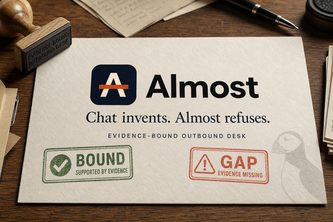
The company appears to be a self-reported proof-of-concept project named "Almost", submitted to the OpenAI 2026 hackathon. The author describes it as an evidence-bound outbound desk tool that checks AI-generated text for factual grounding using a gate mechanism. It distinguishes between claims supported by direct textual evidence ("BOUND") and those not evidenced ("GAP"), with the latter remaining named in the output.
The project is described as a technical prototype, built with Python, JavaScript, HTML/CSS, and AI models like GPT-5.6 and Codex. It includes components such as a server-side gate, a Clearance Workspace UI, and a verification system using cryptographic seals.
What changed: The author states that the project was built in response to a Friday deadline scenario where founders paste board updates into chat, and the model returns clean sentences — but the second half may not be in the source. The goal is to provide "clearance before send", not just better prose.
The single most important open question: Is there any evidence of real-world usage or traction beyond this hackathon submission? The description provides no information on revenue, customers, adoption, or commercial viability.
Note: This analysis is based entirely on the self-reported project description provided by the author. No external verification or historical data is available.
What The Product Actually Is
- The description states that Almost is an evidence-bound outbound desk.
- It allows users to paste a source document and an AI-generated draft.
- A server-side gate checks each claim:
- BOUND: The quote is a real substring of the excerpt supplied.
- GAP: The quote is not evidenced; it stays named on purpose.
- The product includes:
- A pack with span pins (offsets + hash) and an issuer seal.
- A verification system at
/verifythat re-checks claims. - A Clearance Workspace UI for source + draft + clearance dock.
- An embed widget at
/embed/clear.
- The tool is described as fail-closed, meaning it refuses to let unverified content pass through.
Inference: Based on the description, this seems to be a proof-of-concept prototype focused on AI-generated text integrity and accountability. It does not appear to be a finished product or service with customers.
Positioning & Claim Evolution
- The author states that the project was inspired by a scenario where a founder pastes a board update into chat, and the model returns a clean sentence — but the second half was never in the source.
- The goal is clearance before send, not another model that writes nicer prose.
- The tagline is: "Chat invents. Almost refuses."
- The project positions itself as a tool for truth-bound communication, not just improved writing.
Claim: The author claims to have built a system that prevents AI-generated text from inventing facts, using a gate mechanism and named gaps.
Inference: This is a conceptual shift from generative tools to accountability tools. It reflects an awareness of the risks of AI hallucination in professional settings.
Target Customer & ICP
- The description does not name specific customers or personas.
- The author describes a use case involving founders pasting board updates into chat, suggesting a B2B SaaS or startup team audience.
- It is implied that the tool targets users who need to verify AI-generated content before sending it out, especially in professional contexts.
Not evidenced: No explicit customer segments, personas, or ICP are described. The target audience is inferred from the use case.
Business Model & Pricing Evidence
- There is no mention of pricing, monetization, or business model.
- The project is described as a hackathon submission, not a commercial product.
- It includes a demo mode (
?demo=1) that keeps the judge path alive without an account. - The tool uses OpenAI / Gemini draft only from BOUND claims and works with zero keys.
Not evidenced: No information on revenue, pricing tiers, or monetization strategy is provided.
Technical & Delivery Signals
- Built with:
- Python (for the fail-closed gate in
evidence.py) - JavaScript, HTML/CSS, SQLite
- OpenAI / Gemini for drafting
- Vercel, Cloud Run, stdlib HTTP server
- Python (for the fail-closed gate in
- The gate checks:
- Substring match in source
- Lexical support
- Polarity/negation/contradiction lite (not full NLI)
- Includes cryptographic features:
- Ed25519 seal when available
- HMAC fallback
- Verification system at
/verifyre-runs the gate on artifacts. - No Chrome extension required; embed widget available.
Inference: The project is a lightweight prototype, likely built for demonstration purposes, with minimal infrastructure dependencies and no production-grade scalability.
Traction & Maturity Signals
- Team size: 0
- Members: not stated
- Project is described as a hackathon submission (OpenAI 2026)
- No mention of users, customers, or adoption
- No revenue or funding data provided
- Demo cookie (
?demo=1) exists to keep the judge path alive without an account
Not evidenced: No traction, headcount, or commercial activity beyond the hackathon submission.
Competitive Context
- The description does not mention competitors.
- It is implied that the tool addresses a gap in AI-generated content verification.
- It contrasts with tools that simply improve prose or generate text without grounding.
- It is positioned as a truth-bound alternative to generative AI tools.
Not evidenced: No competitive landscape, market positioning, or competitor analysis provided.
Open Questions & Risks
- The project is described as a hackathon submission, not a commercial product.
- No team, funding, or traction data available.
- The tool is built with minimal infrastructure (e.g.,
stdlib HTTP server, no production-grade deployment). - The gate mechanism relies on substring matching and lexical support — not full NLI or entailment checking.
- The project may be too early-stage to assess commercial viability.
Inference: This is a conceptual prototype, not a product ready for market. Risks include lack of real-world testing, scalability concerns, and unclear path to monetization.
Questions the description leaves open
- What is the intended use case beyond the hackathon scenario?
- How does the substring-based gate mechanism handle paraphrasing or rewording?
- Is there any plan for production deployment or scaling beyond demo mode?
- Are there any real-world users or pilot programs?
- What are the long-term plans for monetization or commercialization?
- How does this tool integrate with existing workflows (e.g., Slack, Notion)?
- Has the team considered legal or compliance implications of such a system?
Overall Assessment
- The project is described as a hackathon submission, not a commercial product.
- No evidence of traction, revenue, or customer adoption.
- The tool is conceptual and built for demonstration purposes.
- It addresses a potential pain point in AI-generated content integrity but lacks real-world validation.
Assessment: Not ready for investment or partnership. This is a proof-of-concept with no demonstrated commercial viability or market traction. Further development, team building, and product-market fit testing are required before any serious consideration.
User Stories BotA demo video on every pull request
Get a demo video on every new feature
GitHub App that watches your pull requests and records a narrated, captioned demo.
Save time on demo prep and make informed decisions faster with a video walkthrough of every new feature.
Source
Submitted to the OpenAI 2026 hackathon on Devpost. Project home on Devpost. Back to the full gallery on Devpost.
This competitive analysis was produced by top-founders.com (opens in a new tab)
Generated by a language model from this project's public Devpost page — its tagline, the author's own write-up and any built-with tags listed there — as captured in August 2026. Short quotations are the author's words. It is an opinion on the idea as a business, not on the people behind it, and it reflects the description as published then. If the project has moved on, request a correction below. The analysis is not independent research and contains no verified traction, revenue or customer data.
An independent guide by KFG International LLC — not affiliated with, endorsed by, or connected to Devpost or OpenAI.