

Archive position — measured, not model output
0 likes on Devpost
2,263 of the 7,850 archived projects have more likes, and 5,587 share exactly 0 — so this project's #2,617 place in the like-ranked listing is a tie-break inside that group, not a ranking.
Projects (log scale)
Likes on Devpost. ▲ marks this project's group.
Show the figures
| Likes | Projects | Share of archive |
|---|---|---|
| 0 | 5,587 | 71.2% |
| 1 | 1,758 | 22.4% |
| 2 | 284 | 3.6% |
| 3–4 | 132 | 1.7% |
| 5–9 | 75 | 1.0% |
| 10+ | 14 | 0.2% |
 User Stories BotA demo video on every pull request
Get a demo video on every new feature
GitHub App that watches your pull requests and records a narrated, captioned demo.
Save time on demo prep and make informed decisions faster with a video walkthrough of every new feature.
Executive Summary
What the company appears to be
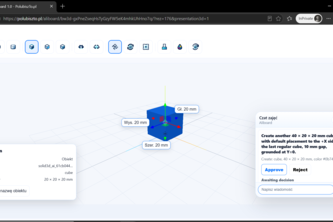
Aliboard 3D is a browser-based 3D collaborative workspace where an AI assistant (named Axel) proposes changes to a shared 3D scene based on natural-language instructions, but only applies those changes after human approval. The system supports real-time collaboration between multiple users and integrates manual editing with AI-assisted operations.
What changed
The project evolved from PolubiszTo.pl, an online education platform with collaborative whiteboard technology, extending that concept into a 3D environment for human-AI co-creation.
Single most important open question
Is there evidence of traction, revenue, or customer adoption beyond the author’s self-reported development process?
Note: This analysis is based entirely on the self-reported project description provided by the author. No external verification or historical data is available. All claims are unverified and should be treated as stated by the author.
What The Product Actually Is
- The description states that Aliboard 3D is a browser-based 3D workspace.
- It allows users to create and edit 3D objects through both manual interaction and natural-language instructions.
- An integrated AI assistant named Axel interprets natural-language commands, proposes operations, and only applies them after human approval.
- The system supports real-time collaboration between multiple users working on the same project.
- It uses a Django-based platform with real-time communication for synchronization.
- The product is built using technologies including HTML5, JavaScript, Python (Django), PostgreSQL, Redis, Three.js, WebGL, WebSockets, and OpenAI APIs.
Inference: The system appears to be a hybrid tool combining manual 3D design with AI-assisted operations in a shared environment. It does not appear to have a commercial product or user base yet, as no revenue or customer data is mentioned.
Positioning & Claim Evolution
- The description states that Aliboard 3D explores a "different approach" to AI design tools by enabling a shared workspace where humans and AI understand the same scene and collaborate.
- It positions itself as a tool for "human-AI collaboration in a shared 3D environment."
- The project emphasizes that AI proposes, but humans decide — reinforcing control over creative outcomes.
- The author claims this approach was inspired by their prior work on a 2D collaborative whiteboard platform (PolubiszTo.pl).
- There is no mention of pricing, target markets beyond education or design, or competitive positioning beyond the general "AI design tools" category.
Inference: The positioning is centered around collaboration and human control in AI-assisted creation. It does not yet reflect a clear commercial strategy or market differentiation beyond its conceptual uniqueness.
Target Customer & ICP
- The description mentions that Aliboard 3D was inspired by PolubiszTo.pl, an online education platform.
- It states that the long-term goal is to become a shared environment for teachers, students, designers, technical specialists, and AI to build together.
- The author notes that it's not intended to replace the human creator but to support them as an AI partner.
Inference: Potential ICP includes educators, students, and creative professionals working in 3D environments. However, no specific customer segments or personas are defined.
Business Model & Pricing Evidence
- No pricing information is provided.
- There is no indication of a monetization strategy or business model beyond the project’s development phase.
- The description does not mention any revenue streams, subscriptions, licensing, or sales channels.
Inference: No evidence of a business model or pricing structure exists in the description.
Technical & Delivery Signals
- Built with Django, Python, PostgreSQL, Redis, Three.js, WebGL, WebSockets, and OpenAI APIs.
- Features real-time operation-based synchronization with server-authoritative conflict control.
- Supports direct manual object manipulation and natural-language input.
- AI assistant (Axel) interprets structured scene context and proposes operations before execution.
- The system separates AI reasoning from execution to ensure human control.
- The development process involved AI assistants supporting programming, debugging, testing, and documentation.
Inference: The technical stack suggests a modern web-based 3D platform with real-time collaboration capabilities. However, no evidence of production deployment or scalability is provided.
Traction & Maturity Signals
- The project was submitted to the OpenAI 2026 hackathon.
- It originated from a larger educational platform (PolubiszTo.pl).
- The author describes a human-AI development process, but does not provide evidence of user adoption or product usage beyond its creation.
Inference: No traction data, customer base, or product maturity indicators are present. The project appears to be in early-stage development.
Competitive Context
- The description does not mention competitors.
- It positions itself as different from typical AI design tools that follow a one-way model (user gives command, AI generates result).
- It emphasizes the collaborative and controlled nature of its AI integration.
Inference: No competitive landscape or positioning against existing tools is described. The project may be in a niche space with limited known competitors.
Open Questions & Risks
- The product has no evidence of traction, revenue, or customer adoption.
- It was built as part of a hackathon and lacks any indication of commercial viability or market validation.
- The team size is listed as one person (Bogdan Augustyński), raising questions about scalability and execution capacity.
- No mention of funding, partnerships, or go-to-market strategy.
- The project appears to be conceptual or early-stage, with no indication of a product in use.
Inference: High risk due to lack of commercial evidence, limited team size, and absence of any validated market demand.
Questions the description leaves open
- What is the current status of Aliboard 3D? Is it live or still under development?
- Has there been any user testing or feedback from educators or designers?
- How do you plan to monetize this product, and what is your go-to-market strategy?
- Are there any existing users or pilot programs with schools or institutions?
- What are the technical challenges in scaling real-time collaboration for multiple users?
- How does the AI assistant (Axel) handle complex 3D scenes or large-scale projects?
- What is the roadmap beyond the current features, and how do you plan to iterate based on user needs?
Overall Assessment
- The description states that Aliboard 3D is a browser-based 3D collaborative workspace where AI proposes changes but humans decide.
- It was developed as part of a hackathon and has no evidence of traction, revenue, or customer adoption.
- There is no indication of funding, team expansion, or commercial strategy beyond the author’s own development process.
Assessment: Not evidenced. The project lacks any commercial due-diligence signals such as revenue, customers, or product-market fit. It appears to be an early-stage concept with no known market validation or business model. Any investment or partnership potential would require further evidence of traction and scalability.
User Stories BotA demo video on every pull request
Get a demo video on every new feature
GitHub App that watches your pull requests and records a narrated, captioned demo.
Save time on demo prep and make informed decisions faster with a video walkthrough of every new feature.
Source
Submitted to the OpenAI 2026 hackathon on Devpost. Project home on Devpost. Back to the full gallery on Devpost.
This competitive analysis was produced by top-founders.com (opens in a new tab)
Generated by a language model from this project's public Devpost page — its tagline, the author's own write-up and any built-with tags listed there — as captured in August 2026. Short quotations are the author's words. It is an opinion on the idea as a business, not on the people behind it, and it reflects the description as published then. If the project has moved on, request a correction below. The analysis is not independent research and contains no verified traction, revenue or customer data.
An independent guide by KFG International LLC — not affiliated with, endorsed by, or connected to Devpost or OpenAI.