

Archive position — measured, not model output
0 likes on Devpost
2,263 of the 7,850 archived projects have more likes, and 5,587 share exactly 0 — so this project's #2,619 place in the like-ranked listing is a tie-break inside that group, not a ranking.
Projects (log scale)
Likes on Devpost. ▲ marks this project's group.
Show the figures
| Likes | Projects | Share of archive |
|---|---|---|
| 0 | 5,587 | 71.2% |
| 1 | 1,758 | 22.4% |
| 2 | 284 | 3.6% |
| 3–4 | 132 | 1.7% |
| 5–9 | 75 | 1.0% |
| 10+ | 14 | 0.2% |
 User Stories BotA demo video on every pull request
Get a demo video on every new feature
GitHub App that watches your pull requests and records a narrated, captioned demo.
Save time on demo prep and make informed decisions faster with a video walkthrough of every new feature.
Executive Summary
What the company appears to be
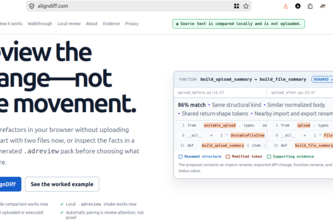
AlignDiff is a browser-local, structure-aware code comparison tool for Python, JavaScript, and TypeScript. The author states it enables reviewers to see complete old and new files while explaining which structures moved, changed, appeared, or disappeared. It operates entirely within the user's local browser without uploading source code to external services.
What changed
The project evolved from earlier comparator foundations into a deployable tool during a hackathon, with focus on local processing, privacy, and trustworthiness of comparisons.
Single most important open question
Does AlignDiff have any commercial traction or adoption beyond the author's own development work?
What The Product Actually Is
The description states that AlignDiff is:
- A browser-local, structure-aware comparison tool
- For Python, JavaScript, and TypeScript
- That parses supported languages locally
- Identifies functions, classes, methods, imports, constants, and other structures
- Pairs structures that were moved, renamed, or modified
- Distinguishes unchanged, moved, modified, added, deleted, and uncertain matches
- Aligns detailed code rows within changed structures
- Falls back safely to text comparison when structural parsing is unreliable
- Keeps source code in the browser instead of sending it to a hosted service
The tool has three main views:
- Aligned File view - preserves complete-file context
- Source Order view - helps investigate movement and matching rationale
- Pair Details view - investigates detailed changes
It uses Tree-sitter language parsers in browser workers, a Rust comparison engine compiled to WebAssembly, and runs entirely client-side.
Evidence Self-reported by the author; no independent verification or data on actual usage.
Positioning & Claim Evolution
The author states:
- Traditional line diffs become difficult to trust during refactors
- The tool answers "Can a reviewer see the complete old and new files while the tool also explains which structures moved, changed, appeared, or disappeared?"
- Source-code privacy was equally important - developers should not have to upload proprietary code merely to understand a refactor
- AlignDiff deliberately exposes uncertainty rather than presenting every possible match as fact
The positioning emphasizes:
- Privacy-first approach - 100% code and network privacy
- Trustworthiness - complete file context, explicit uncertainty handling
- Structure-awareness - beyond line-level diffs to semantic understanding
- Local processing - no external API calls
Evidence Self-reported claims about product positioning and intent; no evidence of market reception or customer feedback.
Target Customer & ICP
The description states:
- The tool is designed for reviewers who need to understand refactors
- It addresses the challenge that "traditional line diffs become difficult to trust during refactors"
- Users can paste or load an old and new file for comparison
- Primary use case involves developers reviewing code changes
Evidence Self-reported; no evidence of actual customers, user personas, or market segmentation data.
Business Model & Pricing Evidence
The description states:
- The application is deployed at aligndiff.com
- No pricing information is provided
- No revenue model or monetization strategy described
- No mention of enterprise features or tiered offerings
Evidence Not evidenced - no commercial details beyond deployment URL.
Technical & Delivery Signals
The author states:
- Built with React and TypeScript interface
- Vite for development and production builds
- Tree-sitter language parsers running in a browser worker
- Rust comparison engine compiled to WebAssembly
- Deterministic structural matching and classification
- Browser-local detailed diff refinement
- Vitest, Node test suites, Rust tests, and Playwright browser validation
- CircleCI delivery to Cloudflare Pages
The tool is described as:
- Deployed at aligndiff.com
- Has 150 functional browser tests
- Has 10 production deployment smoke tests
- Passed canonical repository validation
- Uses deterministic quality and regression catalogs
- Supports local Git changeset generation (future work)
Evidence Self-reported technical stack and delivery pipeline; no evidence of actual usage, performance metrics, or scalability data.
Traction & Maturity Signals
The description states:
- The tool was built during a hackathon (OpenAI 2026)
- It had earlier comparator foundations
- Build Week transformed those foundations into a deployable experience
- The released candidate passed validation tests before deployment
- No mention of users, customers, or adoption metrics
Evidence Not evidenced - no data on user base, customer acquisition, or product usage.
Competitive Context
The description states:
- Traditional line diffs become difficult to trust during refactors
- AlignDiff aims to improve upon this by providing structure-aware comparisons
- No specific competitors named
- No competitive analysis provided
Evidence Not evidenced - no information about existing tools or market positioning relative to others.
Open Questions & Risks
Inferences based on self-reported description:
- Single-person development team - only one member (Ankur Sawhney) listed, suggesting limited capacity for scaling
- No commercial traction - no evidence of users, customers, or revenue
- Limited language support - currently supports Python, JavaScript, and TypeScript only
- Hackathon origin - may indicate early-stage product with unproven market demand
- Privacy-focused but not necessarily scalable - local processing may limit performance or adoption in large-scale environments
- No pricing model - unclear path to monetization
Evidence Self-reported; no independent verification of any risk factors.
Questions the description leaves open
- What is the actual user base or customer traction beyond personal development?
- How does the tool handle edge cases in code structure that might not be parsed correctly?
- Are there plans to expand support beyond Python, JavaScript, and TypeScript?
- What are the long-term monetization strategies if any?
- How do you plan to scale from a single developer to a sustainable business?
- What is the competitive advantage over existing tools like GitHub's diff viewer or other code review platforms?
Overall Assessment
Not evidenced
The description provides no information about:
- Revenue or financial performance
- Customer base or adoption metrics
- Market size or competitive landscape
- Financial projections or funding history
- Team experience or track record
- Product-market fit validation
This is a self-reported, unverified product description from a hackathon project with no demonstrated commercial traction. The author states the tool works but provides no evidence of users, customers, or market demand.
Confidence level Low - based entirely on one person's account without external corroboration or data on adoption, revenue, or customer feedback.
The project appears to be an experimental tool built during a hackathon with strong technical execution but no commercial validation. It lacks any evidence of product-market fit, user traction, or business model viability beyond the author's own development work.
User Stories BotA demo video on every pull request
Get a demo video on every new feature
GitHub App that watches your pull requests and records a narrated, captioned demo.
Save time on demo prep and make informed decisions faster with a video walkthrough of every new feature.
Source
Submitted to the OpenAI 2026 hackathon on Devpost. Project home on Devpost. Back to the full gallery on Devpost.
This competitive analysis was produced by top-founders.com (opens in a new tab)
Generated by a language model from this project's public Devpost page — its tagline, the author's own write-up and any built-with tags listed there — as captured in August 2026. Short quotations are the author's words. It is an opinion on the idea as a business, not on the people behind it, and it reflects the description as published then. If the project has moved on, request a correction below. The analysis is not independent research and contains no verified traction, revenue or customer data.
An independent guide by KFG International LLC — not affiliated with, endorsed by, or connected to Devpost or OpenAI.