

Archive position — measured, not model output
0 likes on Devpost
2,263 of the 7,850 archived projects have more likes, and 5,587 share exactly 0 — so this project's #2,531 place in the like-ranked listing is a tie-break inside that group, not a ranking.
Projects (log scale)
Likes on Devpost. ▲ marks this project's group.
Show the figures
| Likes | Projects | Share of archive |
|---|---|---|
| 0 | 5,587 | 71.2% |
| 1 | 1,758 | 22.4% |
| 2 | 284 | 3.6% |
| 3–4 | 132 | 1.7% |
| 5–9 | 75 | 1.0% |
| 10+ | 14 | 0.2% |
 User Stories BotA demo video on every pull request
Get a demo video on every new feature
GitHub App that watches your pull requests and records a narrated, captioned demo.
Save time on demo prep and make informed decisions faster with a video walkthrough of every new feature.
Executive Summary
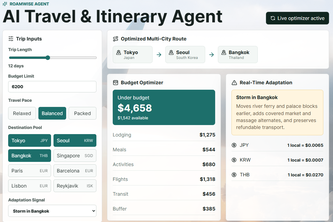
The description states that "AI Travel & Itinerary Agent" is a multi-destination travel planning tool built with TypeScript, HTML, and CSS. The author claims it builds logical city routes, balances budgets across currencies, and adapts schedules based on weather or logistics changes. It was submitted as a hackathon project to the OpenAI 2026 hackathon by Youth Inno Lab, a team of one member.
The product appears to be an early-stage prototype with no evidence of revenue, customers, or traction. The author describes it as a solution to the challenge of tracking expenses and travel plans across multiple destinations. There is no evidence of pricing, business model, or technical delivery details beyond its development stack.
Key open question
What is the actual commercial viability of this concept, given that it is described only as an early-stage hackathon project with no demonstrated market traction?
What The Product Actually Is
The description states that the product is a "multi-destination travel planning workspace" built using TypeScript, HTML, and CSS. It claims to build logical city routes, balance budgets across currencies, and adapt schedules in response to weather or logistics changes.
Inference Based on the author's own write-up, it appears to be a web-based tool for managing complex travel itineraries involving multiple destinations, with some automation around currency handling and dynamic schedule adjustments. However, this is not independently verified.
Positioning & Claim Evolution
The description states that the product aims to be a universal travel & itinerary planner that helps users make plans and sort out currency spending when traveling overseas.
Inference The positioning seems to target travelers who face complexity in managing multi-destination trips, particularly around budgeting and scheduling. The claim evolution appears to be from a personal problem (tracking expenses and plans) to a general solution (a universal travel planner). No evidence of prior positioning or market testing is provided.
Target Customer & ICP
The description does not specify target customers or ideal customer profiles (ICP). It only states that the tool was inspired by the need for a universal travel & itinerary planner, especially for overseas travel.
Inference The author implies a broad audience of travelers who plan multi-destination trips and struggle with expense tracking. However, no segmentation or specific persona data is provided.
Business Model & Pricing Evidence
There is no evidence in the description regarding pricing, monetization strategy, or business model. The project is described as a hackathon submission without any indication of how it would generate revenue or be sold.
Inference The business model remains unknown, and there is no indication whether this will be offered as a freemium, subscription, or one-time purchase product.
Technical & Delivery Signals
The description states that the project was built with TypeScript, HTML, and CSS. It also mentions that it integrates with APIs in its future development plans.
Inference The technical stack suggests a frontend-heavy web application. However, no information is provided about backend architecture, scalability, or delivery mechanisms beyond API integration.
Traction & Maturity Signals
There is no evidence of traction, revenue, or customer adoption. The project is described as a hackathon submission by a single-member team (Youth Inno Lab), with no mention of usage metrics, user feedback, or product maturity.
Inference This appears to be an early-stage prototype or proof-of-concept with no demonstrated market traction or product-market fit.
Competitive Context
The description does not provide any information about existing competitors or the competitive landscape. No mention is made of similar tools in the travel planning space.
Inference Without evidence, it's impossible to assess how this tool compares to existing solutions in the market.
Open Questions & Risks
- The project is described only as a hackathon submission with no revenue, customers, or traction.
- No evidence of business model, pricing, or monetization strategy.
- No indication of technical scalability or delivery mechanisms beyond API integration.
- No mention of user feedback or product iteration.
- The team size is listed as one, suggesting limited development capacity.
Inference These are significant open questions for early-stage projects without demonstrated traction or commercial viability.
Questions the description leaves open
- What specific APIs will the tool integrate with?
- How does the tool handle real-time data updates (e.g., weather, logistics)?
- What is the intended pricing model and monetization strategy?
- Have you conducted any user research or testing with travelers?
- What are the key assumptions underlying this product idea?
- How do you plan to scale beyond a single developer?
Overall Assessment
The description states that this is a hackathon project submitted by Youth Inno Lab, a team of one member. There is no evidence of revenue, customers, or traction.
Inference Given the lack of any commercial evidence, this appears to be an early-stage idea with no demonstrated market viability or product development progress. It is not ready for investment or partnership consideration at this time.
User Stories BotA demo video on every pull request
Get a demo video on every new feature
GitHub App that watches your pull requests and records a narrated, captioned demo.
Save time on demo prep and make informed decisions faster with a video walkthrough of every new feature.
Source
Submitted to the OpenAI 2026 hackathon on Devpost. Project home on Devpost. Back to the full gallery on Devpost.
This competitive analysis was produced by top-founders.com (opens in a new tab)
Generated by a language model from this project's public Devpost page — its tagline, the author's own write-up and any built-with tags listed there — as captured in August 2026. Short quotations are the author's words. It is an opinion on the idea as a business, not on the people behind it, and it reflects the description as published then. If the project has moved on, request a correction below. The analysis is not independent research and contains no verified traction, revenue or customer data.
An independent guide by KFG International LLC — not affiliated with, endorsed by, or connected to Devpost or OpenAI.