

Archive position — measured, not model output
1 like on Devpost
505 of the 7,850 archived projects have more likes, and 1,758 share exactly 1 — so this project's #563 place in the like-ranked listing is a tie-break inside that group, not a ranking.
Projects (log scale)
Likes on Devpost. ▲ marks this project's group.
Show the figures
| Likes | Projects | Share of archive |
|---|---|---|
| 0 | 5,587 | 71.2% |
| 1 | 1,758 | 22.4% |
| 2 | 284 | 3.6% |
| 3–4 | 132 | 1.7% |
| 5–9 | 75 | 1.0% |
| 10+ | 14 | 0.2% |
 User Stories BotA demo video on every pull request
Get a demo video on every new feature
GitHub App that watches your pull requests and records a narrated, captioned demo.
Save time on demo prep and make informed decisions faster with a video walkthrough of every new feature.
Executive Summary
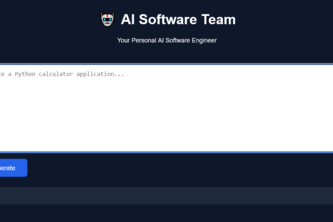
What the company appears to be: The author describes AI Software Team as an AI-powered software engineering assistant that supports developers throughout the software development lifecycle — from planning features to writing code, reviewing pull requests, fixing bugs, and generating documentation.
What changed: This is a self-reported project submitted for the OpenAI 2026 hackathon. It represents an early-stage idea or prototype, not a commercial product with traction or customers.
The single most important open question: Is there any evidence of actual usage, revenue, or customer feedback beyond the author’s own description?
The analysis is based entirely on the self-reported, unverified project description provided by the caller. No external data, funding history, user base, or performance metrics are available.
What The Product Actually Is
The description states that AI Software Team is an intelligent development assistant designed to act like a virtual software engineering team. It allows users to describe their idea in natural language and supports tasks such as:
- Generating project plans and technical architecture
- Writing clean and maintainable code
- Explaining and improving existing code
- Detecting bugs and suggesting fixes
- Reviewing code quality
- Generating documentation
- Assisting with deployment and best practices
The system is built using OpenAI’s language models (specifically GPT-5, as stated) and integrates with GitHub via the GitHub API. It uses a modern web stack including Next.js, React, TypeScript, Node.js, Tailwind CSS, and Vercel.
This is a self-reported product description. No evidence of actual functionality or deployment exists beyond what the author states.
Positioning & Claim Evolution
The author positions AI Software Team as an assistant that helps developers "ship products faster" by automating repetitive tasks. The goal is to reduce time spent on non-creative work so developers can focus on solving real problems.
It claims to automate common software engineering workflows, including feature planning, code writing, debugging, and documentation generation.
The author also mentions future ambitions such as:
- Multi-agent collaboration
- GitHub pull request automation
- CI/CD integration
- Voice-powered coding assistant
- Team collaboration features
- Support for additional programming languages
- Enterprise integrations
These claims reflect the author’s vision but are not substantiated by evidence of execution or market traction.
Target Customer & ICP
The description states that AI Software Team targets developers who spend time on planning, debugging, code review, documentation, and deployment. It positions itself as a tool to help them build better software faster.
There is no explicit segmentation beyond "developers", nor any indication of specific personas or use cases beyond general software engineering tasks.
The author does not define a clear ICP or target customer segment beyond the broad category of developers.
Business Model & Pricing Evidence
No information about pricing, monetization strategy, or business model is provided in the description. The project appears to be a prototype submitted for a hackathon and lacks any indication of commercial viability or revenue streams.
Not evidenced.
Technical & Delivery Signals
The project is built using:
- OpenAI API (including GPT-5)
- Next.js, React, TypeScript, Node.js, Tailwind CSS
- GitHub API
- Vercel
It includes an interactive interface for collaborating with AI during development.
The author notes challenges in maintaining context across tasks and designing a user-friendly experience.
The technical stack is self-reported. No evidence of production deployment or scalability.
Traction & Maturity Signals
There is no evidence of traction, customers, or adoption beyond the project being submitted to a hackathon. The team size is listed as one person (Varanesh P R), and there are no mentions of users, usage data, or product-market fit indicators.
Not evidenced.
Competitive Context
The author does not reference competitors or provide any competitive analysis. However, based on the stated capabilities — such as code generation, bug detection, pull request review, and documentation — this project aligns with a growing category of AI-powered developer tools (e.g., GitHub Copilot, Tabnine, Cursor, Replit Ghostwriter).
No evidence of competitive positioning or differentiation.
Open Questions & Risks
- Unproven market demand: No evidence of real-world usage or customer feedback.
- Single-founder team: Limited capacity for execution and scaling.
- Prototype nature: Submitted to a hackathon; no indication of commercial readiness.
- Overreliance on AI hallucinations: The described features (e.g., code generation, bug detection) are risky without validation.
- No pricing or monetization model: Unclear path to revenue or sustainability.
These risks stem from the lack of evidence for traction, product-market fit, or business viability.
Questions the description leaves open
- What specific problems do developers face that this tool solves, and how did you validate those needs?
- Have you tested the tool with real developers? If so, what were the results?
- How does the AI handle edge cases or ambiguous inputs in code generation?
- Are there any known limitations of the current prototype that would prevent it from being used at scale?
- What is your plan for monetization and customer acquisition?
- Do you have any existing users or early adopters who are willing to speak to the value proposition?
These questions aim to uncover gaps in the self-reported narrative.
Overall Assessment
There is no evidence of a functioning product, revenue, or customer base. The project is described as a hackathon submission with no indication of commercial traction or viability.
Not evidenced. No basis for investment or partnership decision at this stage.
User Stories BotA demo video on every pull request
Get a demo video on every new feature
GitHub App that watches your pull requests and records a narrated, captioned demo.
Save time on demo prep and make informed decisions faster with a video walkthrough of every new feature.
Source
Submitted to the OpenAI 2026 hackathon on Devpost. Project home on Devpost. Back to the full gallery on Devpost.
This competitive analysis was produced by top-founders.com (opens in a new tab)
Generated by a language model from this project's public Devpost page — its tagline, the author's own write-up and any built-with tags listed there — as captured in August 2026. Short quotations are the author's words. It is an opinion on the idea as a business, not on the people behind it, and it reflects the description as published then. If the project has moved on, request a correction below. The analysis is not independent research and contains no verified traction, revenue or customer data.
An independent guide by KFG International LLC — not affiliated with, endorsed by, or connected to Devpost or OpenAI.