

Archive position — measured, not model output
1 like on Devpost
505 of the 7,850 archived projects have more likes, and 1,758 share exactly 1 — so this project's #560 place in the like-ranked listing is a tie-break inside that group, not a ranking.
Projects (log scale)
Likes on Devpost. ▲ marks this project's group.
Show the figures
| Likes | Projects | Share of archive |
|---|---|---|
| 0 | 5,587 | 71.2% |
| 1 | 1,758 | 22.4% |
| 2 | 284 | 3.6% |
| 3–4 | 132 | 1.7% |
| 5–9 | 75 | 1.0% |
| 10+ | 14 | 0.2% |
 User Stories BotA demo video on every pull request
Get a demo video on every new feature
GitHub App that watches your pull requests and records a narrated, captioned demo.
Save time on demo prep and make informed decisions faster with a video walkthrough of every new feature.
Executive Summary
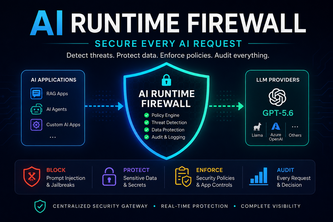
The description states that AI Runtime Firewall is a centralized security gateway for AI applications, designed to inspect prompts, block prompt injection attacks, mask sensitive data, enforce policies, and audit requests before they reach an LLM. It is presented as a proof-of-concept built during a hackathon, with no evidence of revenue, customers or production deployment beyond the author's own local demo. The project appears to be a prototype with limited commercial traction, and the author has not yet deployed it in a scalable or enterprise-ready form.
Key open question
Is there any evidence that this concept has been validated in real-world use cases or by potential paying customers?
What The Product Actually Is
The description states that AI Runtime Firewall is a centralized security gateway for AI applications, sitting between the application and the LLM. It inspects prompts, detects prompt injection attempts, masks sensitive data, enforces security policies, and audits every request.
It includes:
- A policy engine that makes decisions based on deterministic checks and contextual GPT analysis
- Caching of semantically similar requests to reduce token costs
- Logging of all decisions for audit trail purposes
- Integration with a sample RAG application using ChromaDB and Ollama
The product is described as being built with ASP.NET Core backend and Angular.js UI, and uses technologies like GPT-5.6, Ollama, and REST APIs.
Inference The product appears to be a prototype or proof-of-concept rather than a finished commercial offering.
Positioning & Claim Evolution
The description states that the author built this tool because most AI applications send requests directly to LLMs without any chokepoint for policy enforcement or inspection. The positioning is that it provides a centralized runtime security layer for AI apps.
Claims:
- It protects AI applications by detecting sensitive data and blocking prompt attacks
- Enforces security policies
- Audits every request before reaching the LLM
The author also notes that they learned AI security is more like "normal app security plus governance and auditability bolted on."
Inference The positioning evolved from a simple idea to a more nuanced understanding of AI security as a blend of traditional app security with governance.
Target Customer & ICP
Not evidenced. The description does not state who the target customer is, nor what the ideal customer profile (ICP) might be.
Finding
No evidence of target customer or ICP in the self-reported description.
Business Model & Pricing Evidence
Not evidenced. There is no mention of pricing, licensing, monetization strategy, or business model in the description.
Finding
No evidence of any business model or pricing structure.
Technical & Delivery Signals
The description states:
- Built with ASP.NET Core (backend), Angular.js (UI)
- Uses GPT-5.6 for contextual risk analysis
- Integrates with Ollama and ChromaDB
- Implements a flow where deterministic checks are followed by GPT analysis, then policy engine makes the final decision
- Includes caching of semantically similar requests
- Logs every decision for audit trail
The author notes challenges in processing flow complexity and separating request paths to ensure consistent logging.
Inference The technical architecture is described as modular but complex, with a focus on separation of concerns between deterministic checks and AI-based analysis.
Traction & Maturity Signals
Not evidenced. The description states that the project was built for a hackathon and that it was deployed in production rather than left as a local demo, but no evidence of revenue, customers, or adoption is provided.
Finding
No evidence of traction, customers, or commercial deployment beyond the author's own use case.
Competitive Context
Not evidenced. The description does not mention any competitors or how this product compares to existing solutions in the AI security space.
Finding
No evidence of competitive landscape or positioning relative to other tools.
Open Questions & Risks
- Prototype only: The project is described as a hackathon submission, with no evidence of commercial viability or scalability.
- No customer validation: There are no signs of real-world use cases or feedback from potential users.
- Unproven business model: No indication of how the product would be monetized or whether it has a viable path to revenue.
- Limited team size: The team is stated as 0, which raises questions about execution capability and product development.
Inference The lack of traction, customer feedback, and commercialization signals suggest that this is an early-stage idea with high uncertainty around its viability.
Questions the description leaves open
- What specific use cases or industries are you targeting?
- Have you validated the need for this product with potential customers?
- How do you plan to monetize this solution?
- What is your roadmap for scaling beyond a single-user, local demo?
- Are there any existing partnerships or integrations planned with LLM providers or AI platforms?
Overall Assessment
Not evidenced. The description does not contain sufficient information to assess the commercial potential or investment readiness of this project.
Finding
No evidence to support a conclusion on whether this is an attractive investment or partnership opportunity. The project appears to be in very early stages, with no demonstrated traction or business model.
User Stories BotA demo video on every pull request
Get a demo video on every new feature
GitHub App that watches your pull requests and records a narrated, captioned demo.
Save time on demo prep and make informed decisions faster with a video walkthrough of every new feature.
Source
Submitted to the OpenAI 2026 hackathon on Devpost. Project home on Devpost. Back to the full gallery on Devpost.
This competitive analysis was produced by top-founders.com (opens in a new tab)
Generated by a language model from this project's public Devpost page — its tagline, the author's own write-up and any built-with tags listed there — as captured in August 2026. Short quotations are the author's words. It is an opinion on the idea as a business, not on the people behind it, and it reflects the description as published then. If the project has moved on, request a correction below. The analysis is not independent research and contains no verified traction, revenue or customer data.
An independent guide by KFG International LLC — not affiliated with, endorsed by, or connected to Devpost or OpenAI.