

Archive position — measured, not model output
0 likes on Devpost
2,263 of the 7,850 archived projects have more likes, and 5,587 share exactly 0 — so this project's #2,523 place in the like-ranked listing is a tie-break inside that group, not a ranking.
Projects (log scale)
Likes on Devpost. ▲ marks this project's group.
Show the figures
| Likes | Projects | Share of archive |
|---|---|---|
| 0 | 5,587 | 71.2% |
| 1 | 1,758 | 22.4% |
| 2 | 284 | 3.6% |
| 3–4 | 132 | 1.7% |
| 5–9 | 75 | 1.0% |
| 10+ | 14 | 0.2% |
 User Stories BotA demo video on every pull request
Get a demo video on every new feature
GitHub App that watches your pull requests and records a narrated, captioned demo.
Save time on demo prep and make informed decisions faster with a video walkthrough of every new feature.
Executive Summary
What the company appears to be
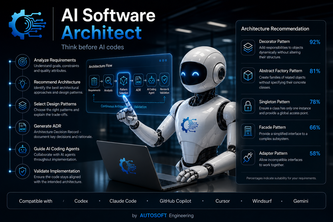
The author describes a self-contained, architecture-first plugin for AI coding assistants (specifically Codex) that helps developers make explicit architectural decisions before implementation. It operates as an installable tool within existing AI coding environments and is designed to guide AI agents in building maintainable software by analyzing requirements, recommending design patterns, and recording approved architecture decisions.
What changed
This project introduces a new workflow for AI-assisted development where architecture is considered before code begins. The plugin integrates directly into the developer’s existing AI assistant environment (Codex), enabling structured architectural reasoning without requiring additional services or API keys.
Single most important open question
Is there evidence of real-world usage, adoption, or feedback from developers using this tool in practice? The description is self-reported and unverified; no data on customer engagement, traction, or commercial viability is provided.
What The Product Actually Is
The description states that AI Software Architect is an installable, architecture-first plugin for Codex, a platform for AI coding assistants. It functions through one public skill invocation: $AI Software Architect.
Key technical components include:
- A single public Codex skill with internally routed workflows.
- Progressive disclosure of architecture knowledge.
- Modular references covering various architectural styles and patterns (e.g., GoF, dependency, data, integration, resilience).
- Use of Pydantic contracts and YAML schemas for structured artifacts.
- Short-lived Codex hooks that activate only during an architect workflow.
- Deterministic guardrails for repository inspection and artifact persistence.
- A portable shared Python core intended to support future adapters.
The plugin does not require another AI account or API key, nor does it run a persistent background process. It is built using GPT-5.6 Sol and integrates with tools like GitHub, PowerShell, and Pydantic.
Inference The product is a developer tool designed to enhance AI-assisted coding by embedding architectural decision-making into the workflow. It is not a hosted service or SaaS offering but rather an extension or plugin for existing AI platforms.
Positioning & Claim Evolution
The author positions AI Software Architect as:
- A tool that adds missing architecture steps directly inside the developer’s existing AI assistant.
- Not meant to replace human architects or create another hosted AI service.
- Focused on helping developers think before coding, compare credible alternatives, and preserve decisions for future sessions.
It aims to:
- Clarify requirements.
- Recommend design patterns.
- Compare multiple architecture options with transparent fit scores and explanations.
- Record approved Architecture Decision Records (ADRs).
- Create architecture contracts and handoffs.
- Review later implementation against the approved architecture.
Claim vs. Fact
The description claims this tool enhances maintainability, improves decision transparency, and supports conformance review across tasks — all of which are assertions about value, not verified outcomes.
Target Customer & ICP
The author identifies the primary user as:
- Developers working with AI coding agents, particularly those using Codex.
- Users who want to ensure their software remains maintainable and aligned with architectural intent.
There is no explicit mention of enterprise customers, teams, or specific verticals. The focus appears on individual developers or small teams using AI-assisted development tools.
Inference Based on the context (Codex, GitHub, Python), it seems aimed at technical users in software development environments — likely mid-to-senior-level engineers or those working with modern, agile development practices.
Business Model & Pricing Evidence
The description does not contain any information about:
- Revenue streams.
- Pricing models.
- Monetization strategy.
- Subscription plans or licensing terms.
It only mentions that the project is MIT-licensed and intended to become a community-driven architecture companion.
Inference There is no evidence of a commercial business model at this stage. The tool appears to be open source, possibly with an intent for community contribution rather than direct monetization.
Technical & Delivery Signals
The author describes:
- Use of GPT-5.6 Sol for product design and implementation.
- Integration with Codex via skills and hooks.
- Static inspection rules and fail-closed safety mechanisms.
- Pydantic validation, secret scanning, and artifact reconstruction.
- A modular Python core designed to support future adapters for other coding assistants (e.g., GitHub Copilot, Claude Code).
- 100 automated tests and five reproducible end-to-end exploratory evaluations.
The system is described as:
- Host-native — the model selected by the user performs reasoning.
- Portable across different AI coding assistants.
- Designed to avoid modifying source code during architecture planning.
- Safe in terms of not executing untrusted code or altering project files.
Inference The technical approach shows strong engineering discipline, especially around safety and modularity. However, no evidence exists regarding scalability, performance under load, or production deployment details.
Traction & Maturity Signals
The description provides no data on:
- Number of users.
- Customer retention or engagement metrics.
- Adoption rate.
- Feedback from developers.
- Product usage statistics.
It does state that:
- The first release includes a complete human-approved architecture workflow.
- It supports 100 automated tests and five exploratory evaluations.
- It has been demonstrated in a “deliberately concentrated Python expense application.”
Inference While the tool is described as functional and tested, there is no evidence of real-world traction or user feedback beyond internal testing. The maturity level appears to be early-stage prototype or MVP.
Competitive Context
The author does not reference any competitors or existing solutions in the market for AI-assisted architectural decision-making tools.
Absence of evidence
No mention of similar products, platforms, or services that address the same problem space — such as architecture decision record systems, AI coding assistants with built-in design guidance, or enterprise architecture frameworks integrated into development workflows.
Open Questions & Risks
- No commercial traction or revenue data — The tool is described as a hackathon submission and open-source project.
- Unproven adoption — No evidence of developer usage beyond internal testing.
- Limited scope — Currently only supports Codex; future adapters are planned but not implemented.
- Self-reported success metrics — All claims about functionality, testing, and performance come from the author’s own account.
- No clear path to monetization — The MIT license implies open-source intent, which may limit commercial viability.
Questions the description leaves open
- What is the actual usage or feedback from developers who have tried this tool?
- How does it integrate with other AI coding assistants beyond Codex (e.g., GitHub Copilot)?
- Are there any plans for monetization or commercial partnerships?
- Has the tool been tested in real-world development environments, or is it limited to controlled demos?
- What are the key assumptions behind its architecture and safety mechanisms?
- How does it handle edge cases or complex architectural scenarios?
Overall Assessment
There is no evidence of commercial traction, revenue, or customer adoption beyond the author’s own account. The project is described as a hackathon submission, open-source tool, and early-stage prototype.
It shows technical sophistication and clear intent to solve a real problem in AI-assisted development — but lacks any demonstration of market demand or scalable business model.
Confidence Level Low
Assessment Not ready for investment or partnership consideration without further evidence of traction, user feedback, or commercial viability.
User Stories BotA demo video on every pull request
Get a demo video on every new feature
GitHub App that watches your pull requests and records a narrated, captioned demo.
Save time on demo prep and make informed decisions faster with a video walkthrough of every new feature.
Source
Submitted to the OpenAI 2026 hackathon on Devpost. Project home on Devpost. Back to the full gallery on Devpost.
This competitive analysis was produced by top-founders.com (opens in a new tab)
Generated by a language model from this project's public Devpost page — its tagline, the author's own write-up and any built-with tags listed there — as captured in August 2026. Short quotations are the author's words. It is an opinion on the idea as a business, not on the people behind it, and it reflects the description as published then. If the project has moved on, request a correction below. The analysis is not independent research and contains no verified traction, revenue or customer data.
An independent guide by KFG International LLC — not affiliated with, endorsed by, or connected to Devpost or OpenAI.