

Archive position — measured, not model output
0 likes on Devpost
2,263 of the 7,850 archived projects have more likes, and 5,587 share exactly 0 — so this project's #2,762 place in the like-ranked listing is a tie-break inside that group, not a ranking.
Projects (log scale)
Likes on Devpost. ▲ marks this project's group.
Show the figures
| Likes | Projects | Share of archive |
|---|---|---|
| 0 | 5,587 | 71.2% |
| 1 | 1,758 | 22.4% |
| 2 | 284 | 3.6% |
| 3–4 | 132 | 1.7% |
| 5–9 | 75 | 1.0% |
| 10+ | 14 | 0.2% |
 User Stories BotA demo video on every pull request
Get a demo video on every new feature
GitHub App that watches your pull requests and records a narrated, captioned demo.
Save time on demo prep and make informed decisions faster with a video walkthrough of every new feature.
Executive Summary
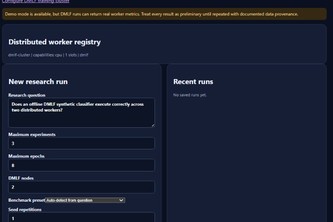
The description states that Aster - AI Research Scientist is a personal AI researcher tool designed to automate parts of machine learning (ML) experimentation workflows. It claims to support distributed training across multiple devices, manage research plans, fetch related papers, and aggregate results.
Key commercial due-diligence questions:
- Is there any evidence of actual usage or adoption?
- What is the product's current maturity level?
- Are there any revenue streams or business model elements described?
- How does it differentiate from existing tools in the ML research space?
The author describes a prototype with limited functionality (e.g., two-device PyTorch DDP training), built for a hackathon context. No evidence of traction, customers, or monetization is provided.
Most important open question
Does this project have any commercial viability beyond its current prototype stage? There is no evidence that it has moved past proof-of-concept or gained users.
What The Product Actually Is
The description states:
- Aster - AI Research Scientist is a multi-agent research workflow tool.
- It allows users to configure and execute ML experiments in a distributed manner across multiple devices.
- It supports literature search via Semantic Scholar/OpenAlex, paper selection, hypothesis planning, and experiment execution.
- The system uses Node.js backend, JavaScript agents, Python-based PyTorch DDP framework, gRPC communication, and SQLite for job state persistence.
- It includes a dashboard with live node registry, job history, cancellation, and persistent startup scripts.
Inferred from the description:
- The tool is intended to reduce manual effort in ML research by automating literature review, experiment design, execution, and result aggregation.
- It supports distributed computing on heterogeneous LAN devices using PyTorch Distributed Data Parallel (DDP) and gRPC for communication.
Not evidenced:
- Whether the system has been used beyond the hackathon context.
- If any real-world users or customers exist.
- Any pricing model or monetization strategy.
Positioning & Claim Evolution
The description states:
- The tool is positioned as a personal AI Researcher that automates research workflows.
- It aims to fetch related papers, plan hypotheses, execute experiments on distributed devices, and produce results/suggestions.
- It supports distributed training, allowing users to connect multiple laptops or PCs for experiment execution.
Inferred from the description:
- The product evolved from a personal project addressing pain points in ML experimentation (e.g., cluttered work, lack of GPU resources).
- It claims to offer an auditable research timeline and reproducible artifacts.
- It positions itself as a solution for researchers who want to scale experiments without managing infrastructure manually.
Not evidenced:
- How it compares to existing tools like Jupyter Notebooks, MLflow, or Weights & Biases.
- Whether the author has iterated on this idea beyond the hackathon submission.
- Any marketing claims about scalability, performance, or adoption.
Target Customer & ICP
The description states:
- The tool is intended for ML researchers who perform experiments and need to manage them efficiently.
- It targets users who face challenges with manual workflows, lack of GPU resources, and cluttered experiment tracking.
Inferred from the description:
- The primary user base likely consists of individual ML practitioners, especially those working in small teams or solo.
- It may appeal to researchers using low-end hardware who want to leverage distributed computing.
Not evidenced:
- Specific customer segments (e.g., academic vs. industry).
- Customer personas or usage patterns beyond the author’s own experience.
- Any evidence of target market size, demand, or competitive positioning.
Business Model & Pricing Evidence
The description states:
- No explicit mention of a business model or pricing structure.
- The tool is described as a personal AI researcher, implying it may be used by individuals rather than organizations.
- It was built for a hackathon and submitted to Devpost, suggesting no commercial intent at this stage.
Inferred from the description:
- If monetized, potential models could include freemium tiers, enterprise licensing, or usage-based pricing.
- The tool might appeal to institutions or labs looking to streamline research processes.
Not evidenced:
- Revenue streams.
- Pricing plans.
- Any indication of monetization strategy or customer acquisition efforts.
Technical & Delivery Signals
The description states:
- Built using Node.js, JavaScript, Python, PyTorch, and gRPC.
- Supports distributed training with PyTorch DDP, Gloo, and Torchvision.
- Uses SQLite for durable job state, PowerShell automation for Windows setup, and HTTP APIs.
- Includes a dashboard with live node registry, job history, cancellation, and structured logs.
Inferred from the description:
- The system is built on modern open-source technologies.
- It supports asynchronous execution and error handling in distributed environments.
- It includes mechanisms for observability (logs, metrics) and recovery (cancellation, stale process cleanup).
Not evidenced:
- Code quality or scalability beyond a prototype.
- Any production deployment or infrastructure details.
- Performance benchmarks or reliability data.
Traction & Maturity Signals
The description states:
- The project was submitted to the OpenAI 2026 hackathon.
- Accomplishments include completing a real two-device PyTorch DDP synthetic training run.
- It includes features like paper approval, plan critic, and reproducibility manifests.
Inferred from the description:
- This is a prototype-level tool, not yet mature for production use.
- The author has demonstrated basic functionality but not real-world adoption or scaling.
Not evidenced:
- Any user base or customer feedback.
- Metrics on usage frequency, retention, or satisfaction.
- Evidence of product-market fit or growth indicators.
Competitive Context
The description states:
- No direct mention of competitors.
- The tool aims to automate parts of ML research workflows similar to tools like MLflow, Jupyter Notebooks, and Weights & Biases.
Inferred from the description:
- It competes with platforms that help manage ML experiments, track results, and support collaboration.
- Its distributed computing capabilities may differentiate it from simpler tools but are not unique in the broader ML ecosystem.
Not evidenced:
- Any competitive analysis or differentiation strategy.
- Market share or competitive positioning data.
- Evidence of existing users or adoption trends.
Open Questions & Risks
The description states:
- The system was built for a hackathon, indicating early-stage development.
- Challenges included multi-device training on Windows, including GPU mismatches, port conflicts, and firewall interference.
- It only supports two-device training in its current form.
Inferred from the description:
- The tool is not production-ready and lacks scalability beyond small setups.
- Technical complexity around distributed computing may limit usability for non-experts.
- Lack of real-world usage or feedback suggests a high risk of misalignment with actual user needs.
Open questions:
- No evidence of traction, revenue, or customer engagement.
- Prototype nature implies limited commercial viability without further development.
- The author is a single individual, raising questions about long-term maintenance and support.
Questions the description leaves open
- What is the current stage of development beyond the hackathon prototype?
- Have you tested this tool with more than two devices or in real-world research settings?
- Are there any plans to monetize or commercialize the product?
- How do you plan to scale beyond the current distributed setup?
- What are your thoughts on integrating with existing ML platforms like MLflow or Weights & Biases?
- Do you have any feedback from potential users or collaborators?
- What is the roadmap for future features and improvements?
Overall Assessment
The description states:
- The project was built as a hackathon submission.
- It includes only basic functionality (e.g., two-device training).
- No evidence of traction, revenue, or customer adoption.
Inferred from the description:
- This is a pre-product-stage idea, not yet ready for investment or partnership discussions.
- It shows potential but lacks commercial viability or market validation.
- The author has demonstrated technical capability, but no business model or user base exists.
Assessment: Not suitable for investment or partnership at this time. A significant upgrade in functionality, traction, and commercialization strategy would be required before considering further due diligence.
User Stories BotA demo video on every pull request
Get a demo video on every new feature
GitHub App that watches your pull requests and records a narrated, captioned demo.
Save time on demo prep and make informed decisions faster with a video walkthrough of every new feature.
Source
Submitted to the OpenAI 2026 hackathon on Devpost. Project home on Devpost. Back to the full gallery on Devpost.
This competitive analysis was produced by top-founders.com (opens in a new tab)
Generated by a language model from this project's public Devpost page — its tagline, the author's own write-up and any built-with tags listed there — as captured in August 2026. Short quotations are the author's words. It is an opinion on the idea as a business, not on the people behind it, and it reflects the description as published then. If the project has moved on, request a correction below. The analysis is not independent research and contains no verified traction, revenue or customer data.
An independent guide by KFG International LLC — not affiliated with, endorsed by, or connected to Devpost or OpenAI.