

Archive position — measured, not model output
0 likes on Devpost
2,263 of the 7,850 archived projects have more likes, and 5,587 share exactly 0 — so this project's #2,461 place in the like-ranked listing is a tie-break inside that group, not a ranking.
Projects (log scale)
Likes on Devpost. ▲ marks this project's group.
Show the figures
| Likes | Projects | Share of archive |
|---|---|---|
| 0 | 5,587 | 71.2% |
| 1 | 1,758 | 22.4% |
| 2 | 284 | 3.6% |
| 3–4 | 132 | 1.7% |
| 5–9 | 75 | 1.0% |
| 10+ | 14 | 0.2% |
 User Stories BotA demo video on every pull request
Get a demo video on every new feature
GitHub App that watches your pull requests and records a narrated, captioned demo.
Save time on demo prep and make informed decisions faster with a video walkthrough of every new feature.
Executive Summary
What the company appears to be
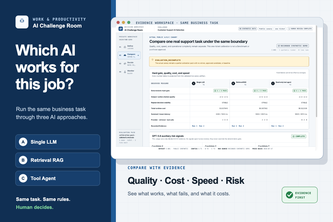
AI Challenge Room is a self-reported decision workspace that enables enterprises to compare different AI configurations (LLM, RAG, tool agent) on the same business task and select the simplest sufficient option with evidence. It was built as a demonstration for OpenAI Build Week.
What changed
The project evolved from an initial focus on discovering possible AI solutions to a more structured approach that emphasizes defining success, rejecting failures, comparing quality against cost and complexity, and keeping decisions human-owned.
Single most important open question
Is there evidence of traction or commercial interest beyond the hackathon demo?
What The Product Actually Is
The description states that AI Challenge Room is a decision workspace built with TypeScript and React, hosted on Cloudflare Workers. It supports comparing three AI configurations (single LLM, RAG, tool agent) under identical task constraints using OpenAI APIs.
It includes:
- A browser-based interface for running and reviewing candidates.
- Execution contracts and adapters to ensure consistent inputs.
- Evidence collection including cost, latency, retries, citations, and tool usage.
- Blinded review process where GPT-5.6 provides advisory risk signals but does not make final decisions.
- Human selection of the simplest sufficient candidate.
- Generation of a Decision Memo from evaluation evidence.
This is described as an end-to-end private challenge for enterprise tasks, not a leaderboard or model ranking tool.
Positioning & Claim Evolution
The author states that AI Challenge Room began with the idea of turning real business problems into private challenges and comparing different AI approaches under the same rules. The initial focus was on discovery, but evolved to emphasize:
- Trustworthy definition of success.
- Rejection of critical failures.
- Comparison of quality against cost and complexity.
- Keeping final decisions human-owned.
The positioning is that it offers a decision-making framework rather than just an AI evaluation tool. It aims to help companies choose the simplest configuration sufficient for their task, not necessarily the most complex or highest-performing one.
Target Customer & ICP
The description indicates that AI Challenge Room targets enterprise customers who need to evaluate AI configurations for real business tasks. The use of terms like "enterprise task," "policy-retrieval RAG," and "deterministic policy hard gates" suggests a focus on organizations with structured workflows, compliance requirements, or internal policies.
It is not explicitly stated whether the target customer is a technical team (e.g., AI engineers), product managers, or decision-makers. However, the emphasis on human ownership of decisions implies that it may appeal to those responsible for AI adoption decisions within enterprises.
Business Model & Pricing Evidence
Not evidenced. The description does not contain any information about pricing models, revenue streams, or monetization strategies.
Technical & Delivery Signals
The project is built using:
- Cloudflare Workers (hosted API)
- React (frontend)
- TypeScript
- OpenAI APIs: Responses API, Retrieval API, GPT-5.6
- D1 (database)
- R2 (storage)
- Codex for development acceleration
It uses:
- A shared execution contract and three candidate adapters.
- Deterministic hard gates to enforce policy rules.
- Blinded review process.
- Server-side access gate, bounded run counts, duplicate-execution protection.
- Evidence provenance tracking via explicit source labels.
The architecture separates authority into:
- Deterministic hard gates
- GPT-5.6 advisory signals
- Human decision-making
Traction & Maturity Signals
Not evidenced. There is no mention of actual users, customers, revenue, or adoption beyond the hackathon demo. The project is described as a demo, not a product in production.
The description notes that:
- It was built for OpenAI Build Week.
- It includes a live demo URL (https://ai-challenge-room.aside-hazle.chatgpt.site).
- The demo is accessible only through Devpost's private testing field.
- No data on usage, retention, or feedback is provided.
Competitive Context
Not evidenced. The description does not reference competitors or market positioning beyond its own claims.
Open Questions & Risks
- No commercial traction or revenue: The project is described as a hackathon demo with no evidence of real-world use.
- Self-reported only: All information is from the author and unverified.
- Limited scope: The demo focuses on one synthetic ticket and does not scale to enterprise-level deployment.
- Dependency on external providers: Heavy reliance on OpenAI APIs, which introduces risk related to availability, cost, and control.
- Unproven business model: No indication of how the company plans to monetize or sustain this product.
Questions the description leaves open
- What is the intended path from this demo to a commercial offering?
- Are there any early adopters or pilot customers?
- How does the team plan to handle scaling beyond a single synthetic task?
- What are the long-term plans for integrating with other AI providers or platforms?
- Is there a roadmap for adding more candidate types or evaluation criteria?
- How will the product be priced or monetized?
Overall Assessment
Not evidenced. There is no indication of funding, valuation, or investment interest beyond the hackathon submission.
The project appears to be an experimental prototype with strong technical execution but no demonstrated commercial traction or business model. It lacks evidence of:
- Revenue
- Customers
- Market demand
- Product-market fit
- Scalability
Given that this is a self-reported, unverified demo, and there is no indication of any real-world usage or monetization strategy, the likelihood of it being a viable investment or partnership opportunity at this stage is low. Any further diligence would require evidence of traction, customer engagement, or product-market alignment beyond what is described here.
User Stories BotA demo video on every pull request
Get a demo video on every new feature
GitHub App that watches your pull requests and records a narrated, captioned demo.
Save time on demo prep and make informed decisions faster with a video walkthrough of every new feature.
Source
Submitted to the OpenAI 2026 hackathon on Devpost. Project home on Devpost. Back to the full gallery on Devpost.
This competitive analysis was produced by top-founders.com (opens in a new tab)
Generated by a language model from this project's public Devpost page — its tagline, the author's own write-up and any built-with tags listed there — as captured in August 2026. Short quotations are the author's words. It is an opinion on the idea as a business, not on the people behind it, and it reflects the description as published then. If the project has moved on, request a correction below. The analysis is not independent research and contains no verified traction, revenue or customer data.
An independent guide by KFG International LLC — not affiliated with, endorsed by, or connected to Devpost or OpenAI.