

Archive position — measured, not model output
0 likes on Devpost
2,263 of the 7,850 archived projects have more likes, and 5,587 share exactly 0 — so this project's #2,455 place in the like-ranked listing is a tie-break inside that group, not a ranking.
Projects (log scale)
Likes on Devpost. ▲ marks this project's group.
Show the figures
| Likes | Projects | Share of archive |
|---|---|---|
| 0 | 5,587 | 71.2% |
| 1 | 1,758 | 22.4% |
| 2 | 284 | 3.6% |
| 3–4 | 132 | 1.7% |
| 5–9 | 75 | 1.0% |
| 10+ | 14 | 0.2% |
 User Stories BotA demo video on every pull request
Get a demo video on every new feature
GitHub App that watches your pull requests and records a narrated, captioned demo.
Save time on demo prep and make informed decisions faster with a video walkthrough of every new feature.
Executive Summary
The description states that the project is an AI-Based Soil Report Interpreter and Fertilizer Recommender, built for farmers to interpret soil test reports and receive fertilizer recommendations. The app uses AI for explanation and chatbot support, while deterministic agronomic rules handle fertiliser dose calculations. It includes features like multilingual support, cost breakdowns, and vocabulary explanations.
What changed: The project is a self-reported hackathon submission with no evidence of commercial traction or product-market fit beyond the author’s own account.
Single most important open question: Is there any evidence that farmers are using this tool, or that it has been tested in real-world conditions?
What The Product Actually Is
The description states that the app is an AI-Based Soil Report Interpreter and Fertilizer Recommender, designed to help farmers interpret soil test reports and receive fertilizer recommendations. It processes farm details and soil values, then generates a clear advisory report.
Key features include:
- Soil report interpretation in simple language
- Input validation for unrealistic values
- NPK classification into deficient, adequate, or excess
- Fertiliser dose recommendations
- Fertiliser product quantity calculation
- Estimated fertiliser cost
- Product-wise cost breakdown graph
- Regional-language support
- AI chatbot for follow-up questions
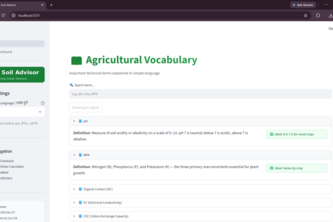
- Vocabulary section for agricultural terms
- Downloadable advisory report
The app is built using Python and Streamlit, with AI components powered by Groq OpenAI-compatible API. Fertiliser recommendations are calculated using deterministic agronomic rules.
Evidence: The author describes the product’s functionality in detail, but no evidence of actual deployment or usage exists beyond the self-reported write-up.
Positioning & Claim Evolution
The description states that the app aims to "make soil reports easier to understand and turn raw soil values into practical fertiliser guidance."
It positions itself as a tool that simplifies complex soil data for farmers, using AI to explain results and deterministic logic for actionable fertilizer advice.
The author claims this is more than a basic chatbot — it combines AI with validation, rule-based agronomic logic, cost estimation, multilingual support, and contextual follow-up chat.
Evidence: The positioning is self-reported. No external market validation or customer feedback is provided to confirm how well the app meets its stated goals.
Target Customer & ICP
The description states that the app is designed for farmers, but also mentions agriculture students and extension workers as potential users.
It includes features like multilingual support and vocabulary explanations, suggesting an intent to serve farmers with varying levels of technical knowledge or language proficiency.
Evidence: The target customer is described, but there is no evidence of actual user testing, feedback, or adoption data.
Business Model & Pricing Evidence
The description does not state any pricing model, revenue streams, or monetization strategy. It only describes the app’s functionality and features.
Evidence: Not evidenced.
Technical & Delivery Signals
The app is built using:
- Python
- Streamlit (for UI)
- Groq OpenAI-compatible API
- Pandas, scikit-learn, codex, visual-studio
It uses deterministic logic for fertiliser calculations and JSON-based AI responses with cleanup and fallback mechanisms.
Evidence: The technical stack and architecture are described by the author. No evidence of scaling, performance, or production deployment is provided.
Traction & Maturity Signals
The description states that this project was submitted to the OpenAI 2026 hackathon, and no further traction or adoption data is provided.
It includes a section on “What’s next for AI-Based Soil Report Interpreter and Fertilizer Recommender,” indicating future development plans, but no evidence of current usage or user base.
Evidence: Not evidenced.
Competitive Context
The description does not mention any competitors or existing solutions in the market. It is unclear whether similar tools already exist or how this app would differentiate itself.
Evidence: Not evidenced.
Open Questions & Risks
- No commercial traction or user feedback: The project is described as a hackathon submission with no evidence of real-world use.
- Unverified AI reliability: While the author mentions JSON cleanup and fallbacks, there is no data on how often AI outputs are accurate or reliable.
- Deterministic logic vs. AI: The app separates AI from safety-critical calculations, which may be a strength but also suggests limited AI utility beyond explanation.
- No pricing or monetization model: No indication of how the product would generate revenue or sustain itself.
Evidence: These risks are inferred from the lack of real-world data and commercial evidence in the self-reported description.
Questions the description leaves open
- Has the app been tested with actual farmers? What feedback did you receive?
- How do you plan to validate that AI-generated explanations are accurate and helpful?
- Are there any existing tools or platforms doing similar work, and how does this differ?
- What is your path to monetization or scaling beyond a hackathon project?
- Have you considered regulatory or agronomic standards for fertilizer recommendations?
Overall Assessment
The description states that the app was built as part of a hackathon submission, with no evidence of commercial traction, revenue, or adoption.
Assessment: Not evidenced. This is an early-stage idea with no demonstrated product-market fit or business model. The project is not ready for investment or partnership without further validation and proof of concept in real-world use.
User Stories BotA demo video on every pull request
Get a demo video on every new feature
GitHub App that watches your pull requests and records a narrated, captioned demo.
Save time on demo prep and make informed decisions faster with a video walkthrough of every new feature.
Source
Submitted to the OpenAI 2026 hackathon on Devpost. Project home on Devpost. Back to the full gallery on Devpost.
This competitive analysis was produced by top-founders.com (opens in a new tab)
Generated by a language model from this project's public Devpost page — its tagline, the author's own write-up and any built-with tags listed there — as captured in August 2026. Short quotations are the author's words. It is an opinion on the idea as a business, not on the people behind it, and it reflects the description as published then. If the project has moved on, request a correction below. The analysis is not independent research and contains no verified traction, revenue or customer data.
An independent guide by KFG International LLC — not affiliated with, endorsed by, or connected to Devpost or OpenAI.