

Archive position — measured, not model output
0 likes on Devpost
2,263 of the 7,850 archived projects have more likes, and 5,587 share exactly 0 — so this project's #2,428 place in the like-ranked listing is a tie-break inside that group, not a ranking.
Projects (log scale)
Likes on Devpost. ▲ marks this project's group.
Show the figures
| Likes | Projects | Share of archive |
|---|---|---|
| 0 | 5,587 | 71.2% |
| 1 | 1,758 | 22.4% |
| 2 | 284 | 3.6% |
| 3–4 | 132 | 1.7% |
| 5–9 | 75 | 1.0% |
| 10+ | 14 | 0.2% |
 User Stories BotA demo video on every pull request
Get a demo video on every new feature
GitHub App that watches your pull requests and records a narrated, captioned demo.
Save time on demo prep and make informed decisions faster with a video walkthrough of every new feature.
Executive Summary
What the company appears to be
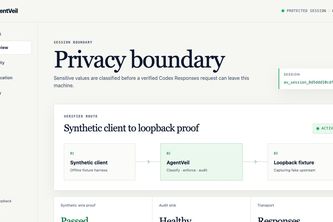
AgentVeil is a self-reported Rust-based tool designed to protect sensitive data in AI coding agent workflows, specifically targeting the Codex CLI. It claims to enforce privacy controls by filtering and normalizing JSON payloads before forwarding them to upstream services like OpenAI, using a loopback-only architecture with schema-aware validation.
What changed
The project was submitted as a hackathon prototype for the OpenAI 2026 hackathon. No prior version or commercial evolution is described; it is presented as a new development effort.
Single most important open question
Is there any evidence that AgentVeil has moved beyond a prototype, or whether it has been tested in real-world usage with actual users and production-grade data?
Note: This analysis is based entirely on the self-reported project description provided by the author. No external verification, traction data, revenue figures, customer names, or independent sources are available.
What The Product Actually Is
- The description states that AgentVeil is a Rust application.
- It operates as a secure launcher, an Axum gateway, a schema-aware privacy engine, and a value-free audit sink.
- It interfaces with the Codex CLI (version 0.144.4) through a loopback-only custom provider.
- It uses gpt-5.6-luna via Codex’s OpenAI Responses API.
- It is built around four boundaries:
- Secure launcher
- Axum gateway
- Schema-aware privacy engine
- Value-free audit sink
Inference: The product appears to be a local proxy or middleware that filters and sanitizes data before it reaches AI models, particularly in the context of Codex.
Positioning & Claim Evolution
- The project positions itself as a privacy control tool for AI coding agents.
- It claims to offer narrow, observable control at the point where Codex requests leave the machine.
- The author states that it aims to prevent exposure of credentials and private keys, while allowing lower-risk data to be replaced with opaque tokens.
- It is described as a no-network claim — not claiming to intercept or modify network traffic broadly, but rather to protect specific local workflows.
Claim: AgentVeil is positioned as a data loss prevention (DLP) tool for AI coding agents, focused on protecting sensitive data in Codex workflows.
Inference: The positioning reflects an intent to build a secure boundary between user environments and AI services, but the description does not indicate any prior commercialization or market traction.
Target Customer & ICP
- The description does not name specific customer segments or personas.
- It is implied that the target is developers using Codex CLI in local environments.
- The tool is designed to work with local AI agents, particularly those interacting with OpenAI via Codex.
- It targets users who are concerned about data leakage in AI workflows, especially around credentials and private identifiers.
Inference: The ICP likely includes developers or teams using Codex CLI for code assistance, who want to ensure sensitive data isn’t exposed during model interactions.
Business Model & Pricing Evidence
- No pricing information is provided.
- There is no mention of a monetization strategy or business model.
- The project is described as a hackathon prototype, not a commercial offering.
Not evidenced: No evidence of revenue, pricing, or monetization strategy.
Technical & Delivery Signals
- Built with Rust and uses libraries like
axum,tokio,serde,reqwest. - Uses Codex CLI 0.144.4, pinned to a specific version.
- Implements loopback-only architecture with exact host validation and no TLS interception.
- Includes schema-aware privacy engine that classifies JSON values, normalizes text, and blocks S0 material.
- Has 51 passing tests, including library, binary CLI, demo CLI integration, and gateway end-to-end tests.
- Uses a value-free audit sink to record decisions without exposing sensitive data.
- Does not install a local CA, perform generic TLS interception, or require a Codex fork.
Inference: The technical implementation suggests a strong focus on secure, local execution with minimal exposure of sensitive data. However, this is a prototype and lacks production-grade features like scalability or integration with broader platforms.
Traction & Maturity Signals
- The project is described as a hackathon submission.
- It includes synthetic fixtures, deterministic harnesses, and wire-level checks.
- It has 51 passing tests, including automated regression checks.
- It uses prebuilt judge artifacts for Ubuntu and macOS.
- No real-world usage, customer feedback, or adoption metrics are mentioned.
Not evidenced: No evidence of traction, revenue, or user base. The project is presented as a prototype with no indication of deployment beyond testing environments.
Competitive Context
- The description does not name competitors.
- It is implied that the tool addresses a gap in AI agent data protection, particularly for local workflows.
- It is positioned against data leakage in AI coding agents, but no direct comparison to existing DLP tools or privacy frameworks is made.
Inference: AgentVeil appears to be addressing a niche within AI agent security, potentially overlapping with general-purpose DLP tools or internal security practices for AI workflows. No clear competitive landscape is described.
Open Questions & Risks
- The project is explicitly labeled as a hackathon prototype, not a production-grade product.
- It does not claim to protect against malicious local machines or all forms of data leakage (e.g., image input, binary bodies, browser ChatGPT).
- It does not support live OpenAI restoration, and only works with synthetic fixtures.
- The tool is not tested in real-world usage, and its effectiveness beyond the demo environment is unknown.
- It relies heavily on schema validation, which may be bypassed or insufficient in complex data structures.
Open question: The prototype nature of the project raises concerns about whether it can scale or be trusted in production environments.
Questions the description leaves open
- Is there any plan to move beyond the hackathon prototype stage?
- Has AgentVeil been tested with real-world data or user workflows?
- What are the limitations of its schema validation and normalization approach?
- How does it handle edge cases like Unicode, percent encoding, or JSON escapes?
- Are there plans to support other AI clients beyond Codex CLI?
- What is the roadmap for expanding coverage of supported payloads?
- Has the tool been evaluated for performance impact on local development workflows?
Overall Assessment
- AgentVeil is a self-reported hackathon prototype with no evidence of commercial traction, revenue, or user adoption.
- It presents a technical solution to a known problem in AI agent data leakage but lacks production-grade features and real-world validation.
- The tool is not yet ready for investment or partnership, as it has not demonstrated scalability, market fit, or operational maturity.
Assessment: Not ready for investment or partnership. A strong technical foundation exists, but the project remains in a pre-commercial prototype phase with no evidence of traction or real-world usage.
User Stories BotA demo video on every pull request
Get a demo video on every new feature
GitHub App that watches your pull requests and records a narrated, captioned demo.
Save time on demo prep and make informed decisions faster with a video walkthrough of every new feature.
Source
Submitted to the OpenAI 2026 hackathon on Devpost. Project home on Devpost. Back to the full gallery on Devpost.
This competitive analysis was produced by top-founders.com (opens in a new tab)
Generated by a language model from this project's public Devpost page — its tagline, the author's own write-up and any built-with tags listed there — as captured in August 2026. Short quotations are the author's words. It is an opinion on the idea as a business, not on the people behind it, and it reflects the description as published then. If the project has moved on, request a correction below. The analysis is not independent research and contains no verified traction, revenue or customer data.
An independent guide by KFG International LLC — not affiliated with, endorsed by, or connected to Devpost or OpenAI.