

Archive position — measured, not model output
0 likes on Devpost
2,263 of the 7,850 archived projects have more likes, and 5,587 share exactly 0 — so this project's #6,354 place in the like-ranked listing is a tie-break inside that group, not a ranking.
Projects (log scale)
Likes on Devpost. ▲ marks this project's group.
Show the figures
| Likes | Projects | Share of archive |
|---|---|---|
| 0 | 5,587 | 71.2% |
| 1 | 1,758 | 22.4% |
| 2 | 284 | 3.6% |
| 3–4 | 132 | 1.7% |
| 5–9 | 75 | 1.0% |
| 10+ | 14 | 0.2% |
 User Stories BotA demo video on every pull request
Get a demo video on every new feature
GitHub App that watches your pull requests and records a narrated, captioned demo.
Save time on demo prep and make informed decisions faster with a video walkthrough of every new feature.
Executive Summary
The description states that "repo-native agent harness" is a system designed to support long-running AI agent projects by using Git repositories as a persistent project control plane. The author claims it addresses problems like memory loss after interruptions, outdated intentions, and lack of trustworthy evidence in agent-driven work.
Key commercial due-diligence questions:
- What is the actual product being built? (not evidenced)
- Is there any evidence of traction or usage beyond this submission?
- How does this differ from existing tools or approaches?
The single most important open question: What specific functionality has been implemented, and how does it integrate with current agent workflows?
What The Product Actually Is
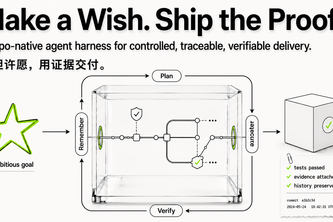
The description states that the project is a "repo-native agent harness" — a system where Git repositories store not only code but also serve as a persistent project control plane for humans and agents working together.
It describes the system as:
- A versioned, auditable, and recoverable workspace for agent-driven projects
- A system that externalizes critical project state from model memory
- A framework that separates project state into three layers: versioned project control plane, durable operational state, and ephemeral runtime state
The description does not provide evidence of a working product or implementation details beyond the conceptual design.
Positioning & Claim Evolution
The description states:
- The system aims to make AI agent projects "continuous, controllable, and verifiable"
- It positions itself as addressing problems with chat history as a project state system
- It claims to solve issues around memory loss, outdated intentions, and lack of trustworthy evidence in long-running projects
- The tagline is: "Make a Wish. Ship the Proof."
The author frames this as a shift from current agent tools that are good for local tasks but fail with complex, multi-session projects.
Target Customer & ICP
The description states:
- The target use case involves "real software engineering, machine learning research, and scientific computing projects"
- These projects "rarely end in one session"
- Projects go through "changing requirements, failed experiments, rejected plans, team handoffs, runtime changes"
- The system is designed for situations with "frequent project interruptions", "multiple humans or agents contributing", "goals and plans being revised repeatedly"
The description does not identify specific customer segments beyond these general use cases.
Business Model & Pricing Evidence
Not evidenced. The description contains no information about pricing, revenue models, or monetization strategies.
Technical & Delivery Signals
The description states:
- Built with markdown, python
- Uses Git repository as persistent project control plane
- Separates project state into three layers: versioned project control plane, durable operational state, and ephemeral runtime state
- Includes hooks, permissions, validators, and continuous integration checks for safety
- Designed to handle checkpoints, handoffs, recovery, artifacts, evidence, and claims
The description does not provide evidence of implementation details or delivery mechanisms beyond the conceptual framework.
Traction & Maturity Signals
Not evidenced. The description contains no information about users, customers, revenue, adoption, or usage metrics.
Competitive Context
Not evidenced. The description does not mention competitors, existing solutions, or market positioning relative to other tools.
Open Questions & Risks
- The project is described as a single-person effort ("Team size: 1")
- No evidence of implementation beyond conceptual design
- No evidence of traction, customers, or revenue
- The system appears to be a research/prototype-level concept rather than a production-ready product
- The description makes strong claims about solving complex problems without demonstrating concrete solutions
- The project is presented as part of a hackathon submission (OpenAI 2026)
Questions the description leaves open
- What specific functionality has been implemented and tested?
- How does this system integrate with existing agent frameworks or tools?
- What are the concrete use cases where this approach provides measurable benefits over current practices?
- Have you conducted any experiments or pilot tests to validate these claims?
- What is the roadmap for development beyond this prototype?
- How do you plan to scale this solution beyond a single-person project?
Overall Assessment
Not evidenced. The description contains no information about funding, valuation, or investment status. The project appears to be at an early conceptual stage with no demonstrated traction or commercial viability. The single-person team size and hackathon context suggest it is not yet ready for investment or partnership consideration.
User Stories BotA demo video on every pull request
Get a demo video on every new feature
GitHub App that watches your pull requests and records a narrated, captioned demo.
Save time on demo prep and make informed decisions faster with a video walkthrough of every new feature.
Source
Submitted to the OpenAI 2026 hackathon on Devpost. Project home on Devpost. Back to the full gallery on Devpost.
This competitive analysis was produced by top-founders.com (opens in a new tab)
Generated by a language model from this project's public Devpost page — its tagline, the author's own write-up and any built-with tags listed there — as captured in August 2026. Short quotations are the author's words. It is an opinion on the idea as a business, not on the people behind it, and it reflects the description as published then. If the project has moved on, request a correction below. The analysis is not independent research and contains no verified traction, revenue or customer data.
An independent guide by KFG International LLC — not affiliated with, endorsed by, or connected to Devpost or OpenAI.