

Archive position — measured, not model output
0 likes on Devpost
2,263 of the 7,850 archived projects have more likes, and 5,587 share exactly 0 — so this project's #2,426 place in the like-ranked listing is a tie-break inside that group, not a ranking.
Projects (log scale)
Likes on Devpost. ▲ marks this project's group.
Show the figures
| Likes | Projects | Share of archive |
|---|---|---|
| 0 | 5,587 | 71.2% |
| 1 | 1,758 | 22.4% |
| 2 | 284 | 3.6% |
| 3–4 | 132 | 1.7% |
| 5–9 | 75 | 1.0% |
| 10+ | 14 | 0.2% |
 User Stories BotA demo video on every pull request
Get a demo video on every new feature
GitHub App that watches your pull requests and records a narrated, captioned demo.
Save time on demo prep and make informed decisions faster with a video walkthrough of every new feature.
Executive Summary
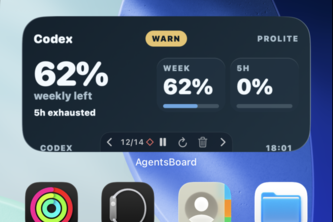
What the company appears to be: AgentsBoard is a self-reported iOS app that presents graphical, actionable cards on the phone’s home screen via widgets. The app has a companion backend server for agents (possibly AI) to publish content non-invasively. It was built by one person as part of a hackathon and is described as a solution to notification fatigue and digital minimalism.
What changed: The author reports building an iOS app with widget support, integrating a backend server, and using AI tools like GPT and Codex for development. The project includes experimental features such as HotSpot zones that can trigger app installation or webhook-based updates.
The single most important open question: Is there any evidence of product-market fit, user adoption, or commercial traction beyond the author’s own use case? The description contains no data on revenue, customers, usage metrics, or monetization attempts.
What The Product Actually Is
- The description states that AgentsBoard is an iOS app with widget support.
- It includes a companion backend server, accessible via MCP or REST protocols.
- The app allows agents to publish graphical, actionable cards on the phone’s home screen.
- These cards are displayed in an auto-rotating widget format.
- There is mention of three types of cards: native Swift components, image-based, and HTML-rendered widgets.
- The system supports Apple Push Notifications for updating widgets.
- The app also includes a Discover section, where users might subscribe to general-purpose cards.
Note: No evidence provided regarding actual functionality beyond the author’s description. The product is not demonstrated or tested in real-world conditions.
Positioning & Claim Evolution
- The author positions AgentsBoard as a solution to notification fatigue and digital minimalism.
- It aims to provide non-invasive information delivery, contrasting with traditional push notifications.
- The app is described as widget-first, emphasizing the use of iOS widgets for information display.
- There is an implication that the app could be used by AI agents (or other automated systems) to deliver timely updates.
- The author mentions potential business use cases, including gamification leaderboards for sales teams.
- The project was submitted to a hackathon, suggesting it is in early development or prototype stage.
Inference: The positioning appears to be based on personal experience and self-perception rather than market research or user feedback. The claim of solving digital minimalism is not substantiated by any external data.
Target Customer & ICP
- The author describes the target audience as individuals who care about digital calmness and want to stay informed without interruptions.
- Potential users may include those interested in AI agents, automation, or personal productivity tools.
- There is a mention of business use cases, such as sales teams using leaderboards, but no evidence of actual business customers or pilot programs.
Not evidenced: No specific customer segments, personas, or buyer profiles are defined. The ICP remains speculative and based on the author’s own interests.
Business Model & Pricing Evidence
- The author states that they are currently investing their own money into the project.
- There is a potential for monetization, possibly through small fees for companies using it.
- The app may be open-sourced or offered under an open foundation model, such as the Openclaw Foundation.
- No pricing information, revenue streams, or monetization strategy are provided.
Inference: Monetization is speculative and not yet implemented. The business model is unclear beyond personal investment and future plans.
Technical & Delivery Signals
- Built using iOS (Swift) and Django/Python.
- Uses Apple Push Notifications for widget updates.
- Supports MCP or REST APIs for agent communication.
- Features include:
- Native Swift card components
- Image-based cards
- HTML-rendered widgets (converted to images)
- The author used GPT and Codex extensively during development, including for testing and debugging.
- Includes a Discover section for general-purpose cards.
- HotSpot zones allow agents to trigger actions like app installation or webhook execution.
Not evidenced: No evidence of scalability, performance metrics, or production deployment. The technical architecture is described but not validated.
Traction & Maturity Signals
- The project was built as part of a hackathon.
- The author reports self-testing and experimentation, including dog walks with Codex.
- There are no signs of user adoption, customer feedback, or real-world usage.
- No mention of downloads, active users, or retention data.
Not evidenced: No traction indicators beyond the author’s own development efforts. The project is not shown to have reached a stable or scalable state.
Competitive Context
- The author does not reference any direct competitors.
- The concept aligns with existing tools that offer widgets, notifications, or AI agent integrations.
- Widgets are already supported by iOS and Android, but few apps integrate AI agents in this way.
- No evidence of competitive analysis or differentiation strategy.
Inference: The competitive landscape is unknown. The product may be unique in its approach to combining widgets with AI agents, but no validation exists.
Open Questions & Risks
- The project is self-built by one person and lacks team structure or external validation.
- It was developed for a hackathon, suggesting it is in early-stage prototype form.
- There is no evidence of monetization, user feedback, or real-world testing.
- The author’s own use case may not reflect broader market demand.
- The project relies heavily on AI tools (GPT, Codex), which introduces dependency risks and lack of control over tool availability or accuracy.
Inference: High risk due to lack of external validation, no traction, and unproven commercial viability.
Questions the description leaves open
- What specific use cases have you identified for businesses or individuals beyond personal productivity?
- Have you tested the app with real users or conducted any form of user research?
- How do you plan to monetize the product, and what is your go-to-market strategy?
- Can you provide evidence of how the widget system performs under load or in different iOS environments?
- What are the technical limitations or scalability concerns with the current architecture?
- Have you considered how to handle data privacy or security for agents interacting with user devices?
Overall Assessment
- The project is self-reported, unverified, and not demonstrated.
- There is no evidence of traction, revenue, or customer adoption.
- It appears to be a personal prototype built during a hackathon.
- The author has not yet validated the product-market fit or established any commercial model.
- The idea shows potential in addressing digital minimalism and AI agent integration, but lacks real-world proof.
Assessment: Not ready for investment or partnership at this time. Requires further development, user testing, and demonstration of traction before any serious consideration.
User Stories BotA demo video on every pull request
Get a demo video on every new feature
GitHub App that watches your pull requests and records a narrated, captioned demo.
Save time on demo prep and make informed decisions faster with a video walkthrough of every new feature.
Source
Submitted to the OpenAI 2026 hackathon on Devpost. Project home on Devpost. Back to the full gallery on Devpost.
This competitive analysis was produced by top-founders.com (opens in a new tab)
Generated by a language model from this project's public Devpost page — its tagline, the author's own write-up and any built-with tags listed there — as captured in August 2026. Short quotations are the author's words. It is an opinion on the idea as a business, not on the people behind it, and it reflects the description as published then. If the project has moved on, request a correction below. The analysis is not independent research and contains no verified traction, revenue or customer data.
An independent guide by KFG International LLC — not affiliated with, endorsed by, or connected to Devpost or OpenAI.