

Archive position — measured, not model output
0 likes on Devpost
2,263 of the 7,850 archived projects have more likes, and 5,587 share exactly 0 — so this project's #2,395 place in the like-ranked listing is a tie-break inside that group, not a ranking.
Projects (log scale)
Likes on Devpost. ▲ marks this project's group.
Show the figures
| Likes | Projects | Share of archive |
|---|---|---|
| 0 | 5,587 | 71.2% |
| 1 | 1,758 | 22.4% |
| 2 | 284 | 3.6% |
| 3–4 | 132 | 1.7% |
| 5–9 | 75 | 1.0% |
| 10+ | 14 | 0.2% |
 User Stories BotA demo video on every pull request
Get a demo video on every new feature
GitHub App that watches your pull requests and records a narrated, captioned demo.
Save time on demo prep and make informed decisions faster with a video walkthrough of every new feature.
Executive Summary
What the company appears to be
Agentard is a self-reported visual editor for designing multi-agent workflows that can be exported as Codex-ready Agent Skills. The product is built by one person (Brayan Roberto Ccarita Cruz) and submitted as a hackathon project to the OpenAI 2026 hackathon.
What changed
The author states that Agentard was created in response to a perceived gap in AI development tools — which tend to focus on enhancing single agents rather than enabling complex, multi-agent systems. The product introduces a visual workflow editor and integrates with Codex for execution.
Single most important open question
Is there any evidence of traction, revenue, or customer adoption beyond the author’s own description?
What The Product Actually Is
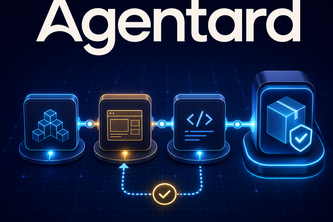
The description states that Agentard is a visual editor for designing specialized multi-agent workflows, which it then exports as Codex-ready Agent Skills. It supports both manual node-based creation and natural language input via an AI layer (Agentard Architect powered by GPT-5.6).
It includes features such as:
- Specialized agents and personas
- Instructions, responsibilities, connections, handoffs
- Conditions, approval gates, iteration loops
- MCP and tool requirements
- Acceptance criteria
The final output is packaged into a project-scoped Agent Skill that Codex can interpret and execute.
Inference Agentard appears to be a workflow design tool for AI agents, intended to bridge the gap between conceptualization and execution in software development using AI.
Positioning & Claim Evolution
The author claims that most AI development tools focus on making a single agent more capable, whereas real development tasks often require multiple specialized roles with clear handoffs, validation steps, conditions, and iteration loops.
Agentard positions itself as a tool to design these systems visually, akin to building a workflow, and then package the result into something Codex can understand.
Inference The positioning reflects an attempt to address a perceived lack of tools for managing complex multi-agent workflows in AI development — especially those that are repeatable and context-specific.
Target Customer & ICP
The description does not explicitly name target customers or personas. However, it implies usage by:
- Developers working with AI agents
- Teams designing specialized workflows for specific use cases (e.g., barbershop app)
- Users who want to integrate multi-agent systems into Codex-based projects
Inference Target users likely include developers and teams building AI-powered applications where coordination among multiple agents is required, particularly in environments using Codex.
Business Model & Pricing Evidence
There is no evidence of a business model or pricing structure. The description only mentions the tool's functionality and how it works with Codex.
Not evidenced
Technical & Delivery Signals
The product is built using Next.js, according to the author’s declaration. It includes:
- A node-based web editor
- Structured workflow schema
- Deterministic validation and compilation layer
- Integration with GPT-5.6 through OpenAI API
- Exporting into Codex-compatible Agent Skills
Agentard Architect is described as a controlled AI assistant, not a replacement for the visual editor, and uses tools like creating agents, connecting nodes, assigning MCP requirements, defining conditions, and configuring loop limits.
Inference The architecture suggests a hybrid approach combining AI planning with deterministic validation to ensure safety and portability of workflows.
Traction & Maturity Signals
There is no evidence of traction, revenue, customers, or adoption beyond the author’s own description. The project was submitted as part of a hackathon (OpenAI 2026), indicating early-stage development.
Not evidenced
Competitive Context
The description does not mention any competitors. It implies that existing AI development tools focus on single-agent enhancement rather than multi-agent orchestration, suggesting a potential niche or gap in the market.
Inference Agentard may be positioned to compete with or supplement tools focused on individual agent capabilities, though no direct competitors are named.
Open Questions & Risks
- Single-person team: The entire project is attributed to one person (Brayan Roberto Ccarita Cruz), raising concerns about scalability and long-term maintenance.
- Unverified claims: The product is described as being built during a hackathon, with no independent verification of its functionality or performance.
- No revenue or customer data: No evidence of monetization, users, or market traction exists.
- AI dependency: Reliance on GPT-5.6 and OpenAI API introduces potential risks related to availability, cost, and control.
- Limited scope: The demo focuses on a barbershop application; no indication of broader applicability or use cases.
Questions the description leaves open
- What is the current status of development beyond the hackathon?
- Have you tested Agentard with real users or teams?
- How do you plan to scale beyond a single developer?
- Are there any plans for monetization or commercial use?
- Can you demonstrate how workflows are validated and compiled into Codex-ready skills?
- What are your thoughts on the long-term viability of relying on GPT-5.6?
- Is there any internal testing or feedback from developers using Codex?
Overall Assessment
There is no evidence of revenue, customers, traction, or a defined business model. The project was submitted as a hackathon entry and lacks any indication of commercial readiness or market validation.
Confidence Level: Low
This is a self-reported concept with no external corroboration. It reflects an idea for a product that could be valuable in the future but has not yet demonstrated real-world utility or adoption.
User Stories BotA demo video on every pull request
Get a demo video on every new feature
GitHub App that watches your pull requests and records a narrated, captioned demo.
Save time on demo prep and make informed decisions faster with a video walkthrough of every new feature.
Source
Submitted to the OpenAI 2026 hackathon on Devpost. Project home on Devpost. Back to the full gallery on Devpost.
This competitive analysis was produced by top-founders.com (opens in a new tab)
Generated by a language model from this project's public Devpost page — its tagline, the author's own write-up and any built-with tags listed there — as captured in August 2026. Short quotations are the author's words. It is an opinion on the idea as a business, not on the people behind it, and it reflects the description as published then. If the project has moved on, request a correction below. The analysis is not independent research and contains no verified traction, revenue or customer data.
An independent guide by KFG International LLC — not affiliated with, endorsed by, or connected to Devpost or OpenAI.