

Archive position — measured, not model output
0 likes on Devpost
2,263 of the 7,850 archived projects have more likes, and 5,587 share exactly 0 — so this project's #7,744 place in the like-ranked listing is a tie-break inside that group, not a ranking.
Projects (log scale)
Likes on Devpost. ▲ marks this project's group.
Show the figures
| Likes | Projects | Share of archive |
|---|---|---|
| 0 | 5,587 | 71.2% |
| 1 | 1,758 | 22.4% |
| 2 | 284 | 3.6% |
| 3–4 | 132 | 1.7% |
| 5–9 | 75 | 1.0% |
| 10+ | 14 | 0.2% |
 User Stories BotA demo video on every pull request
Get a demo video on every new feature
GitHub App that watches your pull requests and records a narrated, captioned demo.
Save time on demo prep and make informed decisions faster with a video walkthrough of every new feature.
Executive Summary
What the company appears to be
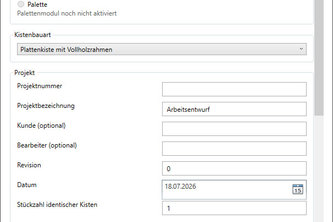
XBE Transport Crate Engineering is a self-reported Windows desktop application for industrial transport-crate design. The project was built as a functional prototype during an OpenAI Build Week hackathon, using Codex and GPT-5.6 in collaboration with domain expertise. It is described as a modular engineering platform with two planned modules: one for crate design and another for pallet engineering.
What changed
The project evolved from a practical industrial problem—manual planning of transport crates through spreadsheets and sketches—to a structured digital workflow that begins with cargo data and outputs 3D models. The author states it was developed in a few days, with an iterative process involving Codex-assisted development and expert corrections.
Single most important open question
Is the application’s core functionality sufficient to be considered a usable engineering tool, or is it still limited to demonstration-level prototyping?
What The Product Actually Is
The description states that XBE Transport Crate Engineering is a Windows desktop application designed for industrial transport-crate planning. It allows users to:
- Create new projects,
- Enter cargo information (dimensions, weight, center of gravity, support conditions),
- Define construction parameters,
- Generate and inspect 3D models in isometric and technical views,
- Work through dedicated tabs for inputs, construction, connections, technical data, verification, and output,
- Save and reopen project data.
The application is described as a modular engineering platform, with:
- Module 1: industrial transport-crate design
- Module 2: planned pallet design and manufacturing workflows
It is not intended to replace final engineering approval or production drawings. The current version is a functional engineering prototype.
Positioning & Claim Evolution
The author states that the project was inspired by a real-world industrial challenge in packaging and logistics, where traditional methods (spreadsheets, sketches) are insufficient for complex cargo types.
Positioning:
- The product is positioned as a structured engineering workflow, not a generic CAD tool.
- It starts with cargo data and produces a traceable 3D transport-crate design.
- It aims to be a specialist tool that guides users through one industrial workflow, rather than a general-purpose system.
Claim evolution:
- The original claim was to turn practical crate-building knowledge into a digital process.
- The current version is described as a functional prototype, not a final product.
- Future modules are planned for pallet design and manufacturing workflows.
Target Customer & ICP
The description does not explicitly name target customers or define an Ideal Customer Profile (ICP). However, it implies the following:
- The application targets industrial packaging engineers or logistics professionals who work with transport crates.
- It is intended for users who need to plan complex crates, such as those that are heavy, long, fragile, asymmetrical, export-sensitive, or have a high center of gravity.
The product is described as a specialist tool, not a general-purpose CAD system, suggesting it is aimed at professionals with domain knowledge rather than end-users.
Business Model & Pricing Evidence
Not evidenced.
The description does not mention any pricing model, monetization strategy, or business model.
Technical & Delivery Signals
The application is built using:
- .NET (versions 10 and 11)
- C#
- WPF (Windows Presentation Foundation)
- Codex and GPT-5.6 for development
- Desktop, offline-first, self-contained deployment
- File formats: JSON, SVG, PDF, SHA-256 storage
- Graphics: Vector, 3D rendering
Development process:
- Iterative workflow using Codex and human domain expertise.
- The author states that Codex supported:
- Application architecture,
- UI implementation,
- Data handling,
- 3D rendering,
- Validation logic,
- Debugging,
- Refactoring,
- Testing.
The application is described as a modular engineering platform, with planned expansion to pallet design workflows.
Traction & Maturity Signals
Not evidenced.
There is no mention of revenue, customers, or adoption beyond the prototype stage. The product is described as a functional engineering prototype and not yet intended to replace final engineering approval or production drawings.
The author states that the application is designed for modular development, with future modules planned for pallet design and manufacturing workflows.
Competitive Context
Not evidenced.
No information is provided about competitors, market size, or competitive positioning beyond the general context of industrial packaging tools or CAD systems.
Open Questions & Risks
- The application is described as a functional prototype, not a production-ready tool.
- It is not intended to replace final engineering approval or production drawings.
- The use of Codex and GPT-5.6 for development raises questions about the reliability and traceability of code generation.
- The project is self-reported, with no independent verification of functionality or claims.
- The application is Windows desktop-only, limiting its accessibility.
- The author notes that complex engineering knowledge must be converted into structured data—a challenge that may affect scalability or accuracy.
Questions the description leaves open
- What specific industrial workflows does the tool support, and how are they validated?
- How is the integration of Codex with domain expertise managed in practice?
- Are there any known limitations or edge cases where the 3D model may be incorrect despite appearing valid?
- What is the plan for validating engineering calculations and ensuring compliance with industry standards?
- Is there a roadmap for transitioning from prototype to production-ready software?
- How does the tool handle data persistence, version control, and collaboration between users?
Overall Assessment
Not evidenced.
There is no information on funding rounds, valuation, or investment status. The project is described as a self-reported hackathon submission, not a commercial venture.
The application is a functional prototype with clear intent to develop into a modular engineering platform. However, it has not yet demonstrated traction, revenue, or customer adoption. It may be a promising idea for further development but lacks evidence of commercial viability or market readiness at this stage.
User Stories BotA demo video on every pull request
Get a demo video on every new feature
GitHub App that watches your pull requests and records a narrated, captioned demo.
Save time on demo prep and make informed decisions faster with a video walkthrough of every new feature.
Source
Submitted to the OpenAI 2026 hackathon on Devpost. Project home on Devpost. Back to the full gallery on Devpost.
This competitive analysis was produced by top-founders.com (opens in a new tab)
Generated by a language model from this project's public Devpost page — its tagline, the author's own write-up and any built-with tags listed there — as captured in August 2026. Short quotations are the author's words. It is an opinion on the idea as a business, not on the people behind it, and it reflects the description as published then. If the project has moved on, request a correction below. The analysis is not independent research and contains no verified traction, revenue or customer data.
An independent guide by KFG International LLC — not affiliated with, endorsed by, or connected to Devpost or OpenAI.