

Archive position — measured, not model output
0 likes on Devpost
2,263 of the 7,850 archived projects have more likes, and 5,587 share exactly 0 — so this project's #7,736 place in the like-ranked listing is a tie-break inside that group, not a ranking.
Projects (log scale)
Likes on Devpost. ▲ marks this project's group.
Show the figures
| Likes | Projects | Share of archive |
|---|---|---|
| 0 | 5,587 | 71.2% |
| 1 | 1,758 | 22.4% |
| 2 | 284 | 3.6% |
| 3–4 | 132 | 1.7% |
| 5–9 | 75 | 1.0% |
| 10+ | 14 | 0.2% |
 User Stories BotA demo video on every pull request
Get a demo video on every new feature
GitHub App that watches your pull requests and records a narrated, captioned demo.
Save time on demo prep and make informed decisions faster with a video walkthrough of every new feature.
Executive Summary
What the company appears to be
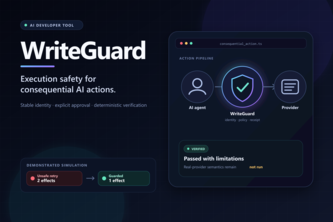
WriteGuard is a developer tool that aims to provide execution memory for AI agents interacting with external systems. The author states it helps developers prevent unintended duplicate actions (e.g., refunds, orders) caused by retries, concurrency, or crashes after an agent has acted.
What changed
The project evolved from a pre-existing TypeScript SDK foundation into a complete developer product journey that includes analysis, review, approval, generation, verification, and integration of guarded tool integrations using GPT-5.6 for design-time reasoning and deterministic code for runtime behavior.
Single most important open question
Does the author’s self-reported functionality and architecture actually work as described in practice, or is this a conceptual framework that has not yet been validated through real-world usage?
What The Product Actually Is
The description states:
- WriteGuard is a tool that provides "durable execution memory" for AI agents.
- It operates on MCP (Model Control Protocol) tools and integrates with external systems like Stripe.
- It uses GPT-5.6 to analyze tool schemas at design time, identifying risks such as retries, concurrency, and uncertain outcomes.
- After developer approval, deterministic code generates typed wrappers, manifests, and failure tests.
- At runtime, it records logical operations and coordinates execution across retries, crashes, and uncertain outcomes using PostgreSQL storage.
Inference The product appears to be a middleware layer that sits between an AI agent and external systems (e.g., payment providers), ensuring that one intended action results in only one real-world effect, even if the agent experiences timeouts or restarts.
Evidence strength
- Evidenced: The author describes how GPT-5.6 analyzes tools and generates deterministic code.
- Inferred: That this system works reliably in practice is not evidenced; it's a claim about capability.
Positioning & Claim Evolution
The description states:
- WriteGuard positions itself as solving the trust gap between probabilistic AI agents and external systems with uncertain outcomes.
- It aims to become the "execution-safety layer beneath agent platforms."
- The author emphasizes that this is not about replacing provider-native idempotency but addressing broader integration problems like identifying logical operations, persisting state, coordinating retries, reconciling uncertainty, testing failures, and preserving evidence.
Inference The positioning suggests a niche in the growing agentic economy where trust and safety are paramount. It is positioned as complementary to existing platforms like Stripe rather than competing with them.
Evidence strength
- Evidenced: The author’s framing of the problem and solution.
- Inferred: That this approach will be widely adopted or seen as necessary in the agent economy is not evidenced.
Target Customer & ICP
The description states:
- The primary audience is developers building AI agents that interact with external systems (e.g., payments, communications, orders).
- It targets those who are moving from AI that recommends actions to AI that performs them.
- The tool is designed for use in agent platforms and developer workflows involving consequential operations.
Inference The ICP likely includes developers working on agent-based applications, particularly in commerce or enterprise systems where reliability and auditability matter.
Evidence strength
- Evidenced: The stated target users and domains.
- Not evidenced: No specific customer names, use cases, or adoption metrics are provided.
Business Model & Pricing Evidence
The description states:
- There is no mention of pricing models, subscriptions, or monetization strategies.
- The evaluation process requires no API keys, credentials, or databases — suggesting a free or open-source model for initial access.
- The tool integrates with Stripe and other providers but does not describe how it would charge for its use.
Inference It is unclear whether the product will be sold as a SaaS offering, integrated into platforms, or offered via open-source license. No business model is described.
Evidence strength
- Not evidenced: No pricing, monetization, or revenue model is mentioned.
Technical & Delivery Signals
The description states:
- Built with technologies including Docker, Node.js, TypeScript, PostgreSQL, OpenAI (GPT-5.6), and MCP.
- Uses a structured output approach via the OpenAI Responses API.
- Includes a credential-free evaluation process that runs without live API calls.
- Generates deterministic code that does not make network calls at runtime.
- Supports versioned contracts for analysis, verification, adapter conformance, and CI policy.
- Has unit tests, integration tests, and pilot workflows.
Inference The technical stack supports both AI reasoning and deterministic execution, with clear separation between design-time and runtime phases.
Evidence strength
- Evidenced: The tech stack and development practices described.
- Not evidenced: Whether these technologies are sufficient to deliver on the claimed safety guarantees in production environments.
Traction & Maturity Signals
The description states:
- The project was built during a 5-day hackathon (Build Week).
- It includes a canonical evaluation that runs in ~39 seconds without live API requests.
- There are separate refund and email consumer pilots.
- A total of 172 unit tests and 20 integration tests are included.
- The repository contains BUILD_WEEK.md, validation reports, commits, and annotated iteration tags.
Inference The project shows early maturity with a working prototype and test suite. However, there is no evidence of real-world deployment or customer feedback.
Evidence strength
- Evidenced: The presence of tests, evaluation scripts, and development history.
- Not evidenced: No user data, adoption rates, or production usage.
Competitive Context
The description states:
- It complements existing platforms like Stripe’s Agentic Commerce Suite and Link CLI.
- It addresses the gap between authorization/security (handled by providers) and execution safety (which WriteGuard aims to solve).
- It is positioned as a provider-agnostic trust layer for the emerging agent economy.
Inference WriteGuard competes indirectly with tools that handle idempotency or transactional integrity in agent workflows, but it does not directly compete with Stripe or similar providers.
Evidence strength
- Evidenced: The author’s framing of its relationship to existing tools.
- Not evidenced: No direct competitors are named or analyzed.
Open Questions & Risks
The description states:
- The system relies heavily on GPT-5.6 for design-time reasoning, which may introduce inaccuracies or misinterpretations.
- It separates probabilistic recommendations from deterministic enforcement — a good practice, but still depends on accurate input.
- There is no evidence of real-world testing beyond the Build Week evaluation.
- The tool does not attempt to replace provider-native idempotency, which could be seen as limiting its utility.
Inference The risk lies in over-reliance on AI for critical decisions and lack of real-world validation. Additionally, without customer feedback or production use cases, it’s unclear how well the system scales or handles edge cases.
Evidence strength
- Evidenced: The reliance on GPT-5.6 and lack of external testing.
- Inferred: That these risks will materialize in practice is not evidenced.
Questions the description leaves open
- What specific types of external systems (e.g., payment providers, cloud APIs) have you tested WriteGuard with?
- How does the system handle situations where GPT-5.6 fails to correctly identify identity fields or reconciliation constraints?
- Can you walk us through a real-world scenario where WriteGuard would be used in production?
- What are the performance implications of using PostgreSQL for durable execution memory at scale?
- Are there any known limitations or edge cases that the current implementation does not address?
Overall Assessment
The description states:
- The project is a developer tool built during a hackathon.
- It includes a working prototype and test suite, but no revenue, customers, or traction data are provided.
- It positions itself as solving a growing problem in the agent economy.
Inference This appears to be an early-stage idea with strong technical execution. However, due to lack of evidence around commercial viability, market demand, or real-world usage, it is difficult to assess whether this represents a viable investment or partnership opportunity.
Evidence strength
- Evidenced: The prototype and development effort.
- Not evidenced: Commercial traction, customer validation, or scalability proof.
User Stories BotA demo video on every pull request
Get a demo video on every new feature
GitHub App that watches your pull requests and records a narrated, captioned demo.
Save time on demo prep and make informed decisions faster with a video walkthrough of every new feature.
Source
Submitted to the OpenAI 2026 hackathon on Devpost. Project home on Devpost. Back to the full gallery on Devpost.
This competitive analysis was produced by top-founders.com (opens in a new tab)
Generated by a language model from this project's public Devpost page — its tagline, the author's own write-up and any built-with tags listed there — as captured in August 2026. Short quotations are the author's words. It is an opinion on the idea as a business, not on the people behind it, and it reflects the description as published then. If the project has moved on, request a correction below. The analysis is not independent research and contains no verified traction, revenue or customer data.
An independent guide by KFG International LLC — not affiliated with, endorsed by, or connected to Devpost or OpenAI.