

Archive position — measured, not model output
2 likes on Devpost
221 of the 7,850 archived projects have more likes, and 284 share exactly 2 — so this project's #500 place in the like-ranked listing is a tie-break inside that group, not a ranking.
Projects (log scale)
Likes on Devpost. ▲ marks this project's group.
Show the figures
| Likes | Projects | Share of archive |
|---|---|---|
| 0 | 5,587 | 71.2% |
| 1 | 1,758 | 22.4% |
| 2 | 284 | 3.6% |
| 3–4 | 132 | 1.7% |
| 5–9 | 75 | 1.0% |
| 10+ | 14 | 0.2% |
 User Stories BotA demo video on every pull request
Get a demo video on every new feature
GitHub App that watches your pull requests and records a narrated, captioned demo.
Save time on demo prep and make informed decisions faster with a video walkthrough of every new feature.
Executive Summary
What the company appears to be
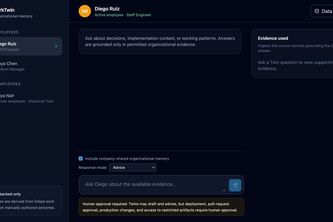
WorkTwin, as described by its author, is a knowledge management tool that creates "evidence-backed Employee Twins" from work artifacts (Slack, GitHub, email). It allows users to ask questions about past decisions or context and receive grounded answers with citations. The system distinguishes between active employees and historical twins, and it is designed to preserve organizational memory without impersonating individuals or exposing restricted data.
What changed
The author states they built this during a hackathon, using React, FastAPI, OpenAI SDK, Supabase, and vector embeddings. They implemented a demo with controlled imports of Slack, GitHub, and email data, including access controls and provenance tracking. The project is presented as an end-to-end prototype with UI flow, citations, and human approval guardrails.
The single most important open question
Is there evidence that WorkTwin has traction or adoption beyond the author’s own demo? The description does not mention any customers, revenue, usage metrics, or product-market fit beyond a hackathon submission.
What The Product Actually Is
The description states:
- WorkTwin creates "evidence-backed Employee Twins" from work artifacts (Slack, GitHub, email).
- It allows users to ask questions about past decisions and get answers with inspectable citations.
- It preserves source type, timestamp, excerpt, canonical reference, and access scope.
- Former employees are represented as historical twins, not real-time agents.
- The system uses embeddings for retrieval, OpenAI API for generating responses, and Supabase for storage.
Inference The product is a knowledge retrieval and synthesis tool that integrates with common workplace tools to maintain organizational memory.
Positioning & Claim Evolution
The description states:
- WorkTwin was built around the question: “Who knows why this was done?”
- It aims to preserve context and reasoning behind decisions even after employees leave.
- The author emphasizes trustworthiness over convincing fluency, embedding citations into the data model from the start.
Inference The positioning is that WorkTwin helps organizations retain institutional knowledge by creating digital twins of individuals based on their work artifacts, with a focus on verifiability and access control.
Target Customer & ICP
The description states:
- The tool targets teams looking to preserve context and reasoning behind decisions.
- It supports both active and former employees, distinguishing between them clearly.
- It is designed for use in organizations where knowledge retention matters.
Inference The target customer appears to be engineering or product teams within larger companies that value knowledge continuity and want to avoid losing institutional memory when people leave.
Business Model & Pricing Evidence
Not evidenced.
Explanation
There is no mention of pricing, monetization strategy, or business model in the description. The project is presented as a hackathon demo with no indication of commercial intent or revenue streams.
Technical & Delivery Signals
The description states:
- Built with React, FastAPI, OpenAI SDK, Supabase, pgvector, PostgreSQL, TypeScript, Tailwind CSS, Vite, Shadcn UI.
- Uses embeddings for retrieval and OpenAI API to generate cited answers.
- Implements controlled imports of Slack, GitHub, and email data.
- Includes access controls, provenance tracking, and audit records.
- Designed with human approval guardrails for deployment, PRs, and production changes.
Inference The technical stack suggests a modern SaaS architecture with vector search, API integration, and UI/UX built for enterprise use cases. The inclusion of access control and audit trails signals an awareness of security and compliance needs.
Traction & Maturity Signals
Not evidenced.
Explanation
There is no evidence of revenue, customers, user engagement, or product usage beyond the hackathon demo. No mention of traction, adoption, or growth metrics is present in the description.
Competitive Context
Not evidenced.
Explanation
The description does not reference competitors, market positioning, or competitive landscape. It does not describe how WorkTwin compares to existing tools for knowledge management or organizational memory.
Open Questions & Risks
- No traction or commercialization evidence: The project is presented as a hackathon demo with no signs of product-market fit or customer validation.
- Unproven scalability: The demo uses controlled imports; live integrations (OAuth, webhooks) are described as future work.
- Unclear path to monetization: No business model or pricing strategy is mentioned.
- Single-founder project: With only one team member, the ability to scale development and go-to-market may be limited.
Questions the description leaves open
- What specific use cases have you identified for WorkTwin beyond the demo?
- Have you tested the product with any real users or teams?
- How do you plan to handle data privacy, access control, and compliance at scale?
- What is your roadmap for moving from a demo to a production-ready product?
- Are there any existing customers or pilot programs?
Overall Assessment
Not evidenced.
Explanation
There is insufficient evidence to assess whether WorkTwin has investment potential or partnership value. The description lacks data on traction, market demand, or commercial viability. It remains a self-reported hackathon prototype with no indication of product-market fit or scalability.
User Stories BotA demo video on every pull request
Get a demo video on every new feature
GitHub App that watches your pull requests and records a narrated, captioned demo.
Save time on demo prep and make informed decisions faster with a video walkthrough of every new feature.
Source
Submitted to the OpenAI 2026 hackathon on Devpost. Project home on Devpost. Back to the full gallery on Devpost.
This competitive analysis was produced by top-founders.com (opens in a new tab)
Generated by a language model from this project's public Devpost page — its tagline, the author's own write-up and any built-with tags listed there — as captured in August 2026. Short quotations are the author's words. It is an opinion on the idea as a business, not on the people behind it, and it reflects the description as published then. If the project has moved on, request a correction below. The analysis is not independent research and contains no verified traction, revenue or customer data.
An independent guide by KFG International LLC — not affiliated with, endorsed by, or connected to Devpost or OpenAI.