

Archive position — measured, not model output
0 likes on Devpost
2,263 of the 7,850 archived projects have more likes, and 5,587 share exactly 0 — so this project's #7,694 place in the like-ranked listing is a tie-break inside that group, not a ranking.
Projects (log scale)
Likes on Devpost. ▲ marks this project's group.
Show the figures
| Likes | Projects | Share of archive |
|---|---|---|
| 0 | 5,587 | 71.2% |
| 1 | 1,758 | 22.4% |
| 2 | 284 | 3.6% |
| 3–4 | 132 | 1.7% |
| 5–9 | 75 | 1.0% |
| 10+ | 14 | 0.2% |
 User Stories BotA demo video on every pull request
Get a demo video on every new feature
GitHub App that watches your pull requests and records a narrated, captioned demo.
Save time on demo prep and make informed decisions faster with a video walkthrough of every new feature.
Executive Summary
What the company appears to be
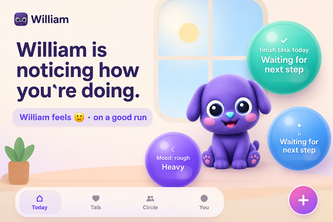
The project described by the caller is William: Emotion-First Personal Growth OS, a self-described personal growth operating system powered by AI that aims to support emotional understanding and authentic relationship-building, without replacing human relationships or professional mental health care.
What changed
This project was submitted as part of the OpenAI 2026 hackathon. It is not evidenced to have any prior traction, revenue, or customer base beyond its development phase.
The single most important open question — the commercial due-diligence read
Is there a viable path from a hackathon prototype to a scalable personal growth platform with sustainable business model and user adoption?
What The Product Actually Is
The description states that William is an Emotion-First Personal Growth Operating System. It uses AI to help users understand themselves, foster authentic relationships, and grow into who they aspire to become.
It is described as having five connected layers:
- A private and psychologically safe space for honest self-expression.
- AI-powered emotional reflection through natural conversations and journaling.
- Long-term memory that builds a living understanding of each user's identity, values, and emotional patterns.
- Authentic human connection by encouraging meaningful relationships instead of algorithm-driven engagement.
- A Growth Ecosystem connecting users with therapists, coaches, educators, communities, and other real-world support when AI alone is not enough.
The system is built using OpenAI models as the reasoning engine, combined with a Personal Growth OS architecture integrating emotional journaling, identity modeling, long-term memory, relationship mapping, and ecosystem recommendations.
Confidence Low — this is entirely self-reported and lacks evidence of functionality or user interaction beyond the authors' claims.
Positioning & Claim Evolution
The project positions itself as an emotion-first personal growth OS, distinct from typical AI chatbots. The authors claim it focuses on:
- Understanding emotions as signals rather than problems.
- Supporting long-term personal development through AI and human connection.
- Creating a bridge between everyday emotional life and professional mental health care.
It explicitly states that it does not aim to replace therapists or human relationships but to act as a missing layer between them.
The authors also describe their ambition to build the world’s first Emotion-First Personal Growth Operating System, with a vision of becoming infrastructure for connecting emotional understanding with real-world growth.
Inference The positioning reflects an attempt to differentiate from mainstream AI companions by emphasizing psychological safety, long-term memory, and ecosystem integration.
Target Customer & ICP
The description does not clearly define a specific customer segment or ideal customer profile (ICP). It implies that William is for individuals seeking personal growth, especially those who may be struggling emotionally but are not yet in crisis or receiving professional help.
It targets people who:
- Want to better understand themselves.
- Are interested in emotional reflection and journaling.
- May benefit from a companion that supports their journey between therapy sessions or during times of isolation.
However, there is no evidence of market segmentation, user personas, or any indication of how the team identifies or reaches its intended audience.
Confidence Very low — no stated target customer or ICP beyond general emotional support needs.
Business Model & Pricing Evidence
There is no evidence in the description of a business model or pricing structure. The authors do not mention monetization strategies, subscription plans, freemium tiers, or any revenue-generating mechanisms.
They describe William as part of a larger ecosystem that connects users with real-world support systems (therapists, coaches, etc.), but they do not clarify how this would be monetized or whether William itself is sold to end-users or integrated into third-party platforms.
Confidence Not evidenced — no indication of how the product will generate revenue.
Technical & Delivery Signals
The project is built using:
- OpenAI models
- LLMs (specifically mentioned: phi-4, llama.cpp)
- Speech-to-text capabilities (Whisper)
- Cloudflare Workers
- Electron and Chrome extensions
- JavaScript, HTML5, CSS3, JSON, IPC
- Desktop and API integrations
It is described as using long-term memory, contextual reasoning, and personalized reflection features to build a deeper understanding of users over time.
The authors note that the system avoids optimizing for conversation length or engagement, instead focusing on helping users gain self-awareness and make progress in real life.
There is no mention of scalability, performance metrics, or delivery infrastructure beyond what was used during development.
Confidence Low — technical details are limited to tools and architecture; no evidence of product maturity or operational capability.
Traction & Maturity Signals
The project is described as a hackathon submission, submitted to the OpenAI 2026 hackathon on Devpost. It has no demonstrated traction, revenue, customers, or usage data.
It was built by a team of four members (bambie li, Gillian Wang, labian l, ReginaJin168 y), but there is no evidence of prior experience, funding, or product launches.
The authors describe it as “only the beginning” and express ambitions to expand into a full ecosystem, but no progress toward that vision is evidenced.
Confidence Not evidenced — no signs of traction, adoption, or commercial viability beyond concept stage.
Competitive Context
There are no references in the description to existing competitors or market dynamics. The authors do not discuss how William compares to other AI companions, personal development apps, or mental health tools.
They state that their ambition is not to build the best AI companion but to create a new kind of system integrating AI, humans, and ecosystems — suggesting they see themselves as different from current offerings.
However, without any competitive analysis or market positioning, it's unclear whether this approach is novel or simply aspirational.
Confidence Not evidenced — no competitive landscape or differentiation strategy provided.
Open Questions & Risks
Several key risks are implied by the description:
- Lack of commercial traction or monetization strategy: The project is presented as a hackathon submission with no evidence of revenue, users, or business model.
- Highly philosophical and abstract positioning: The emphasis on emotional signals, long-term memory, and ecosystem integration may be difficult to operationalize without clear user needs or feedback loops.
- Potential ethical concerns around AI in mental health: The authors acknowledge the challenge of balancing support with dependency, but there is no evidence of how they plan to manage risks related to emotional manipulation or over-reliance on AI.
- Unclear path to scalability and sustainability: No indication of how the team plans to grow beyond a prototype or attract users without proven demand.
Inference The project appears to be in early conceptualization, with no clear path to market readiness or product-market fit.
Questions the description leaves open
- What specific user problems are you solving, and how do you know these exist?
- How will you monetize William? Is there a pricing model or revenue plan?
- What is your go-to-market strategy for reaching users who might be interested in personal growth tools?
- How do you plan to ensure ethical use of AI in emotional support contexts?
- Have you conducted any user research or testing beyond the hackathon environment?
- What are the key technical challenges that remain unresolved before launch?
- How does William differentiate from existing mental health apps, therapy platforms, or AI companions?
Overall Assessment
Not evidenced — there is no evidence of traction, revenue, customers, or even a clear product roadmap beyond the hackathon submission.
The project is described as a conceptual framework for an emotion-first personal growth OS, built by a small team in a short timeframe. It lacks any indication of commercial viability, scalability, or strategic direction.
While the idea of integrating AI with human and ecosystem-based support systems is intriguing, it remains unproven in practice.
Confidence Very low — no evidence supports a viable business case or path to growth beyond the initial prototype.
User Stories BotA demo video on every pull request
Get a demo video on every new feature
GitHub App that watches your pull requests and records a narrated, captioned demo.
Save time on demo prep and make informed decisions faster with a video walkthrough of every new feature.
Source
Submitted to the OpenAI 2026 hackathon on Devpost. Project home on Devpost. Back to the full gallery on Devpost.
This competitive analysis was produced by top-founders.com (opens in a new tab)
Generated by a language model from this project's public Devpost page — its tagline, the author's own write-up and any built-with tags listed there — as captured in August 2026. Short quotations are the author's words. It is an opinion on the idea as a business, not on the people behind it, and it reflects the description as published then. If the project has moved on, request a correction below. The analysis is not independent research and contains no verified traction, revenue or customer data.
An independent guide by KFG International LLC — not affiliated with, endorsed by, or connected to Devpost or OpenAI.