

Archive position — measured, not model output
0 likes on Devpost
2,263 of the 7,850 archived projects have more likes, and 5,587 share exactly 0 — so this project's #7,564 place in the like-ranked listing is a tie-break inside that group, not a ranking.
Projects (log scale)
Likes on Devpost. ▲ marks this project's group.
Show the figures
| Likes | Projects | Share of archive |
|---|---|---|
| 0 | 5,587 | 71.2% |
| 1 | 1,758 | 22.4% |
| 2 | 284 | 3.6% |
| 3–4 | 132 | 1.7% |
| 5–9 | 75 | 1.0% |
| 10+ | 14 | 0.2% |
 User Stories BotA demo video on every pull request
Get a demo video on every new feature
GitHub App that watches your pull requests and records a narrated, captioned demo.
Save time on demo prep and make informed decisions faster with a video walkthrough of every new feature.
Executive Summary
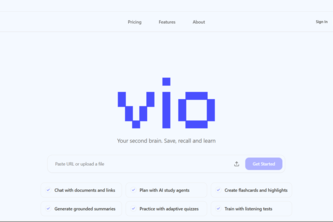
What the company appears to be: Vio is a self-reported AI-powered classroom workspace that enables teachers to manage assignments, submissions, and feedback while retaining full control over grading decisions. It positions itself as an educational platform where AI proposes evaluations but does not make final grades.
What changed: The project evolved from a personal learning tool into a complete classroom and assessment workspace during the OpenAI Build Week hackathon. The author used GPT-5.6 Sol through Codex to rebuild the system, incorporating AI evaluation drafts while maintaining teacher-authority over final assessments.
Single most important open question: Does Vio have any real-world adoption or usage by teachers and students beyond the author's own testing?
Analysis basis: This report is based entirely on the self-reported project description provided by the author. No independent verification, traction data, revenue figures, customer names, or third-party sources are available.
What The Product Actually Is
The description states that Vio is:
- An AI-powered learning and classroom workspace
- A platform where teachers remain responsible for assessment
- A system for creating classrooms, inviting students, publishing assignments, and managing submissions
- A tool that generates AI evaluation drafts containing proposed scores, feedback, strengths/weaknesses, suggested improvements, confidence information, and evidence supporting the evaluation
The product also functions as:
- A personal learning workspace with document chat, grounded summaries, quizzes, personalized learning paths, research assistance, listening tests, persistent conversation history, citation tracking, and tool-enabled workflows
Inference: The author describes Vio as a dual-purpose system—classroom management + personal study assistant—but does not provide evidence of actual classroom usage or student engagement.
Positioning & Claim Evolution
The description states that Vio started as a personal learning workspace but evolved into a classroom-focused platform after a conversation with a teacher about homework organization challenges.
Key claims:
- "AI proposes. Teachers decide." — central positioning
- The system is built around keeping educational decisions in human hands
- It was designed to address real problems faced by teachers, not just AI features
Inference: Vio's positioning shifted from a personal tool to an institutional one, driven by user feedback rather than internal feature development.
Target Customer & ICP
The description states:
- Primary users are teachers and students in educational settings
- Teachers create classrooms, invite students, publish assignments, and manage submissions
- Students submit written answers and files directly through Vio
- The system supports both classroom workflows and personal learning use cases
Inference: The target customer is educators (teachers) who want to streamline homework submission and feedback processes. However, there is no evidence of actual users or specific market segments identified.
Business Model & Pricing Evidence
The description does not contain any information about:
- Revenue model
- Pricing structure
- Monetization strategy
- Customer acquisition costs
- Unit economics
Not evidenced: No commercial details are provided beyond the author's own account of building it for educational purposes.
Technical & Delivery Signals
The description states:
- Built with Next.js, React, TypeScript, Tailwind CSS, shadcn/ui, Radix UI
- Uses TiDB as transactional database
- Appwrite handles authentication and file storage
- AI layer built with FastAPI, Agno, Pydantic, Vertex AI Gemini 2.5 Flash, OpenAI, Groq
- Deployment on Render using Docker container
- AI agent tools are permission-checked, typed, and auditable
- Chat responses stream via server-sent events
- Persistent conversations and memory maintained across sessions
Inference: The technical stack suggests a modern web application with AI integration, but no evidence of production deployment or scalability beyond the author's own testing.
Traction & Maturity Signals
The description states:
- The project was built during a hackathon (OpenAI Build Week)
- It replaced an earlier version that had become difficult to maintain
- The author rebuilt it using GPT-5.6 Sol through Codex
- The system includes automated tests, encryption, checksum-verified migrations, and audit trails
Not evidenced: No evidence of actual users, customer base, revenue, or adoption metrics beyond the author's own development process.
Competitive Context
The description does not mention:
- Competitors in the education technology space
- Market positioning relative to existing platforms like Google Classroom, Canvas, or others
- Differentiation from similar AI-assisted learning tools
Not evidenced: No competitive analysis or market context provided.
Open Questions & Risks
Key risks identified from the description:
- The project is described as a single-person effort with no team or external validation
- No evidence of real-world usage or feedback from teachers or students
- The system relies heavily on AI models and may face reliability issues in production
- Authorization boundaries are complex and could be vulnerable to implementation errors
- The author notes that deployment problems were encountered, suggesting potential instability
Inference: The lack of independent verification and user testing raises concerns about product-market fit and scalability.
Questions the description leaves open
- What specific feedback have you received from teachers or students who tested Vio?
- How do you plan to scale beyond a single developer's capacity?
- Are there any existing partnerships with schools or educational institutions?
- What is your roadmap for addressing authorization and data security concerns?
- How will you validate that AI-generated evaluations are accurate and useful in practice?
Overall Assessment
Confidence level: Low — based on self-reported evidence only.
The description indicates a product concept with clear intent and technical implementation, but lacks any demonstration of traction, revenue, or user adoption. The author's own account suggests this is a personal project built during a hackathon without external validation or commercialization efforts.
Assessment: Not ready for investment or partnership consideration without further evidence of market demand, user engagement, or product-market fit.
User Stories BotA demo video on every pull request
Get a demo video on every new feature
GitHub App that watches your pull requests and records a narrated, captioned demo.
Save time on demo prep and make informed decisions faster with a video walkthrough of every new feature.
Source
Submitted to the OpenAI 2026 hackathon on Devpost. Project home on Devpost. Back to the full gallery on Devpost.
This competitive analysis was produced by top-founders.com (opens in a new tab)
Generated by a language model from this project's public Devpost page — its tagline, the author's own write-up and any built-with tags listed there — as captured in August 2026. Short quotations are the author's words. It is an opinion on the idea as a business, not on the people behind it, and it reflects the description as published then. If the project has moved on, request a correction below. The analysis is not independent research and contains no verified traction, revenue or customer data.
An independent guide by KFG International LLC — not affiliated with, endorsed by, or connected to Devpost or OpenAI.