

Archive position — measured, not model output
0 likes on Devpost
2,263 of the 7,850 archived projects have more likes, and 5,587 share exactly 0 — so this project's #7,532 place in the like-ranked listing is a tie-break inside that group, not a ranking.
Projects (log scale)
Likes on Devpost. ▲ marks this project's group.
Show the figures
| Likes | Projects | Share of archive |
|---|---|---|
| 0 | 5,587 | 71.2% |
| 1 | 1,758 | 22.4% |
| 2 | 284 | 3.6% |
| 3–4 | 132 | 1.7% |
| 5–9 | 75 | 1.0% |
| 10+ | 14 | 0.2% |
 User Stories BotA demo video on every pull request
Get a demo video on every new feature
GitHub App that watches your pull requests and records a narrated, captioned demo.
Save time on demo prep and make informed decisions faster with a video walkthrough of every new feature.
Executive Summary
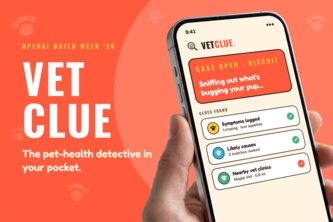
What the company appears to be: VetClue is an AI-powered assistant designed to help pet owners navigate veterinary care by identifying warning signs, researching clinics, preparing a clear patient brief, and facilitating AI-driven appointment scheduling. The project was submitted as part of the OpenAI 2026 hackathon.
What changed: The author describes VetClue as emerging from personal experience with their own pet’s health issue, aiming to reduce stress and improve decision-making for pet owners while also supporting veterinary clinics by automating parts of intake and scheduling processes.
The single most important open question: Is there evidence that either pet owners or veterinary clinics are actively seeking or adopting solutions like VetClue? The description states no revenue, customers, or traction data exist beyond the author's personal experience and hypothetical use cases.
What The Product Actually Is
- The description states that VetClue is an AI assistant for pet owners.
- It claims to check urgent warning signs, research nearby clinics, prepare a clear pet brief, and demonstrate AI appointment scheduling.
- The system uses technologies such as OpenAI, Retell-AI, Voice-AI, Cloud Functions, Firestore, Firebase, and React.
- It integrates with Google Calendar and supports phone-based interactions.
- The author describes it as designed to help users move from a frightening concern to the right clinic and a prepared next step.
Note: No evidence of actual product functionality or deployment is provided. The description is self-reported and unverified.
Positioning & Claim Evolution
- The author positions VetClue as an AI assistant that reduces stress for pet owners during veterinary emergencies.
- It aims to bridge the gap between pet owners and clinics by improving communication, research, and scheduling workflows.
- The project evolved from a personal experience with a blind cat named Neelix who had dental issues.
- The author links VetClue’s value proposition to broader industry trends identified in the AVMA report, although those findings are not directly tied to VetClue's performance.
Inference: The positioning appears to be focused on emotional relief for pet owners and operational efficiency for clinics. However, this is based on a single anecdote and self-reported claims.
Target Customer & ICP
- The primary customer is described as "worried pet owners" facing urgent health concerns.
- These users are said to be stressed about making decisions, researching clinics, and scheduling appointments.
- The author notes that many veterinary clinics still rely heavily on phone calls for scheduling, which creates friction for users with social anxiety.
- A secondary target is veterinary clinics looking to improve efficiency through automation before adding staff.
Not evidenced: No data on actual user segments, demographics, or customer personas beyond the author’s personal experience.
Business Model & Pricing Evidence
- The description does not mention any pricing model or monetization strategy.
- There is no indication of whether VetClue will be offered as a freemium service, subscription, or one-time purchase.
- No evidence of revenue streams, partnerships, or business structure beyond the author’s personal project.
Not evidenced: No information on how VetClue intends to generate value or charge users.
Technical & Delivery Signals
- The system is built using technologies including React, TypeScript, Firebase, OpenAI, Retell-AI, Voice-AI, Cloud Functions, and Google Calendar.
- It integrates with tools like Apify, DataforSEO, SERPAPI, and Firestore.
- The author mentions that VetClue works through phone systems and intake processes already used by clinics.
- The project was submitted to the OpenAI 2026 hackathon.
Not evidenced: No evidence of live deployment, API access, or technical architecture beyond the tools listed. No demonstration or working prototype is described.
Traction & Maturity Signals
- The description states that VetClue is a hackathon submission.
- There is no mention of any users, customers, or real-world usage.
- No data on adoption, retention, or engagement is provided.
- The author explicitly states that VetClue’s savings figures are illustrative planning models and not proven results.
Not evidenced: No traction, revenue, or user feedback available. The project remains conceptual.
Competitive Context
- The description does not name competitors or reference existing solutions in the veterinary tech space.
- It implies a gap in tools that assist pet owners with vet visits and clinic research.
- The author references the AVMA report to support claims about inefficiencies in clinics but does not compare VetClue to other platforms.
Not evidenced: No competitive analysis, market sizing, or benchmarking data is provided.
Open Questions & Risks
- The project is described as a hackathon submission with no evidence of product-market fit or real-world validation.
- The author’s personal experience is the only basis for claims about user needs and impact.
- There is no mention of regulatory compliance, data privacy, or safety considerations relevant to veterinary care.
- No evidence of team capability beyond one individual (Josh Burleson).
- The lack of revenue, customers, or traction raises questions about scalability or commercial viability.
Inference: The risk of misalignment between perceived need and actual demand is high due to absence of external validation.
Questions the description leaves open
- What specific user problems are you solving, and how do you know?
- Have you spoken with pet owners or veterinarians about VetClue’s utility?
- Are there any existing tools in the market that address similar needs?
- How will VetClue scale beyond a single developer's effort?
- What is your plan for data privacy and compliance in handling sensitive health information?
- Do you have any early adopters or pilot users who can validate your approach?
Overall Assessment
- The description indicates that VetClue is an early-stage idea, submitted to a hackathon.
- There is no evidence of traction, revenue, or customer validation.
- The author’s personal story forms the core of the positioning but lacks broader support or market validation.
Assessment: Not ready for investment or partnership. This is a concept with potential, but no demonstrated commercial viability or user demand exists in the provided description.
User Stories BotA demo video on every pull request
Get a demo video on every new feature
GitHub App that watches your pull requests and records a narrated, captioned demo.
Save time on demo prep and make informed decisions faster with a video walkthrough of every new feature.
Source
Submitted to the OpenAI 2026 hackathon on Devpost. Project home on Devpost. Back to the full gallery on Devpost.
This competitive analysis was produced by top-founders.com (opens in a new tab)
Generated by a language model from this project's public Devpost page — its tagline, the author's own write-up and any built-with tags listed there — as captured in August 2026. Short quotations are the author's words. It is an opinion on the idea as a business, not on the people behind it, and it reflects the description as published then. If the project has moved on, request a correction below. The analysis is not independent research and contains no verified traction, revenue or customer data.
An independent guide by KFG International LLC — not affiliated with, endorsed by, or connected to Devpost or OpenAI.