

Archive position — measured, not model output
0 likes on Devpost
2,263 of the 7,850 archived projects have more likes, and 5,587 share exactly 0 — so this project's #7,445 place in the like-ranked listing is a tie-break inside that group, not a ranking.
Projects (log scale)
Likes on Devpost. ▲ marks this project's group.
Show the figures
| Likes | Projects | Share of archive |
|---|---|---|
| 0 | 5,587 | 71.2% |
| 1 | 1,758 | 22.4% |
| 2 | 284 | 3.6% |
| 3–4 | 132 | 1.7% |
| 5–9 | 75 | 1.0% |
| 10+ | 14 | 0.2% |
 User Stories BotA demo video on every pull request
Get a demo video on every new feature
GitHub App that watches your pull requests and records a narrated, captioned demo.
Save time on demo prep and make informed decisions faster with a video walkthrough of every new feature.
Executive Summary
What the company appears to be
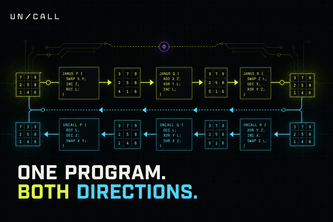
UNCALL is a browser-based implementation of a reversible programming language inspired by Janus86. The author states that it allows developers to write procedures once and execute them both forward (to encode) and backward (to decode or undo), with support for reversible algorithms, workflows, and quantum circuits.
What changed
The project began as an exploration into how reversible computation could simplify quantum programming but evolved toward a broader demonstration of how reverse execution can be derived from the same program semantics. It includes interactive demos in encryption, sorting, tree traversal, quantum circuits, and reversible arithmetic—all editable in the browser.
Single most important open question
Is there a practical use case for this approach beyond academic or experimental exploration? The author does not state any revenue, customers, or adoption data; traction is not evidenced. The project appears to be a prototype built by one developer with no external validation or commercial activity.
What The Product Actually Is
The description states that UNCALL is:
- A browser-based implementation of a Janus86-inspired reversible programming core.
- Capable of executing procedures in both directions (forward and backward).
- Supports reversible updates, swaps, conditionals, loops, arrays, recursion, and procedure calls.
- Includes a runtime for effectful workflows where operations are paired with forward and backward handlers.
- Designed to run entirely in the browser using TypeScript, Cloudflare Workers, and Hono.
The author also notes that UNCALL does not call a language model at runtime, and it is deterministic. It includes five interactive demos covering encryption/decryption, reversible sorting, tree traversal, quantum Fourier transform, and a four-bit reversible adder.
Inference The product appears to be an experimental programming environment rather than a production-ready tool or platform. The author emphasizes that the code displayed in the browser is executable code, not a simulation.
Positioning & Claim Evolution
The description states:
- UNCALL was originally motivated by quantum computing and uncomputation.
- It evolved to explore how reversible computation can simplify general software development tasks like cleanup, rollback, and workflow management.
- The author claims that reverse computation is derived from the semantics of the same program, not manually written.
- The system supports both pure Janus computation and effectful workflows with paired forward/backward handlers.
Inference The positioning shifted from a quantum-focused DSL to a general-purpose reversible programming model. However, there is no evidence of market traction or adoption beyond the author’s own implementation.
Target Customer & ICP
The description does not state:
- Who the intended users are.
- Whether any specific customer segments were targeted.
- If there are existing customers or user groups.
Not evidenced No information on target personas, buyer personas, or customer types is provided.
Business Model & Pricing Evidence
The description states:
- UNCALL is a browser-based tool with no mention of monetization.
- The author built it for exploration and demonstration purposes.
- There are no pricing models, subscriptions, or commercial offerings described.
Not evidenced No business model or pricing information is provided. Revenue streams, if any, are not mentioned.
Technical & Delivery Signals
The description states:
- Built using TypeScript, Cloudflare Workers, Hono, and esbuild.
- Runs entirely in the browser without server-side sessions.
- Implements a full pipeline including tokenization, parsing, static checking, name resolution, and execution.
- Supports reversible updates, swaps, conditionals, loops, arrays, recursion, and forward references.
- Uses a separate runtime for effectful workflows with receipts and cleanup logic.
- Quantum demos use state-vector simulation or computational-basis gates.
Inference The technical stack suggests a lightweight, frontend-heavy implementation. The author claims to have passed 81 automated tests, including exhaustive verification of all 256 four-bit adder inputs.
Traction & Maturity Signals
The description states:
- The project was submitted to the OpenAI 2026 hackathon.
- It includes five interactive demos that run in the browser.
- The author implemented a full reversible language core from scratch.
- The project is self-contained and deterministic.
Not evidenced There is no evidence of user adoption, customer feedback, revenue, ARR, or any form of traction beyond the author’s own development effort. No metrics or usage data are provided.
Competitive Context
The description does not state:
- Who the competitors are.
- Whether similar tools exist in the market.
- How UNCALL differentiates from existing reversible programming systems or quantum DSLs.
Not evidenced No competitive analysis or market positioning is described.
Open Questions & Risks
The description states:
- The author built the entire system alone.
- It is a prototype, not a commercial product.
- Reversible programming requires constraints and trade-offs (e.g., information loss prevention).
- The runtime derives inverse control flow but cannot make every external effect perfectly reversible.
Inference
- Risk of limited scalability or adoption due to niche use case.
- Lack of team or institutional support may hinder long-term development.
- The author acknowledges that the system does not solve all reversibility problems, which could limit its perceived utility.
Questions the description leaves open
- What specific real-world workflows or domains do you believe would benefit from derived inverse control flow?
- Have you identified any early adopters or use cases beyond the demos?
- How do you plan to integrate UNCALL into existing TypeScript applications?
- Are there any known limitations in how well reversible programming scales to larger systems?
- What are your thoughts on the trade-offs between reversibility guarantees and implementation complexity?
Overall Assessment
The description states:
- UNCALL is a prototype built by one developer.
- It has no commercial traction or revenue.
- The author intends to improve integration with TypeScript and explore practical use cases.
Not evidenced There is no evidence of a viable business model, customer base, or commercial readiness. The project appears experimental and exploratory in nature.
Inference This is an early-stage idea with potential for future development but currently lacks the signals required to support investment or partnership decisions. It may be suitable for incubation or proof-of-concept funding, but not for immediate commercial engagement.
User Stories BotA demo video on every pull request
Get a demo video on every new feature
GitHub App that watches your pull requests and records a narrated, captioned demo.
Save time on demo prep and make informed decisions faster with a video walkthrough of every new feature.
Source
Submitted to the OpenAI 2026 hackathon on Devpost. Project home on Devpost. Back to the full gallery on Devpost.
This competitive analysis was produced by top-founders.com (opens in a new tab)
Generated by a language model from this project's public Devpost page — its tagline, the author's own write-up and any built-with tags listed there — as captured in August 2026. Short quotations are the author's words. It is an opinion on the idea as a business, not on the people behind it, and it reflects the description as published then. If the project has moved on, request a correction below. The analysis is not independent research and contains no verified traction, revenue or customer data.
An independent guide by KFG International LLC — not affiliated with, endorsed by, or connected to Devpost or OpenAI.