

Archive position — measured, not model output
0 likes on Devpost
2,263 of the 7,850 archived projects have more likes, and 5,587 share exactly 0 — so this project's #7,338 place in the like-ranked listing is a tie-break inside that group, not a ranking.
Projects (log scale)
Likes on Devpost. ▲ marks this project's group.
Show the figures
| Likes | Projects | Share of archive |
|---|---|---|
| 0 | 5,587 | 71.2% |
| 1 | 1,758 | 22.4% |
| 2 | 284 | 3.6% |
| 3–4 | 132 | 1.7% |
| 5–9 | 75 | 1.0% |
| 10+ | 14 | 0.2% |
 User Stories BotA demo video on every pull request
Get a demo video on every new feature
GitHub App that watches your pull requests and records a narrated, captioned demo.
Save time on demo prep and make informed decisions faster with a video walkthrough of every new feature.
Executive Summary
What the company appears to be
The author describes trace2test as a tool that converts AI agent execution traces into deterministic regression tests, using GPT-5.6 for diagnostics and verification. It supports offline replay, sandboxed fix validation, and integrates with CI via GitHub Actions.
What changed
This is a self-reported project submitted to the OpenAI 2026 hackathon. The author states they built it in one primary Codex CLI thread using GPT-5.6, iterating on real failures to produce a working product loop. It includes a CLI, dashboard UI, GitHub Action integration, and automated tests.
Single most important open question
Is there any evidence of actual usage or adoption beyond the author's own development and testing? The description does not indicate whether trace2test has been used by teams outside the author’s own workflow.
What The Product Actually Is
The description states that trace2test is a developer tool for AI agents. It provides a complete workflow including:
- Importing traces from OpenAI Agents SDK or generic JSONL.
- Generating editable, schema-validated YAML regression suites using GPT-5.6.
- Running deterministic replays offline to check tool order, arguments, outputs, and safety policies.
- Diagnosing failures with GPT-5.6 to explain root causes and propose patches.
- Applying fixes in a sandboxed environment before verifying them.
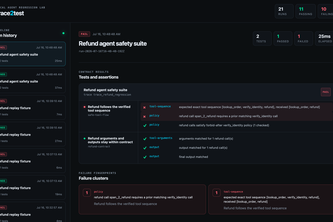
- Offering a UI for run history, assertion details, trace diffs, and diagnosis views.
- Integrating into CI via GitHub Actions.
The tool is built using Node.js, React, TypeScript, Vite, Vitest, Zod, and integrates with OpenAI APIs or Codex CLI. It supports multiple output formats (terminal, JSON, JUnit, Markdown) and can be deployed as a static GitHub Pages snapshot.
Evidence
- Author’s own write-up.
- Technology stack listed: ai-agents, cli, codex, devops, github-actions, gpt-5.6, node.js, openai, react, testing, typescript, vite, vitest, zod.
Inference The tool is designed for developers working with AI agents who need to ensure behavioral consistency and detect subtle regressions in agent behavior.
Positioning & Claim Evolution
The author positions trace2test as a solution for the problem that AI agents do not fail like traditional software — small changes can silently alter which tools are called, in what order, or under what conditions. The tool turns passive observability data (traces) into executable behavioral contracts.
Key claims:
- It normalizes traces from OpenAI Agents SDK or JSONL.
- It uses GPT-5.6 to generate and diagnose tests.
- It enables deterministic offline replay and sandboxed fix verification.
- It integrates with CI via GitHub Actions.
- It provides a UI for inspection and debugging.
Evidence
- The author’s own write-up.
- The tagline: “Turn AI agent traces into deterministic regression tests, diagnose failures with GPT-5.6, and verify fixes in a sandbox before CI lets them ship.”
Inference The positioning reflects an attempt to solve a specific gap in testing AI agents — where conventional unit tests are insufficient due to the probabilistic nature of LLM-based systems.
Target Customer & ICP
The author does not explicitly define target customers or personas. However, based on the product’s functionality and use case, it appears aimed at developers working with AI agents, particularly those using OpenAI’s agent framework or similar tools.
Evidence
- The tool is built for developers integrating AI agents into workflows.
- It uses OpenAI SDKs and Codex CLI.
- It supports GitHub Actions and CI pipelines.
Inference The ICP likely includes teams building or maintaining AI agents that require robust testing, particularly in production environments where agent behavior must be stable and predictable.
Business Model & Pricing Evidence
There is no evidence of a business model or pricing structure. The author describes the tool as open-source (MIT-licensed), with public repositories, documentation, and build logs available.
Evidence
- Public MIT-licensed repository.
- Source code and documentation are publicly accessible.
- No mention of monetization or paid features.
Inference The project appears to be a developer tool built for personal or internal use, possibly intended as a proof-of-concept or open-source contribution. There is no indication of commercial intent or revenue generation at this stage.
Technical & Delivery Signals
The author reports that the tool was developed using one primary OpenAI Codex CLI thread running GPT-5.6. It includes:
- A monorepo scaffold.
- Trace schemas and normalizers.
- Assertion engine.
- CLI workflows.
- Dashboard UI.
- GitHub Action integration.
- Automated tests (86 green).
- Static deployment via GitHub Pages.
The tool handles structured output validation, retries for schema mismatches, and sandboxed fix verification.
Evidence
- Author’s own write-up.
- Technology tags: ai-agents, cli, codex, devops, github-actions, gpt-5.6, node.js, openai, react, testing, typescript, vite, vitest, zod.
Inference The tool shows technical maturity for a hackathon project, with clear architecture and integration points. However, it lacks independent validation or third-party adoption.
Traction & Maturity Signals
There is no evidence of traction beyond the author’s own development and testing. The project includes:
- A public GitHub repository.
- Sample data and build logs.
- An interactive dashboard deployed via GitHub Pages.
- 86 automated tests passing.
No mention of users, customers, or real-world deployment.
Evidence
- Public repository and documentation.
- Build log and sample data included.
- No references to usage beyond the author’s own workflow.
Inference The project is at a prototype or early-stage development stage. It lacks evidence of adoption or market traction.
Competitive Context
The description does not mention competitors or similar tools. The author focuses on solving a niche problem in AI agent testing, where conventional unit tests are inadequate.
Evidence
- No competitor references.
- Focus is on deterministic testing for AI agents using LLMs.
Inference This tool addresses a gap in current AI agent testing practices, but there is no indication of existing tools or platforms solving the same problem. The author may be pioneering this space.
Open Questions & Risks
- No commercial traction or adoption: The project appears to be a personal or internal development with no evidence of external use.
- Unverified claims about GPT-5.6 performance: The tool relies heavily on GPT-5.6, but there is no independent validation of its accuracy or reliability in diagnostics or test generation.
- Limited scalability assumptions: The tool is built for a single developer and may not scale to enterprise-level use cases.
- No monetization strategy: As an open-source project, it does not appear to have a path to revenue or commercial viability.
Evidence
- No customer data, usage metrics, or revenue.
- No indication of team size beyond one person.
- Open-source and self-hosted.
Questions the description leaves open
- What is the actual use case for this tool in a real-world AI agent workflow?
- Have you tested it with multiple agents or only with the example provided?
- How does the tool handle edge cases or failures in GPT-5.6’s output that are not covered by your current validation logic?
- What is the long-term vision for trace2test beyond this hackathon project?
- Are there any plans to support other LLM providers or frameworks beyond OpenAI and Codex?
Overall Assessment
There is no evidence of a commercial product, traction, or revenue. The tool is described as a hackathon submission with an open-source implementation. It shows technical capability but lacks signs of market readiness or scalability.
Evidence
- Self-reported project description.
- No third-party validation.
- No customer data or usage metrics.
Inference This is a developer tool in early development, likely intended for internal use or as a proof-of-concept. It does not appear to be a viable investment or partnership opportunity at this time.
User Stories BotA demo video on every pull request
Get a demo video on every new feature
GitHub App that watches your pull requests and records a narrated, captioned demo.
Save time on demo prep and make informed decisions faster with a video walkthrough of every new feature.
Source
Submitted to the OpenAI 2026 hackathon on Devpost. Project home on Devpost. Back to the full gallery on Devpost.
This competitive analysis was produced by top-founders.com (opens in a new tab)
Generated by a language model from this project's public Devpost page — its tagline, the author's own write-up and any built-with tags listed there — as captured in August 2026. Short quotations are the author's words. It is an opinion on the idea as a business, not on the people behind it, and it reflects the description as published then. If the project has moved on, request a correction below. The analysis is not independent research and contains no verified traction, revenue or customer data.
An independent guide by KFG International LLC — not affiliated with, endorsed by, or connected to Devpost or OpenAI.