

Archive position — measured, not model output
3 likes on Devpost
128 of the 7,850 archived projects have more likes, and 93 share exactly 3 — so this project's #141 place in the like-ranked listing is a tie-break inside that group, not a ranking.
Projects (log scale)
Likes on Devpost. ▲ marks this project's group.
Show the figures
| Likes | Projects | Share of archive |
|---|---|---|
| 0 | 5,587 | 71.2% |
| 1 | 1,758 | 22.4% |
| 2 | 284 | 3.6% |
| 3–4 | 132 | 1.7% |
| 5–9 | 75 | 1.0% |
| 10+ | 14 | 0.2% |
 User Stories BotA demo video on every pull request
Get a demo video on every new feature
GitHub App that watches your pull requests and records a narrated, captioned demo.
Save time on demo prep and make informed decisions faster with a video walkthrough of every new feature.
Executive Summary
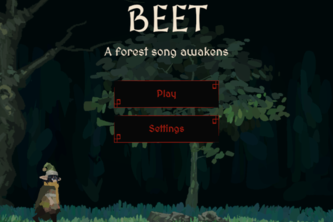
The description states that BEET is an indie game combining 2D combat, 2.5D isometric gardening, and music composition. The author claims it blends hand-drawn art, custom theme music, and narrative elements to create a world where players restore balance by cultivating magical plants that generate custom composed music. It was built as part of a hackathon using Unity, OpenAI's Codex, and other tools. No evidence of revenue, customers, or traction is provided.
The single most important open question is: What is the commercial viability of this concept, and how does it differ from existing games in the space?
What The Product Actually Is
The description states that BEET is an indie game that combines:
- 2D combat
- 2.5D isometric gardening
- Music composition elements
It involves players exploring a world affected by "silence," discovering story elements, and cultivating magical plants that generate unique musical stems and beats. The game uses hand-drawn sprites, custom theme music, and integrates audio-systems with Unity.
Positioning & Claim Evolution
The description states that BEET was inspired by the intersection of nature, art, and audio to create a game where players piece together parts of a fragmented song to restore balance to the world. It blends hand-drawn art, custom music, and narrative elements into a unique experience. The author claims this approach brings the game to life in a "really unique way" and that watching musical compositions build up as the player progresses is a "highly rewarding experience."
Target Customer & ICP
Not evidenced. The description does not state who the target customer or ideal customer profile (ICP) is.
Business Model & Pricing Evidence
Not evidenced. The description does not state anything about business model, pricing, monetization strategy, or revenue streams.
Technical & Delivery Signals
The description states that BEET was built using:
- Unity
- OpenAI's Codex for writing foundational C# scripts and GUI elements
- Cubase and GarageBand for music composition
- Procrate and VSCode for development
- Hand-drawn sprites for gameplay elements including enemies, environment, garden hub, and player models
The team claims to have overcome challenges in balancing dual gameplay loops and integrating Codex-generated code with Unity's audio managers.
Traction & Maturity Signals
Not evidenced. The description does not provide any evidence of traction, revenue, customers, or adoption beyond the fact that it was submitted as a hackathon project.
Competitive Context
Not evidenced. The description does not mention competitors or how BEET compares to existing games in similar spaces.
Open Questions & Risks
- The project is described as a hackathon submission with no evidence of commercial traction or market validation.
- No information on monetization strategy, pricing, or business model.
- No evidence of target customer or market demand.
- The description is self-reported and unverified; there is no independent corroboration of claims made.
Questions the description leaves open
- What specific market need does BEET address that existing games do not?
- How did you identify your target customer, and what evidence supports their interest in this product?
- What is your monetization strategy, and how will you generate revenue from this game?
- Have you conducted any user testing or market research to validate demand for this concept?
- What are the key differentiators of BEET compared to existing games in the genre?
Overall Assessment
Not evidenced. The description does not provide sufficient information to assess investment or partnership potential, including financials, traction, competitive positioning, or scalability. The project appears to be a hackathon submission with no evidence of commercial viability or market validation.
User Stories BotA demo video on every pull request
Get a demo video on every new feature
GitHub App that watches your pull requests and records a narrated, captioned demo.
Save time on demo prep and make informed decisions faster with a video walkthrough of every new feature.
Source
Submitted to the OpenAI 2026 hackathon on Devpost. Project home on Devpost. Back to the full gallery on Devpost.
This competitive analysis was produced by top-founders.com (opens in a new tab)
Generated by a language model from this project's public Devpost page — its tagline, the author's own write-up and any built-with tags listed there — as captured in August 2026. Short quotations are the author's words. It is an opinion on the idea as a business, not on the people behind it, and it reflects the description as published then. If the project has moved on, request a correction below. The analysis is not independent research and contains no verified traction, revenue or customer data.
An independent guide by KFG International LLC — not affiliated with, endorsed by, or connected to Devpost or OpenAI.