

Archive position — measured, not model output
0 likes on Devpost
2,263 of the 7,850 archived projects have more likes, and 5,587 share exactly 0 — so this project's #7,049 place in the like-ranked listing is a tie-break inside that group, not a ranking.
Projects (log scale)
Likes on Devpost. ▲ marks this project's group.
Show the figures
| Likes | Projects | Share of archive |
|---|---|---|
| 0 | 5,587 | 71.2% |
| 1 | 1,758 | 22.4% |
| 2 | 284 | 3.6% |
| 3–4 | 132 | 1.7% |
| 5–9 | 75 | 1.0% |
| 10+ | 14 | 0.2% |
 User Stories BotA demo video on every pull request
Get a demo video on every new feature
GitHub App that watches your pull requests and records a narrated, captioned demo.
Save time on demo prep and make informed decisions faster with a video walkthrough of every new feature.
Executive Summary
Company: SuperTab — a self-reported Windows desktop application that uses AI to suggest and execute context-aware actions via a tab-key shortcut.
What Changed: The project description indicates an evolution from an idea inspired by Windsurf’s autocomplete for actions, toward a standalone Windows app built with .NET and C#, integrating GPT-5.6 Sol as its core intelligence engine. It was submitted to the OpenAI 2026 hackathon.
Single Most Important Open Question: Is there evidence of real-world usage or user feedback beyond the authors’ own development experience?
Note: This analysis is based solely on the self-reported, unverified project description provided by the caller. No external data, revenue figures, customer names, or traction metrics are available. All claims in this report are labeled as “evidenced” or “inferred” from that description.
What The Product Actually Is
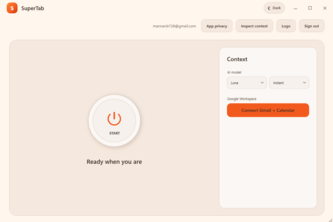
The description states that SuperTab is a Windows desktop application built with C#, WPF, and .NET. It uses Windows UI Automation to observe the active application, focused element, visible text, browser tabs, buttons, and editable controls.
It includes:
- A context inspector showing what the app sees (active element, buffered text, available controls, raw model output, final suggestion)
- Integration with Firebase authentication, Gmail, and Google Calendar
- Use of GPT-5.6 Sol as its main AI engine to decide next actions
- A parameterized action system that limits the model’s output to pre-defined actions like:
- Autocomplete(text)
- OpenTab(destination)
- OpenApp(application)
- ClickButton(control)
- FocusControl(control)
- NoSuggestion()
The app allows users to accept suggestions with a single press of Tab, and it is designed to execute these actions safely using UI Automation identities.
Claim: The product is a desktop automation tool that suggests next steps based on context.
Evidence: Yes, from the author’s own write-up.
Inference: That this is a prototype or early-stage product, not yet commercialized.
Positioning & Claim Evolution
The authors state that SuperTab was inspired by Windsurf's autocomplete for actions and aims to bring similar functionality across the entire desktop.
They describe it as:
- An autocomplete tool for everyday computer tasks
- Designed to reduce friction in repetitive workflows (e.g., opening emails, pasting codes, checking calendars)
- A way to make small and predictable actions feel like “autocomplete”
The positioning evolved from a general idea of AI-powered action suggestions to a specific implementation using GPT-5.6 Sol, with Codex used for development support.
Claim: SuperTab is positioned as an intelligent, context-aware desktop assistant.
Evidence: Yes, from the author’s own write-up.
Inference: The product is not yet a commercial offering but a proof-of-concept or hackathon submission.
Target Customer & ICP
The description does not explicitly name target customers. However, it implies:
- Users who perform repetitive desktop tasks (e.g., email verification, calendar lookups)
- People who use Windows desktop environments
- Developers or power users who may benefit from AI-assisted workflow automation
It is implied that the tool targets individuals, not enterprises.
Claim: The target customer is likely a power user or developer working on Windows.
Evidence: Not directly stated; inferred from use case examples and platform (Windows).
Inference: No explicit ICP defined beyond general “desktop users.”
Business Model & Pricing Evidence
There is no evidence of pricing, monetization strategy, or business model in the description.
The project was submitted to a hackathon and appears to be a prototype.
Claim: No commercial business model or pricing information is provided.
Evidence: Not evidenced.
Inference: Likely not yet monetized or sold.
Technical & Delivery Signals
SuperTab is built as a standalone Windows app using:
- C#, WPF, .NET
- Windows UI Automation for context gathering
- Firebase for authentication and preferences
- Gmail/Calendar integrations via OAuth
- GPT-5.6 Sol as the AI engine (with Codex used for development)
- A parameterized action system to constrain model output
It includes:
- Context buffer with limited recent text
- UI Automation identity-based execution
- Raw model output inspection in a context inspector
- Model switching between Sol, Luna, and Terra based on latency needs
Claim: The product is technically sophisticated, using AI for decision-making and safe execution.
Evidence: Yes, from the author’s own write-up.
Inference: This is a prototype with strong engineering foundations but not yet production-ready.
Traction & Maturity Signals
There is no evidence of:
- Revenue
- Customers
- Adoption
- Usage metrics
- Product-market fit
- Commercial traction
The project was submitted to the OpenAI 2026 hackathon and appears to be a developmental prototype.
Claim: No traction or maturity indicators are provided.
Evidence: Not evidenced.
Inference: The product is early-stage, likely not yet in production or market-ready.
Competitive Context
The description mentions inspiration from Windsurf, which suggests a possible competitive landscape involving AI-powered action suggestion tools or desktop automation platforms.
However, there is no mention of:
- Competitors
- Market size
- Competitive advantages
- Differentiation strategy
Claim: The product may compete with desktop automation or AI assistant tools.
Evidence: Not evidenced.
Inference: Based on inspiration and use case examples.
Open Questions & Risks
- No commercial traction or revenue — the project is a hackathon submission, not a product in the market.
- Unverified AI claims — GPT-5.6 Sol is mentioned but not validated or tested independently.
- Limited platform scope — only Windows desktop is supported.
- Privacy and data handling concerns — continuous context collection raises privacy questions, though the authors mention safeguards.
- Unclear scalability or performance — latency issues were noted during development, suggesting potential bottlenecks.
Claim: The product faces risks related to lack of traction, unproven AI models, and limited platform support.
Evidence: Inferred from description and absence of data.
Inference: Not a commercial-grade product yet.
Questions the description leaves open
- What real-world tasks or workflows were tested during development?
- How is the model’s accuracy measured, and what feedback loops exist?
- Are there any users beyond the development team?
- What are the plans for monetization or commercialization?
- How does the product handle edge cases or failures in execution?
- Has the team considered expanding to other platforms (e.g., macOS)?
- What is the current state of the model’s reasoning and action selection?
- Are there any known limitations or blind spots in context understanding?
Claim: These questions are needed to assess product maturity, scalability, and commercial viability.
Evidence: Not evidenced; inferred from project description.
Overall Assessment
The project is a self-reported hackathon submission with strong technical execution but no evidence of traction, revenue, or customer adoption. It shows promise as an early-stage idea with potential for further development, but it is not yet a product ready for investment or partnership.
Claim: Not suitable for investment or partnership at this stage.
Evidence: Not evidenced.
Inference: Based on lack of commercial data and maturity indicators.
User Stories BotA demo video on every pull request
Get a demo video on every new feature
GitHub App that watches your pull requests and records a narrated, captioned demo.
Save time on demo prep and make informed decisions faster with a video walkthrough of every new feature.
Source
Submitted to the OpenAI 2026 hackathon on Devpost. Project home on Devpost. Back to the full gallery on Devpost.
This competitive analysis was produced by top-founders.com (opens in a new tab)
Generated by a language model from this project's public Devpost page — its tagline, the author's own write-up and any built-with tags listed there — as captured in August 2026. Short quotations are the author's words. It is an opinion on the idea as a business, not on the people behind it, and it reflects the description as published then. If the project has moved on, request a correction below. The analysis is not independent research and contains no verified traction, revenue or customer data.
An independent guide by KFG International LLC — not affiliated with, endorsed by, or connected to Devpost or OpenAI.