

Archive position — measured, not model output
0 likes on Devpost
2,263 of the 7,850 archived projects have more likes, and 5,587 share exactly 0 — so this project's #7,046 place in the like-ranked listing is a tie-break inside that group, not a ranking.
Projects (log scale)
Likes on Devpost. ▲ marks this project's group.
Show the figures
| Likes | Projects | Share of archive |
|---|---|---|
| 0 | 5,587 | 71.2% |
| 1 | 1,758 | 22.4% |
| 2 | 284 | 3.6% |
| 3–4 | 132 | 1.7% |
| 5–9 | 75 | 1.0% |
| 10+ | 14 | 0.2% |
 User Stories BotA demo video on every pull request
Get a demo video on every new feature
GitHub App that watches your pull requests and records a narrated, captioned demo.
Save time on demo prep and make informed decisions faster with a video walkthrough of every new feature.
Executive Summary
What the company appears to be
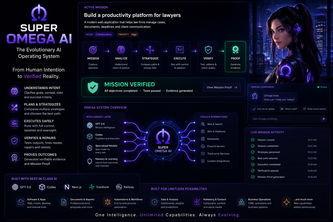
SUPER OMEGA AI is described by its author as a solo-founder project that aims to build an "evolutionary intelligence operating system" designed to understand human goals, coordinate appropriate AI tools and intelligence, execute missions with controlled authority, verify outcomes, and generate persistent evidence of completion. It is positioned not as another chatbot or coding agent but as an intelligence layer above existing tools.
What changed
The author states that this project was conceived and built during OpenAI Build Week by a single founder (Gelio Ancos). The current beta demonstrates the first functional foundation of a larger vision, including a six-stage mission lifecycle: Mission → Analysis → Route → Runtime → Verification → Proof. It focuses on software generation as a proof environment but is intended to support many forms of verifiable work.
The single most important open question
Is there evidence that this system can reliably distinguish between execution that merely "ran" and execution that was actually "verified"? The description claims this distinction is fundamental, yet no data or demonstration of verification in practice is provided beyond the author's own account.
What The Product Actually Is
The description states that SUPER OMEGA AI is an evolutionary decision and execution operating system. It transforms open-ended human objectives into controlled, observable, and verifiable missions using a six-stage lifecycle:
- Mission – captures objective, collaboration mode, context, constraints.
- Analysis – interprets intent, risk, uncertainty, requirements, success criteria.
- Route – compares Conservative, Recommended, and Ambitious execution strategies.
- Runtime – records plan, authority state, execution context, progress.
- Verification – evaluates real artifacts, detects failures, performs bounded repair, retests.
- Proof – generates persistent evidence showing what was created, checked, repaired, and verified.
The system is built to understand complete missions and decide how various AI capabilities (e.g., GPT-5.6, Codex) should work together, without replacing every AI product but coordinating them around a single human objective.
It is described as not being fundamentally a coding product, although software generation is the first proof environment for its general architecture.
Evidence
- Author’s own write-up.
- Technology stack: Next.js 15, TypeScript, React, Supabase, PostgreSQL, Railway.
- Architecture separates intelligence from execution, verification from completion, etc.
Inference The system appears to be a conceptual framework or prototype for managing AI-driven workflows with emphasis on accountability and evidence-based outcomes.
Positioning & Claim Evolution
The author states that SUPER OMEGA AI was not built to be another chatbot, coding agent, or application generator. Instead, it is positioned as an intelligence layer above existing tools, aiming to coordinate capabilities while preserving human authority.
Key claims include:
- AI should continue until the mission has been verified.
- The system distinguishes between work that merely ran and work that was actually verified.
- It does not consider a mission complete just because an AI produced an answer — only when evidence supports the outcome.
- Future vision includes becoming a proactive strategic companion rather than a passive system waiting for instructions.
Evidence
- Self-reported claims in project write-up.
- Emphasis on “controlled execution,” “authority boundaries,” and “verification philosophy.”
Inference The positioning reflects an attempt to differentiate from current AI tools by focusing on trustworthiness, control, and verifiability. However, the lack of external validation or traction makes it unclear whether this approach is viable in practice.
Target Customer & ICP
The description does not explicitly define a target customer or ideal customer profile (ICP). It implies that the system could be used across multiple domains including:
- Websites and software applications;
- Mobile and internal business tools;
- Documents, reports, and presentations;
- Research, analysis, and decision support;
- Marketing campaigns and content systems;
- Automations and operational workflows;
- Dashboards, databases, and business platforms.
However, the current beta focuses on software generation as a proof environment.
Evidence
- Author’s own write-up.
- Mention of “first proof environment for a general architecture intended to support many forms of verifiable work.”
Inference While the system is described as broadly applicable, its initial focus and functionality suggest it may appeal primarily to developers or technical users who are looking for more structured, accountable AI workflows.
Business Model & Pricing Evidence
No information about business model or pricing is provided in the description. The author does not mention any monetization strategy, subscription plans, licensing, or revenue streams.
Evidence
- Not evidenced.
Inference There is no indication of how this would be sold or whether it will ever become a commercial product.
Technical & Delivery Signals
The system was built solo during OpenAI Build Week using:
- GPT-5.6 for mission-intelligence layer
- Codex for implementation, debugging, testing, integration
- Next.js 15, TypeScript, React, Supabase, PostgreSQL, Railway
It includes features such as:
- Persistent projects and missions
- Controlled execution workspaces
- Structured runtime records
- Deterministic verification rules
- Bounded repair and retesting
- Evidence repositories
- Mission Proof generation
The architecture intentionally separates intelligence from execution, execution from verification, etc., to avoid blind trust in outputs.
Evidence
- Author’s own write-up.
- Technology tags: chatgpt, codex, gpt-5.6, next.js, openai, railway, react, supabase, typescript
Inference The technical implementation shows a clear architectural intent to manage complexity and ensure accountability through separation of concerns. However, no production performance data or scalability metrics are shared.
Traction & Maturity Signals
There is no evidence of traction, revenue, customers, or adoption beyond the author’s own account.
The project is described as:
- A functional beta built during a single hackathon event
- The first working proof of a much larger architecture
- Conceived and directed by one founder
No mention of user feedback, usage statistics, or product-market fit indicators.
Evidence
- Author’s own write-up.
- No external validation or metrics.
Inference This is an early-stage prototype with no demonstrated traction. The maturity level is low, and it remains unclear whether the system has moved beyond experimental phase.
Competitive Context
The description does not provide any information about competitors or competitive positioning. It does not reference existing platforms like AutoGen, LangChain, LlamaIndex, or other AI orchestration tools.
Evidence
- Not evidenced.
Inference Without knowledge of the competitive landscape, it is impossible to assess how SUPER OMEGA AI compares in terms of features, capabilities, or differentiation.
Open Questions & Risks
Several risks and open questions are evident from the description:
- Single-founder dependency: The entire project was built by one person — raising concerns about scalability, long-term maintenance, and team structure.
- Unverified claims: All assertions about functionality, verification, and outcomes are self-reported without independent corroboration.
- Lack of traction or validation: No evidence of users, customers, or real-world application beyond the author’s own experience.
- Unclear commercial viability: No mention of monetization strategy or business model.
- Technical complexity vs. execution: The architecture is complex and ambitious, but there is no demonstration of how it scales or performs under pressure.
- No external testing or feedback loops: The system lacks any form of third-party validation or user input.
Evidence
- Author’s own write-up.
- Lack of external data or references.
Inference This project appears to be a visionary prototype rather than a mature product, with significant risk in terms of execution, scalability, and commercialization.
Questions the description leaves open
- How does the system actually distinguish between execution that “ran” and execution that was “verified”? Can you show examples?
- What specific mechanisms are in place to prevent false positives or silent failures during verification?
- Is there any mechanism for learning from past missions, and how is that implemented?
- What is your plan for scaling beyond a solo founder? How will the system evolve with more contributors?
- Are there any plans to integrate external APIs, databases, or services into the current architecture?
- What are the key assumptions behind the “controlled execution” model, and how do you test those assumptions?
- How does the system handle situations where the user’s intent is ambiguous or incomplete?
- Has anyone else tested or reviewed the verification logic? What kind of feedback have you received?
Overall Assessment
Confidence Level Low
Assessment This is a conceptual prototype with strong conceptual foundations and ambitious goals, but no demonstrated traction, revenue, or customer validation. It represents an early-stage idea that may evolve into something significant, but currently lacks the evidence needed to assess commercial viability or strategic fit.
The author’s claims about accountability, verification, and controlled execution are compelling in theory, but they remain unproven in practice. There is no indication of a business model, user base, or product-market alignment beyond the author’s own vision.
Recommendation
Proceed with caution. If this project is to be considered for investment or partnership, further due diligence is required to validate:
- The actual performance and reliability of the verification mechanisms
- The scalability of the architecture
- The founder’s ability to scale beyond solo development
- Market demand and competitive positioning
Until such evidence emerges, this remains a highly speculative concept with low commercial readiness.
User Stories BotA demo video on every pull request
Get a demo video on every new feature
GitHub App that watches your pull requests and records a narrated, captioned demo.
Save time on demo prep and make informed decisions faster with a video walkthrough of every new feature.
Source
Submitted to the OpenAI 2026 hackathon on Devpost. Project home on Devpost. Back to the full gallery on Devpost.
This competitive analysis was produced by top-founders.com (opens in a new tab)
Generated by a language model from this project's public Devpost page — its tagline, the author's own write-up and any built-with tags listed there — as captured in August 2026. Short quotations are the author's words. It is an opinion on the idea as a business, not on the people behind it, and it reflects the description as published then. If the project has moved on, request a correction below. The analysis is not independent research and contains no verified traction, revenue or customer data.
An independent guide by KFG International LLC — not affiliated with, endorsed by, or connected to Devpost or OpenAI.