

Archive position — measured, not model output
1 like on Devpost
505 of the 7,850 archived projects have more likes, and 1,758 share exactly 1 — so this project's #1,506 place in the like-ranked listing is a tie-break inside that group, not a ranking.
Projects (log scale)
Likes on Devpost. ▲ marks this project's group.
Show the figures
| Likes | Projects | Share of archive |
|---|---|---|
| 0 | 5,587 | 71.2% |
| 1 | 1,758 | 22.4% |
| 2 | 284 | 3.6% |
| 3–4 | 132 | 1.7% |
| 5–9 | 75 | 1.0% |
| 10+ | 14 | 0.2% |
 User Stories BotA demo video on every pull request
Get a demo video on every new feature
GitHub App that watches your pull requests and records a narrated, captioned demo.
Save time on demo prep and make informed decisions faster with a video walkthrough of every new feature.
Executive Summary
What the company appears to be
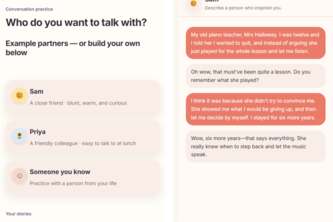
The description states that MyTurn is a tool designed to help users practice speaking by having conversations with AI versions of real people from their lives. The author describes it as a product for language learners, built using AI and conversational interfaces.
What changed
The project was submitted to an OpenAI hackathon, indicating a focus on rapid prototyping and experimentation with AI tools like GPT-5.6 and Codex. It is not clear whether this represents a pivot from an earlier idea or the initial version of a product.
Single most important open question
Is there any evidence of user engagement, feedback loops, or traction beyond the author’s own use case? The description provides no data on adoption, retention, monetization, or even the number of users who have interacted with the system.
What The Product Actually Is
The description states that MyTurn allows users to describe a real person from their life and then engage in a spoken conversation with an AI version of that person. It does not grade the user but instead shows how the story shaped, what phrases worked, and provides a saved "story card." The AI is described as being trained to respond naturally, with repair mechanisms rather than interrogation.
- Product function: To simulate conversational interaction with AI characters based on real-life relationships.
- User interaction model: Spoken conversation via browser-based speech API; feedback provided in text form.
- Technology stack: Next.js, TypeScript, Tailwind, deployed on Vercel; GPT-5.6 for conversations and feedback; Codex for development.
Note: The description does not state whether the AI character is customizable or if users can edit or refine their story cards after a conversation.
Positioning & Claim Evolution
The author positions MyTurn as a tool for language learners who struggle with speaking due to perfectionism. It claims to help users overcome hesitation by allowing them to practice in a safe, non-judgmental environment.
- Core claim: "Stop waiting and start speaking" — encouraging participation over perfection.
- Evolution of positioning: The project started as a personal solution for the author’s own language learning challenges and evolved into a tool that could help others with similar issues.
- Narrative shift: From individual improvement to building a system where people can return to conversations with AI versions of real individuals.
Inference: The product may be positioned more broadly in the future as a conversational AI platform for storytelling, education, or therapy — but this is not yet evidenced.
Target Customer & ICP
The description states that MyTurn was built for someone who studies how we learn language and experiences hesitation in group conversations. It targets individuals who want to improve their speaking fluency through practice.
- Primary persona: Language learners (especially those with low confidence or perfectionist tendencies).
- Secondary use case: People looking to rehearse difficult conversations (e.g., interviews, exams).
Not evidenced: No data on specific demographics, geographic reach, or user segmentation.
Business Model & Pricing Evidence
There is no evidence of pricing structure, monetization strategy, or business model in the description.
- Monetization: Not stated.
- Pricing: Not stated.
- Revenue streams: Not stated.
Inference: If this were to scale, it might involve subscription models or premium features for advanced storytelling or character customization — but no such evidence exists.
Technical & Delivery Signals
The project was built using modern web technologies and AI APIs:
- Frontend: Next.js, TypeScript, Tailwind
- Backend/Deployment: Vercel
- AI Tools Used: GPT-5.6 via Responses API; Web Speech API for speech input/output
- Development Tooling: Codex used in a workflow where the author directed product decisions and Codex wrote code
Not evidenced: No information on scalability, infrastructure, or long-term technical architecture.
Traction & Maturity Signals
There is no evidence of traction, adoption, or user engagement beyond the author’s own experience.
- User base: Not stated.
- Engagement metrics: Not stated.
- Retention: Not stated.
- Product maturity: The project appears to be a hackathon submission with limited production history.
Absence of evidence: No data on how many users have interacted with the system, how long they spent using it, or whether they returned.
Competitive Context
The description does not mention competitors or similar products. It is unclear if there are existing tools in this space that offer AI-driven conversational practice or character-based storytelling.
- Direct competitors: Not mentioned.
- Indirect competitors: Possibly language learning apps, chatbots for therapy or education, or generative AI platforms for roleplay.
- Market positioning: Unclear due to lack of competitive analysis.
Inference: If the product gains traction, it could compete with tools like Duolingo, Grammarly, or AI roleplay platforms — but this is speculative.
Open Questions & Risks
Several risks and open questions emerge from the self-reported nature of the description:
- No revenue or monetization strategy: The project appears to be experimental.
- Single-person team: Limited capacity for scaling or iterating quickly.
- No user feedback loop: No indication that users have provided input or engaged with the system beyond the author’s own use.
- Unverified AI behavior: The description says the AI avoids inventing details, but there is no evidence of how this is enforced or tested.
- Hackathon origin: Suggests a prototype rather than a mature product.
Inference: If the project were to grow, it would need to address ethical concerns around AI-generated personas and data privacy.
Questions the description leaves open
- How many people have used MyTurn beyond yourself?
- What is the feedback loop like for users after a conversation? Do they return to edit or replay?
- Are there any plans to monetize or scale this product?
- How do you ensure that AI-generated characters don’t misrepresent real relationships or individuals?
- What are your long-term goals for MyTurn beyond the hackathon submission?
Overall Assessment
The description presents a self-reported idea with no evidence of traction, revenue, or user engagement. It is not clear whether this represents a viable business opportunity or just an experimental prototype.
- Investment potential: Low — due to lack of commercial data and scalability indicators.
- Partnership interest: Possibly high if the founder intends to build a more robust version with real users and monetization.
- Confidence level: Very low — based on thin evidence and self-reported claims only.
Inference: If this evolves into a product with measurable user engagement, it could have potential in language education or conversational AI spaces.
User Stories BotA demo video on every pull request
Get a demo video on every new feature
GitHub App that watches your pull requests and records a narrated, captioned demo.
Save time on demo prep and make informed decisions faster with a video walkthrough of every new feature.
Source
Submitted to the OpenAI 2026 hackathon on Devpost. Project home on Devpost. Back to the full gallery on Devpost.
This competitive analysis was produced by top-founders.com (opens in a new tab)
Generated by a language model from this project's public Devpost page — its tagline, the author's own write-up and any built-with tags listed there — as captured in August 2026. Short quotations are the author's words. It is an opinion on the idea as a business, not on the people behind it, and it reflects the description as published then. If the project has moved on, request a correction below. The analysis is not independent research and contains no verified traction, revenue or customer data.
An independent guide by KFG International LLC — not affiliated with, endorsed by, or connected to Devpost or OpenAI.