

Archive position — measured, not model output
0 likes on Devpost
2,263 of the 7,850 archived projects have more likes, and 5,587 share exactly 0 — so this project's #6,966 place in the like-ranked listing is a tie-break inside that group, not a ranking.
Projects (log scale)
Likes on Devpost. ▲ marks this project's group.
Show the figures
| Likes | Projects | Share of archive |
|---|---|---|
| 0 | 5,587 | 71.2% |
| 1 | 1,758 | 22.4% |
| 2 | 284 | 3.6% |
| 3–4 | 132 | 1.7% |
| 5–9 | 75 | 1.0% |
| 10+ | 14 | 0.2% |
 User Stories BotA demo video on every pull request
Get a demo video on every new feature
GitHub App that watches your pull requests and records a narrated, captioned demo.
Save time on demo prep and make informed decisions faster with a video walkthrough of every new feature.
Executive Summary
What the company appears to be
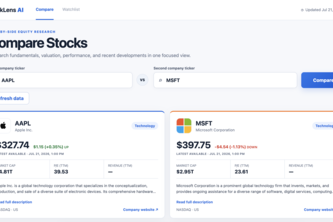
StockLens AI is a self-reported project built by one developer (Licy Li) as part of the OpenAI 2026 hackathon. It is described as an AI-powered stock research assistant that allows users to compare two tickers side-by-side, displaying company profiles, price charts, financial health metrics, curated news, and grounded AI briefs. The system uses deterministic data from PostgreSQL, with AI-generated insights only on demand.
What changed
The project was submitted to a hackathon, indicating an early-stage development effort. It includes a functional local stack with backend services in Java/Spring Boot, frontend in React/TypeScript, and integration with external APIs like Financial Modeling Prep and Yahoo Finance. The author reports using AI tools (ChatGPT and Codex) for both architecture design and implementation.
Single most important open question
Is there any evidence of user adoption or commercial traction beyond the hackathon submission?
What The Product Actually Is
The description states that StockLens AI is a side-by-side dashboard for comparing two stock tickers. It includes:
- Profiles & Market Data
- Price & Return Charts (raw historical prices and normalized percentage returns)
- Financial Health Metrics grouped by valuation, profitability, growth, and leverage
- Curated News with links to original publishers
- Grounded AI Briefs generated on-demand
- Strict Source References for all insights
- Manual data refresh controls
The system is built using a tech stack including React + TypeScript (frontend), Spring Boot 3 / Java 21 (backend), PostgreSQL (data store), Redis (cache), and OpenAI API via Spring AI. The AI briefs are generated only when requested, with validation to prevent hallucinations or invalid citations.
Inference The product is a data-driven tool for individual investors or analysts who want structured comparisons of companies using real-time financial data and AI-assisted insights.
Positioning & Claim Evolution
The tagline states: “AI-powered stock research assistant that turns market news and key financial metrics into clear, actionable insights.”
The author describes the product as not throwing open-ended prompts at an LLM but instead building a deterministic context using normalized data from PostgreSQL. This suggests a focus on reliability over generality.
Inference Positioning appears to be centered around providing trustworthy, source-backed AI analysis for stock research, rather than broad financial commentary or prediction.
Target Customer & ICP
The description does not explicitly name target customers or personas. However, the features suggest it may appeal to:
- Individual investors
- Financial analysts
- Research professionals seeking structured company comparisons
There is no evidence of segmentation or targeting beyond the general use case described.
Inference It seems aimed at users who value accuracy and transparency in financial data and want AI-assisted summaries without hallucinations or unverifiable claims.
Business Model & Pricing Evidence
No information about pricing, monetization strategy, or business model is provided. The project is self-reported as a hackathon submission with no indication of commercial intent or revenue streams.
Not evidenced
Technical & Delivery Signals
The system uses:
- Backend: Java 21 + Spring Boot 3
- Frontend: React + TypeScript
- Data Store: PostgreSQL
- Caching Layer: Redis
- External APIs: Financial Modeling Prep, Yahoo Finance
- AI Integration: OpenAI API via Spring AI
Key technical elements include:
- Structured prompts passed to LLMs
- Multi-step validation pipeline for citations
- Automated repair loop for invalid payloads
- Test suites (150+ backend tests, 28 frontend tests)
- Use of JUnit, Mockito, Testcontainers, Vitest, React Testing Library
The author also reports using AI tools (ChatGPT and Codex) for development.
Inference There is a strong engineering foundation with attention to data integrity, test coverage, and robustness. The use of AI for both design and implementation suggests a developer-centric approach to building scalable features.
Traction & Maturity Signals
The project was submitted to the OpenAI 2026 hackathon. No evidence of user adoption, customer base, or revenue is provided. The author mentions that the local stack, test suite, and core features are stable, but there is no indication of deployment in production or usage beyond development.
Not evidenced
Competitive Context
No mention of competitors or competitive landscape is included in the description. The author does not reference existing platforms for stock research or AI-assisted financial analysis.
Not evidenced
Open Questions & Risks
- Single Developer Team: Only one member listed (Licy Li). This raises questions about scalability and long-term maintenance.
- No Commercial Traction: No evidence of users, customers, or revenue. The project is described as a hackathon submission.
- Limited Scope: Features are focused on comparison dashboards and AI briefs; no indication of broader functionality or monetization plans.
- Dependency on External APIs: Reliance on Financial Modeling Prep and Yahoo Finance introduces potential rate-limiting or data availability risks.
Inference The project lacks commercial viability indicators, and its current maturity is limited to a local development environment with no known users or market validation.
Questions the description leaves open
- What is the intended path from this hackathon prototype to a product with real users?
- Are there any plans for monetization or revenue generation beyond the initial idea?
- How would you scale the system if more than one user were involved?
- Have you considered how to validate the AI-generated insights in a production environment?
- What are your thoughts on integrating additional data sources or LLM backends?
Overall Assessment
There is no evidence of commercial traction, revenue, or customer adoption beyond the hackathon submission. The project shows strong technical execution and an understanding of data integrity and AI validation, but lacks any indication of market readiness or business model.
Assessment Not evidenced as a viable investment or partnership opportunity at this stage. Further due diligence would require evidence of user engagement, product-market fit, or commercial strategy beyond the prototype phase.
User Stories BotA demo video on every pull request
Get a demo video on every new feature
GitHub App that watches your pull requests and records a narrated, captioned demo.
Save time on demo prep and make informed decisions faster with a video walkthrough of every new feature.
Source
Submitted to the OpenAI 2026 hackathon on Devpost. Project home on Devpost. Back to the full gallery on Devpost.
This competitive analysis was produced by top-founders.com (opens in a new tab)
Generated by a language model from this project's public Devpost page — its tagline, the author's own write-up and any built-with tags listed there — as captured in August 2026. Short quotations are the author's words. It is an opinion on the idea as a business, not on the people behind it, and it reflects the description as published then. If the project has moved on, request a correction below. The analysis is not independent research and contains no verified traction, revenue or customer data.
An independent guide by KFG International LLC — not affiliated with, endorsed by, or connected to Devpost or OpenAI.