

Archive position — measured, not model output
0 likes on Devpost
2,263 of the 7,850 archived projects have more likes, and 5,587 share exactly 0 — so this project's #6,892 place in the like-ranked listing is a tie-break inside that group, not a ranking.
Projects (log scale)
Likes on Devpost. ▲ marks this project's group.
Show the figures
| Likes | Projects | Share of archive |
|---|---|---|
| 0 | 5,587 | 71.2% |
| 1 | 1,758 | 22.4% |
| 2 | 284 | 3.6% |
| 3–4 | 132 | 1.7% |
| 5–9 | 75 | 1.0% |
| 10+ | 14 | 0.2% |
 User Stories BotA demo video on every pull request
Get a demo video on every new feature
GitHub App that watches your pull requests and records a narrated, captioned demo.
Save time on demo prep and make informed decisions faster with a video walkthrough of every new feature.
Executive Summary
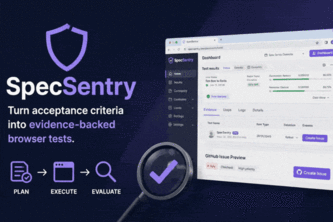
What the company appears to be: SpecSentry is a self-contained AI-powered tool that converts user story acceptance criteria into browser-based test runs and GitHub-ready bug reports. It is built as a single-developer project, deployed on Railway, using technologies including Next.js, TypeScript, Playwright, OpenAI APIs (GPT-5.6, Codex), and SQLite.
What changed: The author states that the tool was developed during a hackathon to address a gap in QA for small dev teams — specifically, how to turn written acceptance criteria into actionable test evidence without manual effort or brittle automation.
Single most important open question: Is there a viable commercial model or product-market fit beyond the single-person demo and hackathon context? The description does not provide any evidence of revenue, customers, or traction outside of the author’s own controlled evaluation.
What The Product Actually Is
The description states that SpecSentry is a tool that:
- Takes a staging URL, user story, and acceptance criteria as input.
- Converts these into a structured test plan using AI (GPT-5.6 Terra).
- Executes this plan in an isolated Chromium browser via Playwright.
- Records actions, screenshots, and browser state.
- Returns a pass/fail/block/inconclusive result.
- Generates a draft GitHub issue with severity, confidence, and reproduction steps.
- Allows human review before any external write to GitHub.
- Is deployed as a Next.js/TypeScript app on Railway.
It is described as a full end-to-end workflow from acceptance criteria to evidence-backed findings — though it currently only supports the Sentry Shop example in its public demo.
Inference: The tool is not a general-purpose QA platform but rather an AI-assisted test automation system tailored for small teams or developers who want to validate their features quickly and with documented evidence.
Positioning & Claim Evolution
The author claims that SpecSentry answers the question: “Could AI turn the requirements teams already write into a useful first test pass?”
This suggests a positioning around AI-driven QA automation, aimed at small dev teams who may not have time or resources for comprehensive manual testing.
It also positions itself as an alternative to:
- Manual QA, which is time-consuming and often done late in sprints.
- Traditional browser automation tools, which require engineering effort and can be brittle.
- General browser agents that don’t produce actionable evidence.
The claim evolution shows a shift from a proof-of-concept (hackathon project) to a potential product, with stated next steps like supporting authenticated staging accounts and PR checks.
Inference: The positioning is currently focused on solving an internal developer workflow problem, not yet a broader market offering. It has not evolved into a commercial proposition beyond the author’s own use case.
Target Customer & ICP
The description states that SpecSentry targets small dev teams who:
- Write acceptance criteria.
- May lack time or resources for full QA.
- Want to validate features quickly and with evidence.
It does not name specific roles, industries, or company sizes. However, the focus on small teams implies a potential ICP of:
- Developers working in agile environments.
- Product managers documenting user stories.
- Engineering leads looking for lightweight QA tools.
Inference: The target customer is likely technical users within small to mid-sized software teams, but no explicit segmentation or persona data is provided.
Business Model & Pricing Evidence
There is no evidence of pricing, monetization strategy, or business model in the description. The tool is described as:
- Self-hosted (with a public demo restricted to one example).
- Deployed on Railway.
- Built with open-source tools like Playwright and Next.js.
The author mentions that self-hosted deployments can test explicitly approved staging domains — implying some control over usage, but no indication of licensing or subscription models.
Inference: No business model is evident. The tool appears to be a personal project or prototype, not yet commercialized.
Technical & Delivery Signals
SpecSentry uses:
- Frontend: Next.js, React, Tailwind
- Backend: Node.js, TypeScript
- AI Tools: GPT-5.6 Terra, Codex, OpenAI API (computer use)
- Testing Frameworks: Playwright, Jest (unit/service tests)
- Infrastructure: Docker, Railway, SQLite
- Data Validation: Zod
- Deployment: Hosted on Railway
The system is structured into three AI phases:
- Planner – Converts criteria to test steps.
- Executor – Runs the test in Chromium.
- Evaluator – Assesses results and creates findings.
It includes safeguards such as:
- Fixed browser dimensions
- Approved test plans
- Action and runtime limits
- Hostname restrictions
- Screenshots after checkpoints
The author notes that the tool was built with Codex for architecture, implementation, debugging, security hardening, and deployment.
Inference: The tech stack is modern and appropriate for a developer-focused tool. It shows clear separation of concerns and attention to safety and data integrity.
Traction & Maturity Signals
The author reports:
- A controlled ten-case live evaluation with:
- 5/5 expected passes
- 3/3 seeded failures
- 1/1 blocked result
- 1/1 inconclusive result
- No false failures, retries, missing screenshots, or off-domain navigation
Additionally:
- The tool has 71 passing unit/service tests and 16 Playwright tests.
- No production dependency vulnerabilities.
- Built during a holiday with no external dependencies.
However, there is no evidence of revenue, customers, user base, or market traction beyond the author’s own testing.
Inference: The product shows strong technical execution in a controlled environment but lacks any sign of real-world adoption or commercial success.
Competitive Context
The description does not mention competitors directly. However, based on its functionality, it overlaps with:
- Browser automation tools (e.g., Playwright, Selenium).
- AI-powered QA platforms (e.g., Testim, Applitools).
- Developer workflow tools that integrate with GitHub and CI/CD pipelines.
It differentiates itself by:
- Automating from acceptance criteria to evidence-backed findings.
- Using AI for planning and evaluation.
- Requiring human review before writing to GitHub.
- Being designed for small teams or individual developers.
Inference: The competitive landscape is not clearly defined, but the tool fills a niche in developer-first QA automation, especially for teams that don’t have dedicated QA resources.
Open Questions & Risks
- Single-person project: No team, no external validation, no product-market fit beyond one developer’s use case.
- No commercial traction or revenue: The tool is not monetized or used by others.
- Limited scope: Public demo only works with one example (Sentry Shop).
- Unclear scalability: Self-hosted deployment implies limited ease of adoption for larger teams.
- AI dependency risk: Reliance on GPT-5.6 and Codex may be fragile if APIs change or become unavailable.
- No clear path to monetization: No pricing, licensing, or enterprise features mentioned.
Inference: The project is in a very early stage — more of a prototype than a product ready for market.
Questions the description leaves open
- What is the actual demand from small teams for this kind of tool?
- How would you monetize this if it were to become a product?
- Are there any existing users or pilot customers beyond your own testing?
- What are the technical limitations of scaling this beyond one developer’s workflow?
- How do you plan to handle edge cases or ambiguous acceptance criteria?
- What is the long-term vision for AI integration — will it evolve beyond just test planning and execution?
- Are there any plans to support enterprise features like team collaboration, CI/CD integration, or multi-staging domains?
Overall Assessment
Not evidenced: The description does not provide sufficient information to assess whether this project is ready for investment or partnership.
The tool is technically impressive and solves a real problem in small-team QA workflows. However:
- There is no evidence of traction, revenue, or customer validation.
- It remains a single-developer hackathon project with no commercialization.
- The business model and path to market are unclear.
Inference: This is a promising idea in need of further development, validation, and product-market fit before it can be considered for investment or partnership.
User Stories BotA demo video on every pull request
Get a demo video on every new feature
GitHub App that watches your pull requests and records a narrated, captioned demo.
Save time on demo prep and make informed decisions faster with a video walkthrough of every new feature.
Source
Submitted to the OpenAI 2026 hackathon on Devpost. Project home on Devpost. Back to the full gallery on Devpost.
This competitive analysis was produced by top-founders.com (opens in a new tab)
Generated by a language model from this project's public Devpost page — its tagline, the author's own write-up and any built-with tags listed there — as captured in August 2026. Short quotations are the author's words. It is an opinion on the idea as a business, not on the people behind it, and it reflects the description as published then. If the project has moved on, request a correction below. The analysis is not independent research and contains no verified traction, revenue or customer data.
An independent guide by KFG International LLC — not affiliated with, endorsed by, or connected to Devpost or OpenAI.