

Archive position — measured, not model output
0 likes on Devpost
2,263 of the 7,850 archived projects have more likes, and 5,587 share exactly 0 — so this project's #4,783 place in the like-ranked listing is a tie-break inside that group, not a ranking.
Projects (log scale)
Likes on Devpost. ▲ marks this project's group.
Show the figures
| Likes | Projects | Share of archive |
|---|---|---|
| 0 | 5,587 | 71.2% |
| 1 | 1,758 | 22.4% |
| 2 | 284 | 3.6% |
| 3–4 | 132 | 1.7% |
| 5–9 | 75 | 1.0% |
| 10+ | 14 | 0.2% |
 User Stories BotA demo video on every pull request
Get a demo video on every new feature
GitHub App that watches your pull requests and records a narrated, captioned demo.
Save time on demo prep and make informed decisions faster with a video walkthrough of every new feature.
Executive Summary
Project: Kernel Forge Studio
Self-reported purpose: A tool that benchmarks AI model performance on Android phones, comparing builds locally using verified files and randomized testing to produce honest recommendations.
What changed: The project was submitted as a hackathon entry for the OpenAI 2026 hackathon. It is not evidenced to have moved beyond prototype or gained traction.
Single most important open question: Is there any evidence of product-market fit, customer demand, or commercial viability beyond the author's own development and testing?
What The Product Actually Is
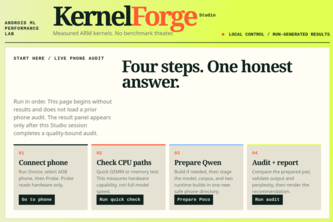
The description states that Kernel Forge Studio is a tool that compares AI builds on Android phones. It prepares verified files, checks phone temperature, runs randomized benchmark pairs, validates model quality, and creates an honest recommendation.
- Claimed functionality: Benchmarking AI models on mobile devices.
- Technical stack: Built with Python, ADB, schema-validated JSON, llama.cpp, and a local web UI.
- Workflow: CLI-based, with a matching web UI; no separate or hidden benchmark logic.
- Key features:
- Verifies copied assets with SHA-256
- Never overwrites phone files
- Keeps raw evidence
- Randomized order of benchmarks
- Temperature monitoring
Inference: The tool is designed for performance validation and comparison, not deployment or inference.
Positioning & Claim Evolution
The author states that the inspiration was to check real results instead of trusting labels like “optimized” or “accelerated.” This suggests a positioning around honesty and verification in an AI-on-phone space where such claims are common.
- Positioning claim: Honest benchmarking of AI models on mobile devices.
- Evolution of claims:
- From general curiosity about performance to a tool that validates model quality and speed.
- The project evolved from a hackathon idea into a tool with a defined workflow and safety measures (e.g., no overwrites, SHA-256 checks).
Inference: The positioning is not yet market-ready; it’s a self-contained tool for developers or researchers.
Target Customer & ICP
The description does not state who the target customer is. It only describes what the tool does and how it was built.
- Not evidenced: No explicit customer segment, persona, or use case beyond developer testing.
- Inference: Likely aimed at AI developers or researchers working on mobile inference, but no evidence of adoption or demand.
Business Model & Pricing Evidence
The description does not mention any business model or pricing structure.
- Not evidenced: No revenue model, monetization strategy, or pricing details.
- Inference: If this is a commercial product, it likely has no evidence of a path to revenue at this stage.
Technical & Delivery Signals
The project is built with Python, ADB, schema-validated JSON, and llama.cpp. It uses a CLI and web UI that mirror each other.
- Technical stack: Python, ADB, JSON schema validation, llama.cpp.
- Delivery approach:
- Local execution
- Web UI for user interaction
- CLI workflow for automation
- Safety features:
- SHA-256 verification of assets
- No overwrites of phone files
- Raw evidence retention
Inference: The tool is technically sound and designed with safety in mind, but it’s not yet a commercial product.
Traction & Maturity Signals
The project was submitted to a hackathon. There is no evidence of traction, customers, or adoption beyond the author's own testing.
- Not evidenced:
- No revenue
- No customer base
- No usage metrics
- No deployment in production
- Inference: The tool is at a prototype stage, likely not yet used by others.
Competitive Context
The description does not mention any competitors or how Kernel Forge Studio fits into the broader AI-on-phone landscape.
- Not evidenced: No competitive analysis, no market positioning, no differentiation from other tools.
- Inference: The tool may be one of many in a growing niche, but its place in that space is unclear without further context.
Open Questions & Risks
- No commercial traction or revenue: The project is not evidenced to have moved beyond the hackathon stage.
- Single founder: Only one team member (Harsh Khandelwal) is mentioned.
- Limited scope: No evidence of support for multiple platforms, models, or runtime environments.
- Unproven market demand: No indication that there’s a market need for this tool beyond personal use.
Questions the description leaves open
- What specific problem are you trying to solve in the AI-on-phone space?
- Have you tested this tool with other developers or researchers? If so, what feedback did you get?
- Are there any plans to monetize this tool or integrate it into a larger product?
- How do you plan to scale beyond the current prototype and test environment?
- What is your roadmap for expanding support for more devices, models, or platforms?
Overall Assessment
Not evidenced: No commercial traction, revenue, or customer data exists.
- Confidence level: Low.
- Assessment: This is a self-reported hackathon project with no evidence of product-market fit or commercial viability. It may be an early-stage idea or prototype, but there is no indication it has progressed beyond that stage.
Inference: If this is a pre-product idea, it could be worth exploring further for potential investment or partnership if the founders can demonstrate traction or a clear path to market. As of now, it is not ready for commercial due diligence.
User Stories BotA demo video on every pull request
Get a demo video on every new feature
GitHub App that watches your pull requests and records a narrated, captioned demo.
Save time on demo prep and make informed decisions faster with a video walkthrough of every new feature.
Source
Submitted to the OpenAI 2026 hackathon on Devpost. Project home on Devpost. Back to the full gallery on Devpost.
This competitive analysis was produced by top-founders.com (opens in a new tab)
Generated by a language model from this project's public Devpost page — its tagline, the author's own write-up and any built-with tags listed there — as captured in August 2026. Short quotations are the author's words. It is an opinion on the idea as a business, not on the people behind it, and it reflects the description as published then. If the project has moved on, request a correction below. The analysis is not independent research and contains no verified traction, revenue or customer data.
An independent guide by KFG International LLC — not affiliated with, endorsed by, or connected to Devpost or OpenAI.