

Archive position — measured, not model output
0 likes on Devpost
2,263 of the 7,850 archived projects have more likes, and 5,587 share exactly 0 — so this project's #6,805 place in the like-ranked listing is a tie-break inside that group, not a ranking.
Projects (log scale)
Likes on Devpost. ▲ marks this project's group.
Show the figures
| Likes | Projects | Share of archive |
|---|---|---|
| 0 | 5,587 | 71.2% |
| 1 | 1,758 | 22.4% |
| 2 | 284 | 3.6% |
| 3–4 | 132 | 1.7% |
| 5–9 | 75 | 1.0% |
| 10+ | 14 | 0.2% |
 User Stories BotA demo video on every pull request
Get a demo video on every new feature
GitHub App that watches your pull requests and records a narrated, captioned demo.
Save time on demo prep and make informed decisions faster with a video walkthrough of every new feature.
Executive Summary
SnapCal is an Android app that automates calendar event creation from screenshots using local OCR and a deterministic ambiguity rejection system. The author states it was built for personal use to solve the problem of forgetting to add events seen in screenshots, particularly from LINE or social media. It runs entirely on-device with no network permissions, and uses Japanese OCR via ML Kit. The app is described as privacy-focused, rejecting ambiguous inputs rather than guessing.
The most important open question is: What is the actual adoption rate or usage volume of this tool, if any? The description provides no evidence of customers, revenue, or product-market fit beyond the author's own use case and a single-person development effort.
This analysis is based entirely on self-reported information from the project description. No third-party verification or historical data exists for this project.
What The Product Actually Is
The description states that SnapCal is an Android app with two entry points:
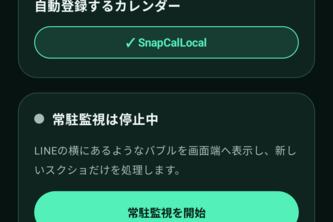
- Sharing a single screenshot from Gallery, LINE, or another app.
- Starting screenshot monitoring with a persistent edge bubble visible on screen.
It uses Japanese OCR via ML Kit, runs entirely on-device, and integrates with Android's standard Calendar Provider. It stores only small operational identifiers for duplicate prevention and Undo functionality.
The app is built in Kotlin with Jetpack Compose, using libraries such as Room, WorkManager, and MediaStore observation. The author used Codex and GPT-5.6 to assist development, including architecture design, end-to-end flow implementation, ambiguity rule design, adversarial testing, and privacy review.
The app is described as having a “deterministic ambiguity rejection” system, where it does nothing when input is unclear (e.g., multiple events, past dates, missing fields). It adds only one event per screenshot if the OCR output is unambiguous.
Not evidenced: No evidence of actual users, usage metrics, or product-market fit beyond the author’s personal use case.
Positioning & Claim Evolution
The author states that SnapCal was built to solve a personal problem: forgetting to add events seen in screenshots. The app’s positioning is framed around automation, privacy, and safety—specifically, it avoids guessing or over-automating by rejecting unclear inputs.
It is described as a “privacy-by-construction” tool, with no network permissions, and no data leaving the device. It also claims to be safe in that it does not persist sensitive information like full OCR text or images.
The evolution of the product’s claim appears to have shifted from a simple “OCR + calendar” idea to a more nuanced approach: rejecting uncertainty as a feature, rather than an error.
Not evidenced: No evidence of how this positioning has evolved over time, nor whether it was tested with others. No marketing or branding claims beyond the author’s own description.
Target Customer & ICP
The author states that SnapCal is for people who take screenshots of events in LINE, social media, or ticket pages, and then forget to add them to their calendar.
It is described as targeting users who are frustrated by manual calendar entry and want a “one-click” solution. The app is built specifically for Android users, with support for Japanese OCR.
The ICP (Ideal Customer Profile) appears to be:
- Android users
- Regularly screenshotting event details
- Interested in privacy and automation
- Likely to be self-employed or tech-savvy individuals
Not evidenced: No evidence of actual customer segments, personas, or feedback from users beyond the author’s own experience.
Business Model & Pricing Evidence
The description states that SnapCal is free to use, with no pricing model or monetization strategy described. It is built as a personal tool and not presented as a commercial product.
There are no mentions of subscriptions, in-app purchases, or paid features. The app is open-source (GitHub repository included), and the author provides setup and testing instructions.
Not evidenced: No evidence of revenue streams, pricing tiers, or monetization plans.
Technical & Delivery Signals
The app is built with Kotlin, Jetpack Compose, and uses ML Kit for Japanese OCR, Room for local data storage, WorkManager for background tasks, and MediaStore observation. It also uses a foreground service to maintain the edge bubble.
It was developed using Codex and GPT-5.6, which helped in architecture, flow implementation, ambiguity rule design, adversarial testing, and privacy review.
The app is described as having a release gate that enforces no network dependencies, runs unit tests, and inspects APK permissions. It was built to be privacy-first, with no data persisted beyond operational identifiers.
Not evidenced: No evidence of scalability, performance metrics, or production deployment details beyond the author’s own development setup.
Traction & Maturity Signals
The project is described as a single-person effort by Hiroyasu Tazawa. It was submitted to the OpenAI 2026 hackathon, and includes a public GitHub repository with setup instructions, signed APKs, and evaluator bundles.
There is no evidence of:
- User adoption or usage metrics
- Customer feedback or testimonials
- Product iterations beyond this version
- Revenue or monetization
The app is described as “safe” and “private”, but there is no evidence of market traction or product-market fit.
Not evidenced: No evidence of users, customers, or adoption beyond the author’s own use case.
Competitive Context
The description does not mention any direct competitors. It is implied that SnapCal fills a gap in automation for calendar entry from screenshots, particularly with a privacy-first approach.
It is not clear whether similar tools exist in the market, nor how it would compare to existing Android apps or services that offer OCR + calendar integration.
Not evidenced: No evidence of competitive landscape, existing solutions, or differentiation strategy.
Open Questions & Risks
- Single-person development: The app was built by one developer and lacks a team or business structure.
- No traction or adoption: There is no evidence of users, customers, or product-market fit.
- Limited scope: It only supports Japanese OCR and Android, with no indication of expansion plans.
- Privacy as a feature vs. market demand: While privacy is emphasized, it’s unclear if this is a strong enough value proposition for widespread adoption.
- No monetization strategy: The app is free and open-source, with no clear path to revenue.
Not evidenced: No evidence of risks being mitigated or addressed in any way beyond the author’s own development choices.
Questions the description leaves open
- What is your actual usage frequency of SnapCal? Is it a tool you use daily?
- Have you received feedback from others who tried the app?
- What are your plans for expanding beyond Japanese OCR or Android?
- How do you plan to monetize or grow this product if at all?
- Are there any technical limitations or scalability concerns with the current architecture?
- Do you have a roadmap for future features or improvements?
Overall Assessment
The project is described as a personal tool built by one developer, with no evidence of traction, customers, or monetization.
It is not evident whether this represents a viable business opportunity or a prototype that may evolve into something larger. The app’s privacy-first approach and deterministic ambiguity rejection are novel features, but without adoption or revenue, it remains unproven as a commercial product.
Not evidenced: No evidence of investment potential, partnership opportunities, or scalability beyond the author's own use case.
User Stories BotA demo video on every pull request
Get a demo video on every new feature
GitHub App that watches your pull requests and records a narrated, captioned demo.
Save time on demo prep and make informed decisions faster with a video walkthrough of every new feature.
Source
Submitted to the OpenAI 2026 hackathon on Devpost. Project home on Devpost. Back to the full gallery on Devpost.
This competitive analysis was produced by top-founders.com (opens in a new tab)
Generated by a language model from this project's public Devpost page — its tagline, the author's own write-up and any built-with tags listed there — as captured in August 2026. Short quotations are the author's words. It is an opinion on the idea as a business, not on the people behind it, and it reflects the description as published then. If the project has moved on, request a correction below. The analysis is not independent research and contains no verified traction, revenue or customer data.
An independent guide by KFG International LLC — not affiliated with, endorsed by, or connected to Devpost or OpenAI.