

Archive position — measured, not model output
1 like on Devpost
505 of the 7,850 archived projects have more likes, and 1,758 share exactly 1 — so this project's #1,938 place in the like-ranked listing is a tie-break inside that group, not a ranking.
Projects (log scale)
Likes on Devpost. ▲ marks this project's group.
Show the figures
| Likes | Projects | Share of archive |
|---|---|---|
| 0 | 5,587 | 71.2% |
| 1 | 1,758 | 22.4% |
| 2 | 284 | 3.6% |
| 3–4 | 132 | 1.7% |
| 5–9 | 75 | 1.0% |
| 10+ | 14 | 0.2% |
 User Stories BotA demo video on every pull request
Get a demo video on every new feature
GitHub App that watches your pull requests and records a narrated, captioned demo.
Save time on demo prep and make informed decisions faster with a video walkthrough of every new feature.
Executive Summary
Company: SkillForge AI
Self-reported basis: The description is entirely from the author’s own submission to the OpenAI 2026 hackathon on Devpost. No external verification or historical data is available.
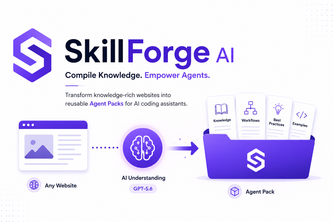
What it appears to be: A tool that compiles knowledge-rich websites into reusable "Agent Packs" for AI coding agents, aiming to reduce repetitive documentation processing.
What changed: The project was submitted as a hackathon entry; no evidence of prior development or commercial activity.
Single most important open question: Is there a real market need for this type of tool, and does the author have a path to product-market fit or traction?
What The Product Actually Is
The description states that SkillForge AI "compiles any knowledge-rich website into an Agent Pack for AI coding agents." It is described as a tool that converts human-oriented documentation into reusable formats for AI agents.
- Claimed function: Transforming documentation websites into structured, agent-readable formats (e.g., skill.md).
- Output format: The project supports "skill.md" and mentions support for additional output formats beyond this.
- Technology stack: Built with codex and OpenAI APIs.
Inference: The tool likely parses content from a website and restructures it into a form suitable for AI agents to consume, reducing the need for agents to process large documentation sets repeatedly.
Positioning & Claim Evolution
The author states that AI coding agents are essential in modern development but face a common limitation: they must repeatedly process documentation.
- Core positioning: SkillForge AI aims to make it easier to teach AI agents new technologies by compiling knowledge from websites into reusable formats.
- Vision: To become "the easiest way to transform human-oriented knowledge into reusable capabilities for AI agents."
Inference: The project positions itself as a tool for developers or AI agent creators who want to streamline the process of integrating documentation into AI workflows.
Target Customer & ICP
The description does not explicitly identify target customers or personas.
- Claimed audience: Developers using AI coding agents, and potentially AI agent creators or platform builders.
- ICP inference: Likely early-stage developers or teams experimenting with AI agents who need to onboard new frameworks or tools quickly.
Not evidenced: No explicit customer segments, use cases, or buyer personas are provided.
Business Model & Pricing Evidence
The description does not state anything about pricing, monetization, or business model.
- Claimed value: Reducing the time and effort required for AI agents to process documentation.
- Monetization inference: Not stated; could be a freemium tool, SaaS, or part of a larger platform.
Not evidenced: No pricing, revenue streams, or monetization strategy are described.
Technical & Delivery Signals
The project is described as built with:
- Tools: codex, OpenAI
- Output format: skill.md (and potentially others)
- Scope: A hackathon submission
Inference: The tool likely uses LLMs to extract and structure documentation into agent-readable formats. It is not clear if it's a CLI tool, web app, or API.
Traction & Maturity Signals
The project was submitted as a hackathon entry (OpenAI 2026).
- Maturity: Not evidenced — no prior development, funding, or product release history.
- Traction: Not evidenced — no customers, usage data, or adoption metrics.
Not evidenced: No evidence of user feedback, product iteration, or market response.
Competitive Context
The description does not mention competitors or the broader market landscape.
- Inference: The space of AI agent documentation tools is emerging; this project may be among early explorers in that space.
Not evidenced: No competitive analysis, market size, or competitor names are provided.
Open Questions & Risks
- No traction or revenue: This is a hackathon submission with no evidence of prior use or adoption.
- Unproven market need: The author states a problem but does not demonstrate demand for the solution.
- Limited team: Only one founder (Billy Gibendi) is mentioned, which may limit execution capacity.
- No monetization strategy: No indication of how the tool would be sold or used commercially.
Questions the description leaves open
- What specific documentation websites are you targeting, and what types of content do they contain?
- How does your tool handle complex or multi-page documentation?
- Have you tested this with real AI agents, and what were the results?
- What is your plan for scaling beyond a hackathon prototype?
- Are there any existing tools that solve similar problems, and how do you differ?
Overall Assessment
Confidence level: Low — based on self-reported, unverified information from a hackathon submission.
- Not evidenced: No revenue, customers, traction, or business model.
- Inference: The idea has potential if there is real demand for AI agent documentation tools, but the current evidence does not support that.
- Next step: If this is a prototype with early traction or a clear path to monetization, further due diligence would be warranted. As-is, it appears to be an experimental idea with no commercial validation.
Assessment: Not ready for investment or partnership without additional evidence of traction, market need, or product-market fit.
User Stories BotA demo video on every pull request
Get a demo video on every new feature
GitHub App that watches your pull requests and records a narrated, captioned demo.
Save time on demo prep and make informed decisions faster with a video walkthrough of every new feature.
Source
Submitted to the OpenAI 2026 hackathon on Devpost. Project home on Devpost. Back to the full gallery on Devpost.
This competitive analysis was produced by top-founders.com (opens in a new tab)
Generated by a language model from this project's public Devpost page — its tagline, the author's own write-up and any built-with tags listed there — as captured in August 2026. Short quotations are the author's words. It is an opinion on the idea as a business, not on the people behind it, and it reflects the description as published then. If the project has moved on, request a correction below. The analysis is not independent research and contains no verified traction, revenue or customer data.
An independent guide by KFG International LLC — not affiliated with, endorsed by, or connected to Devpost or OpenAI.