

Archive position — measured, not model output
0 likes on Devpost
2,263 of the 7,850 archived projects have more likes, and 5,587 share exactly 0 — so this project's #6,649 place in the like-ranked listing is a tie-break inside that group, not a ranking.
Projects (log scale)
Likes on Devpost. ▲ marks this project's group.
Show the figures
| Likes | Projects | Share of archive |
|---|---|---|
| 0 | 5,587 | 71.2% |
| 1 | 1,758 | 22.4% |
| 2 | 284 | 3.6% |
| 3–4 | 132 | 1.7% |
| 5–9 | 75 | 1.0% |
| 10+ | 14 | 0.2% |
 User Stories BotA demo video on every pull request
Get a demo video on every new feature
GitHub App that watches your pull requests and records a narrated, captioned demo.
Save time on demo prep and make informed decisions faster with a video walkthrough of every new feature.
Executive Summary
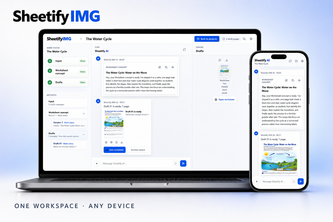
SheetifyIMG is a self-reported tool that uses GPT-5.6 and GPT Image 2 to help teachers generate visual worksheets from ideas, with human control over concept approval and revision before image generation. The author, Julius Herrmann, built it during an OpenAI hackathon as an evolution of a personal prototype. It supports structured workflows involving conversational planning (via Luna), concept writing (via Sol), draft review and PDF saving. The system is described as having moved from deterministic rendering to image-first generation, with improvements made during Build Week to support multi-user access and beta administration.
The single most important open question is: What level of adoption or usage has SheetifyIMG achieved beyond the small beta of four participants?
This analysis is based entirely on the self-reported project description provided by the author. No external verification, revenue data, customer names, traction metrics or independent sources are available.
What The Product Actually Is
The description states that SheetifyIMG:
- Turns a teaching idea, source text or image reference into a visible worksheet concept and then into visual drafts.
- Uses GPT-5.6 Luna for conversational planning and routing to structured actions.
- Uses GPT-5.6 Sol for writing and revising the worksheet concept (texts, tasks, wording, sequence).
- Shows the concept before rendering; teachers can approve or revise it.
- Sends approved concepts to GPT Image 2 for visual draft generation.
- Allows teachers to compare candidates, request revisions, and save preferred worksheets as PDFs.
- Runs Luna and Sol through the Responses API with structured outputs.
- Maintains application-controlled routing, approval, paid generation, credits, versioning, and persistence.
Inferred: The system supports a workflow where a teacher inputs an idea, gets a concept from GPT-5.6 Sol, reviews it, approves it, then generates visuals using GPT Image 2.
Not evidenced: No information on whether the tool is currently live, how many users are active, or what kind of feedback has been collected beyond the beta group.
Positioning & Claim Evolution
The author claims:
- SheetifyIMG was inspired by a personal frustration with worksheet creation in special education.
- It evolved from a deterministic renderer to an image-first approach using GPT Image 2.
- The tool allows teachers to control the process, rather than letting the worksheet shape the lesson.
Inferred: The positioning is centered on empowering educators through AI-assisted, human-controlled worksheet design. The evolution suggests a shift toward more creative and flexible outputs.
Not evidenced:
- No claims about market fit or scalability.
- No indication of how this compares to existing tools in the education space.
- No evidence of user feedback or product-market alignment beyond the beta.
Target Customer & ICP
The description states:
- The primary user is a teacher, specifically one working in special education in Germany.
- It was built for someone who wants to plan lessons before material creation but often ends up choosing the least-wrong worksheet.
- The tool supports multi-user access and session persistence, suggesting it may be intended for broader classroom use or collaboration.
Inferred: The target customer is a teacher (or educator) who needs structured lesson planning tools that allow for flexibility and control over content generation.
Not evidenced:
- No data on how many teachers are using the tool.
- No evidence of segmentation beyond "teachers" or "classroom users."
- No indication of whether the tool targets other roles like curriculum designers, tutors, or administrators.
Business Model & Pricing Evidence
The description states:
- The system includes “credits” and “paid generation.”
- Routing, approval, paid generation, credits, versioning, and persistence remain application-controlled.
- There is a mention of beta administration and pass-scoped workspaces.
Inferred: A freemium or credit-based model appears to be in place, with paid usage for image generation.
Not evidenced:
- No pricing tiers, subscription models, or monetization strategy described.
- No indication of whether the tool is intended for commercial sale or internal use only.
- No evidence of revenue streams beyond implied paid generation.
Technical & Delivery Signals
The description states:
- Built with GPT-5.6 Luna and Sol, GPT Image 2, OpenAI APIs, Cloudflare, Playwright, Remotion, PWA, JavaScript, Node.js, ElevenLabs, Codex.
- Uses the Responses API for structured outputs from models.
- Includes pass-scoped workspaces, persistent sessions, device pairing, beta administration, contextual feedback, recovery paths, bilingual access, generation recovery, and reliability checks.
- Codex was used for architecture, implementation, testing, debugging, deployment preparation, and release cleanup.
- A targeted revision path was improved using Codex to reduce model calls and token usage.
Inferred: The tool is technically complex, integrating multiple AI models and APIs with a focus on structured workflows and user control.
Not evidenced:
- No information about scalability or infrastructure.
- No evidence of performance metrics or reliability in production.
- No indication of how the system handles errors or edge cases beyond basic recovery paths.
Traction & Maturity Signals
The description states:
- Four active participants in a small invited beta created nine projects.
- The system completed 28 generation jobs, 36 generated pages, and 16 saved worksheet PDFs.
- The workflow was no longer confined to the author’s desk; others planned, approved, revised, and saved worksheets.
- The sample size is described as “much too small” to establish educational effectiveness or broad demand.
Inferred: There is limited early-stage traction, but no clear evidence of product-market fit or widespread adoption.
Not evidenced:
- No data on retention rates, user engagement beyond the beta, or long-term usage.
- No evidence of customer acquisition or marketing efforts.
- No indication of whether the tool has moved past prototype stage into a usable product.
Competitive Context
The description does not provide any information about competitors or similar tools in the education or AI-assisted worksheet space.
Not evidenced:
- No mention of existing platforms for lesson planning, worksheet creation, or AI-powered educational tools.
- No indication of how SheetifyIMG differentiates from other solutions.
- No evidence of competitive positioning or market analysis.
Open Questions & Risks
The description states:
- The clearest technical risk is semantic fidelity — GPT Image 2 renders the complete page including text, so a visually convincing result can still misspell, omit, or change approved content.
- A next priority is OCR- or vision-based comparison between the concept and rendered page.
- The author notes that capability alone does not create a useful workflow; human control is essential.
Inferred:
- There is a risk of misalignment between generated visuals and intended concepts.
- The tool may be limited in its ability to scale without further development of quality assurance mechanisms.
- The lack of broader traction or feedback raises questions about user adoption and utility beyond the beta group.
Not evidenced:
- No evidence of financial sustainability or long-term viability.
- No indication of whether the author plans to pursue funding, partnerships, or commercialization.
- No mention of legal, ethical, or data privacy considerations.
Questions the description leaves open
- What specific educational outcomes or improvements have been observed in the beta group?
- How is the tool currently being used outside of the initial prototype and beta?
- Are there any plans to expand beyond the German special education context?
- What are the current limitations of GPT Image 2 that affect the quality or fidelity of generated worksheets?
- Is there a plan for monetization, and how does the credit-based system work in practice?
- How is user feedback being collected and incorporated into future versions?
- What are the key challenges in scaling this tool to more users or broader markets?
Overall Assessment
The description states that SheetifyIMG was built during an OpenAI hackathon as a personal prototype evolved into a beta-ready tool. It is described as having moved from deterministic rendering to image-first generation, with improvements made for multi-user access and beta administration.
Not evidenced:
- No indication of whether the project has moved beyond the prototype or beta stage.
- No evidence of revenue, customers, or traction beyond the small group of four users.
- No information on funding, team size, or commercial strategy.
- No clear indication of whether this is a viable product for investment or partnership.
Inferred: The tool shows early signs of utility in a niche market (special education teachers), but lacks sufficient evidence to assess its potential for growth, scalability, or broader impact. It remains in an exploratory phase with limited external validation.
This analysis is based solely on the self-reported project description provided by the author. No independent verification or additional data points are available.
User Stories BotA demo video on every pull request
Get a demo video on every new feature
GitHub App that watches your pull requests and records a narrated, captioned demo.
Save time on demo prep and make informed decisions faster with a video walkthrough of every new feature.
Source
Submitted to the OpenAI 2026 hackathon on Devpost. Project home on Devpost. Back to the full gallery on Devpost.
This competitive analysis was produced by top-founders.com (opens in a new tab)
Generated by a language model from this project's public Devpost page — its tagline, the author's own write-up and any built-with tags listed there — as captured in August 2026. Short quotations are the author's words. It is an opinion on the idea as a business, not on the people behind it, and it reflects the description as published then. If the project has moved on, request a correction below. The analysis is not independent research and contains no verified traction, revenue or customer data.
An independent guide by KFG International LLC — not affiliated with, endorsed by, or connected to Devpost or OpenAI.