

Archive position — measured, not model output
0 likes on Devpost
2,263 of the 7,850 archived projects have more likes, and 5,587 share exactly 0 — so this project's #6,632 place in the like-ranked listing is a tie-break inside that group, not a ranking.
Projects (log scale)
Likes on Devpost. ▲ marks this project's group.
Show the figures
| Likes | Projects | Share of archive |
|---|---|---|
| 0 | 5,587 | 71.2% |
| 1 | 1,758 | 22.4% |
| 2 | 284 | 3.6% |
| 3–4 | 132 | 1.7% |
| 5–9 | 75 | 1.0% |
| 10+ | 14 | 0.2% |
 User Stories BotA demo video on every pull request
Get a demo video on every new feature
GitHub App that watches your pull requests and records a narrated, captioned demo.
Save time on demo prep and make informed decisions faster with a video walkthrough of every new feature.
Executive Summary
What the company appears to be
Separator Control Challenge is an interactive, browser-based educational simulation that teaches industrial process control through a simplified three-phase separator control challenge. The author states it was built as part of a hackathon submission and uses AI tools for development but not in runtime.
What changed
The project evolved from academic research into a playable web experience focused on PID tuning and real-time control behavior. It represents an attempt to make technical industrial concepts accessible through gamification and visualization.
Single most important open question
Is there any evidence of traction, revenue, or customer adoption beyond the author’s own development effort?
What The Product Actually Is
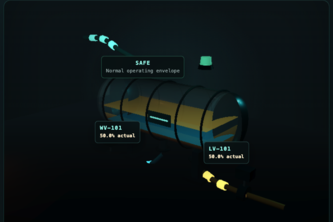
The description states that Separator Control Challenge is an interactive browser-based process control game. It involves:
- Tuning two PID controllers:
- Total liquid level controller (operates oil outlet valve)
- Oil/water interface controller (operates water outlet valve)
- A 3D visualization of a separator with animated inventories and piping
- Deterministic scenarios including disturbances like feed changes, slugs, and sensor noise
- Live process trends, alarms, and performance metrics
- Scoring based on error minimization, stability, safety, and valve efficiency
The simulation runs client-side using fixed-step integration and Web Workers. It does not require external dependencies or runtime AI inference.
Inference The product is a self-contained educational tool designed to demonstrate control theory principles in an engaging way.
Positioning & Claim Evolution
The author claims the project was inspired by doctoral research on oil-well operations and aims to make industrial process control more intuitive through visual, interactive learning.
Key claims:
- Industrial control problems can be turned into “engaging, visual, and playable web experience”
- The challenge is based on a technically meaningful control problem
- It provides an accessible way to understand PID tuning behavior
Inference This is positioned as an educational tool for engineers or students interested in process control. It does not claim commercial viability or market traction.
Target Customer & ICP
The description states that the project was built from personal academic experience and aims to teach industrial control concepts through simulation.
No explicit customer segments are mentioned, but inferred targets include:
- Engineering students
- Practicing engineers seeking refresher training
- Educators in process control or automation
- Developers interested in educational simulations
Inference The ICP is likely a niche audience within engineering education and professional development. No evidence of broader commercial targeting.
Business Model & Pricing Evidence
There is no mention of any business model, pricing strategy, monetization plans, or revenue streams.
The project is described as a hackathon submission with no indication of commercial intent or product-market fit beyond educational utility.
Inference No evidence of a business model or pricing structure; the tool appears to be non-commercial in nature.
Technical & Delivery Signals
The author states that the application was built using:
- Next.js, React, TypeScript
- Three.js, React Three Fiber, Drei for 3D rendering
- Recharts for data visualization
- Web Workers for simulation logic
- Vitest and Playwright for testing
- GPT-5.6 and Codex for development assistance
The simulation includes:
- Coupled liquid inventories with volume balance equations
- PID controllers with practical behaviors (output limits, anti-windup, derivative filtering)
- Deterministic scenarios with fixed seeds
- No runtime dependencies or backend services
Inference The technical stack suggests a modern frontend-heavy approach with strong focus on simulation fidelity and performance. AI was used for implementation but not in the final product.
Traction & Maturity Signals
There is no evidence of traction, users, customers, or adoption beyond the author’s own development effort.
The project is described as a hackathon submission and lacks any indication of deployment, usage metrics, or feedback from users.
Inference No signs of market traction or product maturity. The tool exists only in prototype form.
Competitive Context
No direct competitors are named or described. However, the author references the general field of industrial control education and simulation tools.
The project is positioned as a simplified, interactive alternative to traditional static textbooks or complex engineering software.
Inference It competes within a niche space of educational simulations for process control. No evidence of existing players or competitive positioning beyond self-description.
Open Questions & Risks
- Lack of commercialization: The tool is described as a hackathon project with no indication of monetization or market strategy.
- Limited scope: Only one developer, and the simulation is reduced-order — not suitable for real-world applications.
- No external validation: No third-party reviews, user feedback, or performance data are provided.
- AI dependency in development but not runtime: While AI helped build it, there’s no indication of how this impacts long-term maintainability or scalability.
Inference The project is experimental and educational in nature. It does not appear to be a viable commercial product or scalable solution.
Questions the description leaves open
- What was the intended audience for this tool beyond personal use?
- Has there been any external testing or feedback from educators or engineers?
- Are there plans to expand beyond the current scope (e.g., additional control loops, more complex systems)?
- Is there any interest in integrating with formal education platforms or LMS tools?
- How would you envision monetizing this if at all?
Overall Assessment
Not evidenced.
The project is described as a hackathon submission and lacks evidence of traction, revenue, customers, or commercial strategy. It appears to be an experimental educational tool with no indication of investment potential or partnership opportunities.
Inference No basis for investment or partnership consideration at this time. The tool may have value in niche education markets but does not demonstrate commercial viability or scalability.
User Stories BotA demo video on every pull request
Get a demo video on every new feature
GitHub App that watches your pull requests and records a narrated, captioned demo.
Save time on demo prep and make informed decisions faster with a video walkthrough of every new feature.
Source
Submitted to the OpenAI 2026 hackathon on Devpost. Project home on Devpost. Back to the full gallery on Devpost.
This competitive analysis was produced by top-founders.com (opens in a new tab)
Generated by a language model from this project's public Devpost page — its tagline, the author's own write-up and any built-with tags listed there — as captured in August 2026. Short quotations are the author's words. It is an opinion on the idea as a business, not on the people behind it, and it reflects the description as published then. If the project has moved on, request a correction below. The analysis is not independent research and contains no verified traction, revenue or customer data.
An independent guide by KFG International LLC — not affiliated with, endorsed by, or connected to Devpost or OpenAI.