

Archive position — measured, not model output
0 likes on Devpost
2,263 of the 7,850 archived projects have more likes, and 5,587 share exactly 0 — so this project's #5,052 place in the like-ranked listing is a tie-break inside that group, not a ranking.
Projects (log scale)
Likes on Devpost. ▲ marks this project's group.
Show the figures
| Likes | Projects | Share of archive |
|---|---|---|
| 0 | 5,587 | 71.2% |
| 1 | 1,758 | 22.4% |
| 2 | 284 | 3.6% |
| 3–4 | 132 | 1.7% |
| 5–9 | 75 | 1.0% |
| 10+ | 14 | 0.2% |
 User Stories BotA demo video on every pull request
Get a demo video on every new feature
GitHub App that watches your pull requests and records a narrated, captioned demo.
Save time on demo prep and make informed decisions faster with a video walkthrough of every new feature.
Executive Summary
What the company appears to be
LocalTrace is a self-reported Windows-first plugin for Codex and Claude desktop AI tools. It claims to offer a structured, reviewable workflow for cleaning up local traces of AI tasks — including logs, SQLite entries, UI state, attachments, and more — with safety features such as dry-run defaults, process guards, and verification steps.
What changed
The author reports building LocalTrace during an OpenAI hackathon (Devpost submission), using tools like Codex, GPT-5.6, PowerShell, Python, and SQLite. It evolved from a prototype into a plugin with manifests, synthetic test cases, and a public demo.
Single most important open question
Is there any evidence of actual usage or adoption by users beyond the author’s own development environment?
Note: This analysis is based entirely on the self-reported description provided by the author. No external verification, traction data, revenue figures, customer names, or third-party sources are available.
What The Product Actually Is
The description states that LocalTrace is a Windows-first plugin for Codex and Claude desktop AI tools, designed to manage local traces of AI tasks.
It uses:
- A thin shared skill to select the requested provider.
- PowerShell and Python adapters for discovery and mutation.
- A destructive workflow that is dry-run by default, requires explicit scope, refuses to run while affected apps are open, enforces fixed roots and protected paths, and verifies residual state after execution.
It handles:
- Task descendants
- SQLite stores (current and pre-migration)
- Logs, goals, continuation deferrals
- Prompt indexes, attachments, generated images
- UI state, visualizations, computer-use markers
- Plugin-specific artifacts like Cowork JSON records and CLI transcripts
It does not delete server-side account data or claim forensic erasure from SSD hardware.
Inference: The product appears to be a developer-facing tool focused on local trace cleanup in AI workspaces. It is not a general-purpose deletion utility but rather a safety protocol tailored for AI task artifacts.
Positioning & Claim Evolution
The author positions LocalTrace as:
- A reviewable workflow for local AI task cleanup.
- A safety protocol, not a simple delete button.
- An inspectable process that shows targets, protects reusable work, requires approval, and verifies results.
Key claims include:
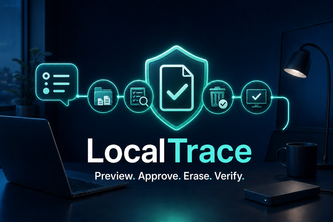
- It turns local cleanup into a reviewable workflow: inventory, preview, approve, erase, verify.
- It supports both Codex and Claude Desktop, with cross-provider adapter architecture.
- It is built to be deterministic, using PowerShell and Python scripts for discovery and mutation.
- It avoids broad deletion rules by focusing on logical record removal inside transactions.
Claim vs Fact: The description makes strong claims about safety, determinism, and workflow design, but these are self-reported and unverified. There is no evidence of actual user feedback or product performance beyond the author’s own testing.
Target Customer & ICP
The description states that LocalTrace targets:
- Users of Codex and Claude desktop AI tools.
- Developers or power users who work with local AI task artifacts.
- Individuals concerned about local trace safety, especially those using AI tools in Windows environments.
It is implied to be a developer tool, not a consumer-facing product.
Inference: The ICP likely includes developers, AI researchers, and advanced users of desktop AI platforms. However, there is no evidence of actual customer segmentation or user interviews.
Business Model & Pricing Evidence
The description does not mention:
- Any pricing model
- Revenue streams
- Monetization strategy
- Subscription plans or licensing terms
Not evidenced: No information on how LocalTrace intends to generate value or charge users.
Technical & Delivery Signals
The project is built with:
- Tools: Codex, GPT-5.6, PowerShell, Python, SQLite, Windows
- Architecture: Cross-provider adapter model, shared user-facing skill, deterministic engine
- Features:
- Dry-run by default
- Process guards (prevents execution if apps are open)
- Protected paths and fixed roots
- Verification post-execution
- Synthetic test cases covering deletion, reconciliation, protection scenarios
It includes:
- Valid plugin manifests for Codex and Claude
- A public demo video
- Judge tests with no API keys or private data
Inference: The technical implementation suggests a lightweight, focused tool built for AI developers. It is not a full platform but a specialized plugin.
Traction & Maturity Signals
The description states:
- The project was built during an OpenAI hackathon.
- A public demo exists (2 min 16 sec).
- Synthetic test cases were created.
- Plugin manifests are valid.
- One-command judge tests exist.
However, there is no evidence of:
- Actual user adoption
- Customer feedback or usage metrics
- Product versioning or release history
- Market traction or growth
Not evidenced: No signs of real-world deployment or user engagement beyond the author’s own development.
Competitive Context
The description does not mention:
- Competitors
- Existing tools in this space
- Market positioning relative to other AI trace cleanup solutions
Not evidenced: No competitive landscape data is available.
Open Questions & Risks
- No user base or adoption evidence – The tool appears to be a prototype with no known users.
- Self-reported only – All claims are unverified and lack independent corroboration.
- Limited scope – Focused on Codex and Claude, with no cross-platform support beyond Windows.
- No monetization strategy – No indication of how the tool will be sold or funded.
- Developer-centric – Likely not suitable for mainstream users or enterprise adoption.
Inference: The project lacks commercial viability indicators and may be a proof-of-concept rather than a scalable product.
Questions the description leaves open
- What is the actual user base or intended audience beyond the author?
- Have you tested LocalTrace with real users or in production environments?
- How do you plan to monetize this tool, if at all?
- Are there any plans for cross-platform support beyond Windows?
- What are the limitations of the current plugin architecture that might prevent scaling?
Overall Assessment
The description presents LocalTrace as a developer-focused prototype built during a hackathon. It is not evidenced to have:
- Revenue
- Customers
- Traction
- Market validation
- A clear path to monetization
Assessment: Based on the self-reported evidence alone, this project appears to be an experimental tool with no demonstrated commercial viability or market readiness. It is not suitable for investment or partnership consideration without further evidence of traction or user adoption.
User Stories BotA demo video on every pull request
Get a demo video on every new feature
GitHub App that watches your pull requests and records a narrated, captioned demo.
Save time on demo prep and make informed decisions faster with a video walkthrough of every new feature.
Source
Submitted to the OpenAI 2026 hackathon on Devpost. Project home on Devpost. Back to the full gallery on Devpost.
This competitive analysis was produced by top-founders.com (opens in a new tab)
Generated by a language model from this project's public Devpost page — its tagline, the author's own write-up and any built-with tags listed there — as captured in August 2026. Short quotations are the author's words. It is an opinion on the idea as a business, not on the people behind it, and it reflects the description as published then. If the project has moved on, request a correction below. The analysis is not independent research and contains no verified traction, revenue or customer data.
An independent guide by KFG International LLC — not affiliated with, endorsed by, or connected to Devpost or OpenAI.