

Archive position — measured, not model output
1 like on Devpost
505 of the 7,850 archived projects have more likes, and 1,758 share exactly 1 — so this project's #1,889 place in the like-ranked listing is a tie-break inside that group, not a ranking.
Projects (log scale)
Likes on Devpost. ▲ marks this project's group.
Show the figures
| Likes | Projects | Share of archive |
|---|---|---|
| 0 | 5,587 | 71.2% |
| 1 | 1,758 | 22.4% |
| 2 | 284 | 3.6% |
| 3–4 | 132 | 1.7% |
| 5–9 | 75 | 1.0% |
| 10+ | 14 | 0.2% |
 User Stories BotA demo video on every pull request
Get a demo video on every new feature
GitHub App that watches your pull requests and records a narrated, captioned demo.
Save time on demo prep and make informed decisions faster with a video walkthrough of every new feature.
Executive Summary
Project: SecPay
Self-reported basis: The description is entirely from the author’s own submission to a hackathon — no independent verification, archived history, or third-party corroboration.
Commercial due-diligence read: SecPay is a self-reported proof-of-concept dApp for real-time wage streaming on Base, built as a hackathon project by one developer. It demonstrates technical feasibility of a lazy-accrual model for continuous salary distribution but lacks evidence of traction, revenue, customers or commercial viability. The most important open question is whether the author intends to build a production-ready product and how they plan to scale beyond a testnet demo.
What The Product Actually Is
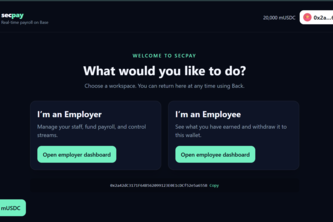
The description states that SecPay is a real-time wage-streaming dApp built on Base. It allows employers to fund a payroll pool, assign employees by wallet address, and distribute salaries continuously — with employees able to withdraw earned amounts at any time.
- Employers create and fund a payroll pool.
- Employees accrue salary every second based on a lazy-accrual model (not real-time blockchain transactions).
- The system supports starting, pausing, resuming, and withdrawing from streams.
- It uses MockUSDC for testing on Base Sepolia.
- Smart contracts are written in Solidity, frontend in Next.js, using tools like wagmi, viem, RainbowKit, and Tailwind CSS.
Inference: The product is a demo-level implementation, not a production-ready service. It uses a testnet environment and mock tokens.
Positioning & Claim Evolution
The author positions SecPay as a solution to the problem of delayed access to earned wages, particularly for workers who face daily expenses but are paid monthly.
- The tagline: “Real-Time Wage Streaming on Blockchain” is a self-stated claim.
- The inspiration behind it comes from the idea that blockchain can enable continuous access to earned income.
- The project is described as a proof-of-concept, not a commercial product.
Inference: The positioning is aspirational and not yet validated in any market. It reflects an idea, not a product with traction or adoption.
Target Customer & ICP
The description does not name specific customers or personas. However, it implies:
- Employers (who create payroll pools)
- Employees (who receive wages via wallet and withdraw earned balances)
It is unclear whether the author envisions:
- Employers as individuals or businesses
- Employees as gig workers, freelancers, or traditional employees
Inference: The ICP is not defined beyond a general audience of employers and employees. No segmentation or targeting data is provided.
Business Model & Pricing Evidence
There is no evidence in the description of:
- A pricing model
- Revenue streams
- Monetization strategy
- Fees or commissions
The project is described as a demo, not a commercial offering.
Inference: No business model is evident. The author has not indicated how SecPay would generate revenue.
Technical & Delivery Signals
The project was built with:
- Solidity for smart contracts
- Foundry for testing
- Next.js and TypeScript for frontend
- Tools like wagmi, viem, RainbowKit
- Mock token deployment on Base Sepolia
- Lazy accrual model to avoid expensive per-second transactions
The author states:
- The system includes deployed contracts, dashboards, live balance animation, and full payroll flow.
- Security features include SafeERC20 transfers, reentrancy protection, employer-only admin controls, and test coverage.
Inference: Technical delivery is functional for a demo but not production-ready. It shows some depth in smart contract design and frontend integration.
Traction & Maturity Signals
The description states:
- The project was built as a hackathon submission
- It includes deployed contracts on Base Sepolia
- A test token faucet, employer/employee dashboards, live balance animation
- No real-world users or customers are mentioned
Inference: There is no evidence of traction, adoption, or user engagement. It is a demo-level prototype.
Competitive Context
The description does not mention any competitors or existing solutions in the wage-streaming or payroll space.
Inference: No competitive landscape is described. The author does not reference similar products or services.
Open Questions & Risks
- Unverified claims: All descriptions are self-reported and unverified.
- Demo-only scope: The product exists only as a testnet demo, not a live system.
- No commercialization plan: No evidence of how the idea will be monetized or scaled.
- Single developer team: Only one person built it.
- Lack of legal/compliance framework: The author notes that real-world rollout would require audits, compliance reviews, and employer verification — but none are currently in place.
Inference: The project is at a very early stage with no commercial or operational infrastructure. It is not ready for production use or investment.
Questions the description leaves open
- What is the plan to move from testnet to mainnet?
- How will you handle identity verification of employers and employees?
- Are there any legal or compliance considerations that have been addressed?
- What are your plans for user acquisition or employer partnerships?
- Do you intend to build a sustainable business model beyond this demo?
- Have you considered how to manage payroll tax implications or regulatory requirements?
- How do you plan to scale the system beyond a single developer?
Overall Assessment
Not evidenced — there is no evidence of revenue, customers, traction, or commercial viability.
The project is a self-reported hackathon demo, not a product with market validation or business traction. It shows technical capability but lacks any indication of:
- Commercial intent
- Product-market fit
- Scalability
- Revenue model
Confidence level: Low — based on thin evidence and self-reporting only.
Assessment: Not ready for investment or partnership at this stage. The author may be exploring an idea, but no product or business exists beyond a prototype.
User Stories BotA demo video on every pull request
Get a demo video on every new feature
GitHub App that watches your pull requests and records a narrated, captioned demo.
Save time on demo prep and make informed decisions faster with a video walkthrough of every new feature.
Source
Submitted to the OpenAI 2026 hackathon on Devpost. Project home on Devpost. Back to the full gallery on Devpost.
This competitive analysis was produced by top-founders.com (opens in a new tab)
Generated by a language model from this project's public Devpost page — its tagline, the author's own write-up and any built-with tags listed there — as captured in August 2026. Short quotations are the author's words. It is an opinion on the idea as a business, not on the people behind it, and it reflects the description as published then. If the project has moved on, request a correction below. The analysis is not independent research and contains no verified traction, revenue or customer data.
An independent guide by KFG International LLC — not affiliated with, endorsed by, or connected to Devpost or OpenAI.