

Archive position — measured, not model output
1 like on Devpost
505 of the 7,850 archived projects have more likes, and 1,758 share exactly 1 — so this project's #1,855 place in the like-ranked listing is a tie-break inside that group, not a ranking.
Projects (log scale)
Likes on Devpost. ▲ marks this project's group.
Show the figures
| Likes | Projects | Share of archive |
|---|---|---|
| 0 | 5,587 | 71.2% |
| 1 | 1,758 | 22.4% |
| 2 | 284 | 3.6% |
| 3–4 | 132 | 1.7% |
| 5–9 | 75 | 1.0% |
| 10+ | 14 | 0.2% |
 User Stories BotA demo video on every pull request
Get a demo video on every new feature
GitHub App that watches your pull requests and records a narrated, captioned demo.
Save time on demo prep and make informed decisions faster with a video walkthrough of every new feature.
Executive Summary
What the company appears to be
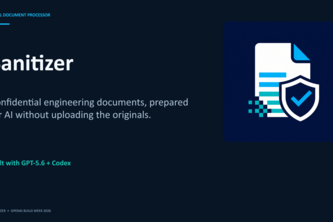
Sanitizer is a self-reported Windows desktop application designed for engineering and business document sanitization, intended to prepare confidential project documentation for use with AI systems like Codex. It is described as a tool that processes local files, removes or masks sensitive information, converts content into Markdown, and organizes documents into an AI-ready workspace.
What changed
The author reports building a complete working desktop application rather than a proof of concept. The project was submitted to the OpenAI 2026 hackathon, indicating a development milestone and public launch intent.
Single most important open question
Is there evidence of traction, revenue, or customer adoption beyond the self-reported build and submission? The description does not include any data on usage, customers, or monetization.
What The Product Actually Is
The description states that Sanitizer is a Windows desktop application. It is designed to:
- Process individual files or complete folders.
- Extract text, images, metadata, and tables from supported documents.
- Apply user-defined rules for deletion or masking of sensitive content.
- Convert supported content into Markdown.
- Organize processed documents by type.
- Generate a searchable index.
- Export a folder-based workspace for Codex.
It is built using .NET, C#, and Windows App SDK technologies. The application preserves original files and operates locally on the user’s computer.
Inference The product is described as a local desktop tool, not a cloud or SaaS offering. It is intended to be used by managers in engineering environments who need to sanitize documents before AI processing.
Positioning & Claim Evolution
The author states that Sanitizer addresses the concern that “privacy and sensitive information protection is the biggest concern when using AI.” The product is positioned as a solution for engineers and managers who work with confidential project documentation and want to safely prepare it for AI tools like Codex.
It claims to be:
- A simple, non-technical tool for document sanitization.
- A local-first solution, keeping data on the user’s machine.
- A bridge between real-world documents and AI-assisted workflows.
- A manager-friendly interface that abstracts complex processes like OCR, indexing, and verification.
Inference Sanitizer positions itself as a sanitization tool for AI-ready engineering documentation, not a general-purpose document editor or AI platform. It is framed as solving a trust and workflow problem in AI adoption.
Target Customer & ICP
The description states that Sanitizer is designed for managers working with engineering project packages, including:
- Specifications
- Control narratives
- Sequences of operation
- Building drawings
- Electrical drawings
- Mechanical drawings
- P&IDs (Piping and Instrumentation Diagrams)
These are described as containing sensitive data such as customer names, site information, addresses, and network details.
Inference The target customer is non-technical professionals in engineering or project management, who need to sanitize confidential documents before AI processing. The ICP appears to be engineering teams or project managers working with large, structured documentation sets.
Business Model & Pricing Evidence
Not evidenced.
The description does not mention any pricing model, monetization strategy, or business model. It is unclear whether Sanitizer will be sold, offered as a free tool, or distributed through a subscription.
Technical & Delivery Signals
The project is built as a native Windows desktop application using:
- .NET
- C#
- Windows App SDK (WinUI 3)
- Microsoft Store distribution
- OpenXML SDK
- OCR
- SQLite for local indexing
- Codex (GPT-5.6 Sol) for development assistance
It is described as a folder-and-file-based system, with no proprietary database dependency.
Inference The technical stack suggests a local-first, Windows-centric solution. The use of Microsoft Store distribution and WinUI 3 indicates an intent to reach users through official Windows channels.
Traction & Maturity Signals
Not evidenced.
There is no mention of:
- Revenue
- Customers
- Usage metrics
- Product adoption
- Market feedback or user testing
The project is described as a working desktop application, but no evidence of traction beyond the hackathon submission exists.
Competitive Context
Not evidenced.
No information is provided about competitors, market size, or competitive positioning. The author does not reference existing tools for document sanitization or AI preparation in engineering workflows.
Open Questions & Risks
- No revenue or customer data: The product is described as a working prototype, but no evidence of monetization or adoption.
- Single-founder team: The project is built by one person (Mikhail Kozyrev), which may limit scalability or long-term development capacity.
- Limited scope: It is focused on Windows desktop and engineering documents. No indication of cross-platform support or broader applicability.
- No verification of claims: The description does not include any independent validation, testing, or user feedback.
Questions the description leaves open
- What specific types of engineering or business documents are supported?
- How is the sanitization process verified? Is there a manual review step?
- Are there plans to support other platforms (e.g., macOS, web)?
- What is the intended pricing model or monetization strategy?
- Has the tool been tested with real users in engineering environments?
- How does Sanitizer handle edge cases like scanned documents or complex metadata?
- Is there a roadmap for expanding document formats or AI integration?
Overall Assessment
Not evidenced.
There is no evidence of traction, revenue, or customer adoption to support an investment or partnership decision. The project is described as a working prototype submitted to a hackathon, with no indication of commercial viability or market readiness.
The author states that the goal is to make confidential project knowledge safely usable with AI—while keeping organizations in control of their information—but this remains a self-reported ambition without supporting data.
User Stories BotA demo video on every pull request
Get a demo video on every new feature
GitHub App that watches your pull requests and records a narrated, captioned demo.
Save time on demo prep and make informed decisions faster with a video walkthrough of every new feature.
Source
Submitted to the OpenAI 2026 hackathon on Devpost. Project home on Devpost. Back to the full gallery on Devpost.
This competitive analysis was produced by top-founders.com (opens in a new tab)
Generated by a language model from this project's public Devpost page — its tagline, the author's own write-up and any built-with tags listed there — as captured in August 2026. Short quotations are the author's words. It is an opinion on the idea as a business, not on the people behind it, and it reflects the description as published then. If the project has moved on, request a correction below. The analysis is not independent research and contains no verified traction, revenue or customer data.
An independent guide by KFG International LLC — not affiliated with, endorsed by, or connected to Devpost or OpenAI.