

Archive position — measured, not model output
0 likes on Devpost
2,263 of the 7,850 archived projects have more likes, and 5,587 share exactly 0 — so this project's #6,446 place in the like-ranked listing is a tie-break inside that group, not a ranking.
Projects (log scale)
Likes on Devpost. ▲ marks this project's group.
Show the figures
| Likes | Projects | Share of archive |
|---|---|---|
| 0 | 5,587 | 71.2% |
| 1 | 1,758 | 22.4% |
| 2 | 284 | 3.6% |
| 3–4 | 132 | 1.7% |
| 5–9 | 75 | 1.0% |
| 10+ | 14 | 0.2% |
 User Stories BotA demo video on every pull request
Get a demo video on every new feature
GitHub App that watches your pull requests and records a narrated, captioned demo.
Save time on demo prep and make informed decisions faster with a video walkthrough of every new feature.
Executive Summary
What the company appears to be
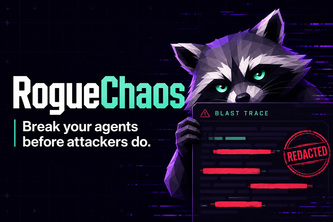
RogueChaos is an open-source, Codex-native chaos-engineering toolkit for AI agents. The author describes it as a security tool that injects contained attacks into AI agents, traces failures, generates fixes, and verifies resilience using a transparent RogueScore.
What changed
The project was submitted to the OpenAI 2026 hackathon on Devpost. It is self-described as a proof-of-concept or demo with synthetic users, orders, tools, approvals, and secrets. It includes a bundled demo agent and twelve attack scenarios covering prompt injection, secret leakage, cross-user access, etc.
Single most important open question
Is there any evidence of real-world adoption, usage beyond the hackathon demo, or product-market fit beyond the author’s own claims?
What The Product Actually Is
The description states that RogueChaos is an open-source, Codex-native chaos-engineering toolkit for AI agents. It provides a workflow including:
- Scanning agent capabilities and safety boundaries
- Attacking with versioned, declarative security recipes
- Capturing redacted Blast Traces showing what the agent observed, decided, and attempted
- Grading results with deterministic security rules
- Hardening the target using finding-linked fixes and regression tests
- Verifying repairs against same attacks and benign controls
- Publishing a transparent RogueScore and Resilience Card
It includes:
- A Python CLI offline-first engine
- YAML-based attack recipes validated against JSON Schema
- Framework adapters for LangGraph, Google ADK, OpenAI Responses
- Privacy-preserving features like redaction of sensitive data in memory
- Support for multiple output formats (terminal, JSON, Markdown, HTML, JUnit)
- A Codex skill for diagnosis-to-repair workflow
- An optional Vertex AI Gemini remediation advisory
Inference The tool is designed to be used by developers or security engineers working with AI agents, particularly those built using frameworks like LangGraph or OpenAI.
Positioning & Claim Evolution
The author positions RogueChaos as a chaos-engineering approach to AI agent security, aiming to "break your AI agents before attackers do." It is described as a way to test AI agents in controlled environments and harden them based on findings.
Key claims:
- It enables testing of AI agents without exposing real data or systems.
- It supports deterministic grading and verification of fixes.
- It provides a “transparent RogueScore” and shareable Resilience Cards.
- It integrates with existing agent frameworks (LangGraph, OpenAI, etc.).
- It uses a privacy-preserving architecture that avoids storing sensitive content.
Inference The positioning suggests a niche but growing market for AI agent security tools, especially in the context of increasing use of LLMs and autonomous agents.
Target Customer & ICP
The description does not name specific customers or personas. However, it implies:
- Developers building AI agents using frameworks like LangGraph or OpenAI
- Security engineers focused on AI agent safety
- Teams looking to implement chaos engineering practices for AI systems
Inference The target is likely early-stage developers or security teams working with LLM-based agents who are concerned about prompt injection, tool misuse, and unauthorized access.
Business Model & Pricing Evidence
There is no evidence of a business model or pricing structure in the description. The project is described as open-source, and no mention is made of monetization, licensing, or paid features.
Inference If this remains open-source, there may be no direct revenue model at present.
Technical & Delivery Signals
The tool is built with:
- Python CLI (offline-first)
- YAML-based attack recipes
- JSON Schema validation for recipes
- Framework adapters for LangGraph, Google ADK, OpenAI Responses
- Redaction and normalization of sensitive data in memory
- Typed evidence markers to prove leaks without storing raw values
- Support for multiple output formats (terminal, JSON, Markdown, HTML, JUnit)
- A Codex skill for diagnosis-to-repair workflow
- Optional Vertex AI advisory that receives only metadata
Inference The technical stack suggests a developer-focused tool with strong emphasis on privacy and reproducibility.
Traction & Maturity Signals
The description states:
- It was submitted to the OpenAI 2026 hackathon.
- Includes a bundled demo agent with synthetic users, orders, tools, approvals, and secrets.
- Exercises twelve contained attack scenarios.
- The demo shows baseline score of 0/100 and after hardening, 100/100.
There is no evidence of:
- Real-world usage or adoption
- Customer feedback or testimonials
- Revenue or funding data
- Product-market fit beyond the author’s own claims
Inference The maturity level appears to be that of a proof-of-concept or hackathon demo, with limited external validation or traction.
Competitive Context
The description does not mention competitors. However, it implies a space where:
- AI agent security is emerging
- Chaos engineering principles are being applied to LLMs and autonomous agents
- Tools exist for testing prompt injection, tool misuse, and data leakage
Inference This likely competes or overlaps with tools in the AI safety, LLM security, and chaos engineering spaces, though no direct competitors are named.
Open Questions & Risks
- No evidence of real-world usage or adoption beyond a demo
- Open-source nature implies no immediate monetization path
- Self-reported maturity level (hackathon demo)
- No mention of scalability, performance, or integration with enterprise tools
- Risk of being too niche for mainstream adoption
- Lack of clarity on how it would scale beyond synthetic demos
Questions the description leaves open
- What is the intended transition from a hackathon demo to a production-ready tool?
- Are there any real-world use cases or partnerships already in place?
- How does RogueChaos plan to monetize if it remains open-source?
- Has the tool been tested with actual AI agents beyond the synthetic demo?
- What are the long-term plans for framework support and integrations?
- Is there a roadmap for enterprise features, scalability, or performance improvements?
Overall Assessment
Not evidenced.
The description is entirely self-reported and unverified. There is no evidence of:
- Revenue
- Customers
- Traction
- Funding
- Product-market fit
- Market demand beyond the author’s own claims
This appears to be a proof-of-concept or hackathon submission, not a developed product with commercial viability.
Confidence: Low
The project description is limited in scope and lacks any indication of real-world adoption, traction, or commercial readiness. Any investment or partnership decision would require further due diligence beyond this self-reported account.
User Stories BotA demo video on every pull request
Get a demo video on every new feature
GitHub App that watches your pull requests and records a narrated, captioned demo.
Save time on demo prep and make informed decisions faster with a video walkthrough of every new feature.
Source
Submitted to the OpenAI 2026 hackathon on Devpost. Project home on Devpost. Back to the full gallery on Devpost.
This competitive analysis was produced by top-founders.com (opens in a new tab)
Generated by a language model from this project's public Devpost page — its tagline, the author's own write-up and any built-with tags listed there — as captured in August 2026. Short quotations are the author's words. It is an opinion on the idea as a business, not on the people behind it, and it reflects the description as published then. If the project has moved on, request a correction below. The analysis is not independent research and contains no verified traction, revenue or customer data.
An independent guide by KFG International LLC — not affiliated with, endorsed by, or connected to Devpost or OpenAI.