

Archive position — measured, not model output
0 likes on Devpost
2,263 of the 7,850 archived projects have more likes, and 5,587 share exactly 0 — so this project's #6,417 place in the like-ranked listing is a tie-break inside that group, not a ranking.
Projects (log scale)
Likes on Devpost. ▲ marks this project's group.
Show the figures
| Likes | Projects | Share of archive |
|---|---|---|
| 0 | 5,587 | 71.2% |
| 1 | 1,758 | 22.4% |
| 2 | 284 | 3.6% |
| 3–4 | 132 | 1.7% |
| 5–9 | 75 | 1.0% |
| 10+ | 14 | 0.2% |
 User Stories BotA demo video on every pull request
Get a demo video on every new feature
GitHub App that watches your pull requests and records a narrated, captioned demo.
Save time on demo prep and make informed decisions faster with a video walkthrough of every new feature.
Executive Summary
What the company appears to be
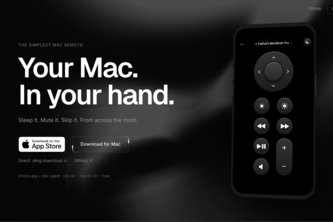
Rimote is a self-reported Mac remote control application that turns an iPhone into a Wi-Fi-only remote for a Mac, without requiring cloud services, accounts, or internet connectivity. It is built as a local-first tool with no analytics or server dependencies.
What changed
The project was submitted as part of the OpenAI 2026 hackathon and describes a production-ready version (v1.0.0) that includes an iOS app on the App Store, a signed macOS menu-bar agent, and end-to-end test coverage. It is presented as a solo effort by one developer.
The single most important open question
Is there any evidence of user adoption or revenue generation beyond the author's own development and submission to a hackathon?
What The Product Actually Is
The description states that Rimote is a Mac remote control application that uses an iPhone as a remote over Wi-Fi only, without cloud services or internet. It supports actions like power management (sleep, lock, restart), audio controls (volume/mute), media playback (play/pause/next/prev), display brightness adjustment, and clickpad functionality for presentations or AI agent workflows.
It also states that the product works via a raw WebSocket on port 8765, uses Bonjour for discovery, and has no IP or configuration requirements. The system is event-driven and designed to minimize idle CPU usage.
Evidence
- "Rimote turns an iPhone into a remote for a Mac over Wi-Fi only, no cloud, no analytics."
- "SwiftUI on iPhone talks to a Swift/AppKit menu-bar agent over a raw WebSocket on port 8765."
- "Discovery is Bonjour (_rimote._tcp), zero IPs, zero config."
Inference The product appears to be a local-first tool with minimal dependencies and strong security posture.
Positioning & Claim Evolution
The author positions Rimote as a solution to the inconvenience of using physical remotes or clunky cloud-based tools for Mac control. It emphasizes simplicity, privacy, and no-account requirements.
Evidence
- "It exists because pausing a movie, accepting your AI Agents plan, or clicking through presentations should be a breeze."
- "Every existing 'remote' required a cloud account or a server. We wanted zero accounts, zero servers, zero internet."
Inference The positioning is rooted in the idea of local-first, privacy-focused control tools — a niche within the broader Mac productivity space.
Target Customer & ICP
The description does not explicitly state target customers or personas. However, it implies use cases for individuals who work with presentations, media playback, and AI agents on Macs, and who value privacy and simplicity.
Evidence
- "clicking through presentations should be a breeze"
- "works across YouTube, Spotify, Music"
- "driving Keynote or an AI agent's plan"
Inference The likely ICP includes power users of macOS who want to avoid cloud-based tools and prefer local control.
Business Model & Pricing Evidence
There is no evidence of pricing, monetization strategy, or business model in the description. The project appears to be a hackathon submission with no commercial traction.
Evidence
- No mention of revenue, pricing tiers, subscriptions, or paid features.
- The product is described as shipped and available on the App Store but without any indication of monetization.
Inference The business model remains unclear; it may be free-to-use or a one-time purchase, but this is not stated.
Technical & Delivery Signals
The project was built using Swift (89.5%) with SwiftUI for iOS and AppKit for macOS. It uses a raw WebSocket connection, Bonjour for discovery, and includes a frozen protocol file to maintain compatibility. The system includes end-to-end tests and security measures like a hardcoded whitelist and constant-time token validation.
Evidence
- "Built with (author-declared): claude, codex, cursor, openai, swift"
- "Stack: 89.5% Swift, 10.5% Shell for DMG packaging and notarization."
- "A 16-check e2e suite drives the real compiled agent binary through the full protocol..."
- "No cloud meant the agent itself had to be the security boundary."
Inference The technical stack is solid and production-grade, with attention to local-first design and security.
Traction & Maturity Signals
The project has shipped a v1.0.0 version, is live on the App Store, and includes signed and notarized macOS app binaries. It also includes end-to-end tests and a protocol file that ensures compatibility between components.
Evidence
- "Shipped, not prototyped: signed, notarized macOS app, live iOS app on the App Store, v1.0.0 tagged."
- "A 16-check e2e suite drives the real compiled agent binary through the full protocol..."
Inference The product is mature enough to be released and has undergone internal testing, but no external adoption or usage data is provided.
Competitive Context
There are no references to competitors in the description. The author notes that existing remotes required cloud services or servers, implying a niche for local-first tools.
Evidence
- "Every existing 'remote' required a cloud account or a server."
Inference The competitive landscape is not described, but it may include other Mac control apps or cloud-based remote solutions. The lack of competitors mentioned suggests either a new space or limited awareness of alternatives.
Open Questions & Risks
- No user data or adoption metrics: There is no evidence of real-world usage or customer feedback.
- Solo developer project: The team size is listed as one, which may limit scalability and long-term maintenance.
- Limited functionality: The product supports only basic Mac control features; it does not include advanced features like app switching or window management.
- Wi-Fi dependency: Bonjour discovery can fail in enterprise environments, limiting usability.
Evidence
- "Team size: 1"
- "Enterprise Wi-Fi that blocks Bonjour kills discovery outright."
- "Some things just don't have a fix, brightness is a blind write since macOS won't report the real level back"
Questions the description leaves open
- What is the actual user adoption or feedback you’ve received post-release?
- Are there any plans to monetize the product beyond its current App Store listing?
- How do you plan to scale beyond a solo developer, especially for feature expansion or support?
- Have you considered how enterprise users with restrictive Wi-Fi policies will use this tool?
- What are your long-term plans for expanding functionality (e.g., app switching, window management)?
- Is there any internal testing or feedback from users beyond the author?
Overall Assessment
Not evidenced.
There is no evidence of revenue, customer traction, or market validation to support an investment or partnership decision. The project appears to be a solo developer’s hackathon submission that has shipped a functional version but lacks any commercial or user engagement metrics.
Confidence Level Low
Reasoning
The description is self-reported and unverified, with no third-party data, customer feedback, or financials. It shows technical maturity but not commercial viability or traction.
User Stories BotA demo video on every pull request
Get a demo video on every new feature
GitHub App that watches your pull requests and records a narrated, captioned demo.
Save time on demo prep and make informed decisions faster with a video walkthrough of every new feature.
Source
Submitted to the OpenAI 2026 hackathon on Devpost. Project home on Devpost. Back to the full gallery on Devpost.
This competitive analysis was produced by top-founders.com (opens in a new tab)
Generated by a language model from this project's public Devpost page — its tagline, the author's own write-up and any built-with tags listed there — as captured in August 2026. Short quotations are the author's words. It is an opinion on the idea as a business, not on the people behind it, and it reflects the description as published then. If the project has moved on, request a correction below. The analysis is not independent research and contains no verified traction, revenue or customer data.
An independent guide by KFG International LLC — not affiliated with, endorsed by, or connected to Devpost or OpenAI.