

Archive position — measured, not model output
4 likes on Devpost
89 of the 7,850 archived projects have more likes, and 39 share exactly 4 — so this project's #117 place in the like-ranked listing is a tie-break inside that group, not a ranking.
Projects (log scale)
Likes on Devpost. ▲ marks this project's group.
Show the figures
| Likes | Projects | Share of archive |
|---|---|---|
| 0 | 5,587 | 71.2% |
| 1 | 1,758 | 22.4% |
| 2 | 284 | 3.6% |
| 3–4 | 132 | 1.7% |
| 5–9 | 75 | 1.0% |
| 10+ | 14 | 0.2% |
 User Stories BotA demo video on every pull request
Get a demo video on every new feature
GitHub App that watches your pull requests and records a narrated, captioned demo.
Save time on demo prep and make informed decisions faster with a video walkthrough of every new feature.
Executive Summary
What the company appears to be
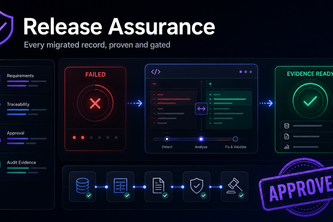
Release Assurance is a self-reported tool designed to prevent silent failures in banking migration processes and generate audit-ready evidence for every fix. It is positioned as a solution for developers or teams managing financial system transitions, with an emphasis on compliance and traceability.
What changed
The project was submitted to the OpenAI 2026 hackathon, suggesting it is early-stage and likely prototypical in nature. No prior traction, revenue, or customer evidence is provided.
Single most important open question
Is there a real-world use case for this tool, or is it an experimental concept with no clear commercial application?
What The Product Actually Is
The description states: “Release Assurance catches silent banking migration failures and turns every fix into audit-ready evidence.”
- Inferred: The product is likely a software tool that monitors and validates financial data migrations to detect silent errors (e.g., missing or incorrect data) and logs these for compliance purposes.
- Not evidenced: No details on how the tool works, what it monitors, or whether it integrates with specific banking systems.
Evidence strength
- Claimed functionality: "Catches silent banking migration failures" — not verified.
- Inferred purpose: To provide audit-ready logs of fixes — not evidenced.
- Not evidenced: Technical architecture, data flow, or integration points.
Positioning & Claim Evolution
The tagline: “Codex proposes. Humans approve. Auditors get receipts.”
- Claimed positioning: The tool is a hybrid between AI (Codex) and human oversight, with audit readiness as a core value proposition.
- Inferred evolution: It appears to be a response to the need for compliance in financial migrations — possibly targeting regulated industries or internal audit teams.
Evidence strength
- Claimed positioning: Yes.
- Claimed evolution: Not evidenced.
- Not evidenced: What problem it solves beyond "silent failures", how it differs from existing tools, or whether this is a new category.
Target Customer & ICP
The description states: “Release Assurance catches silent banking migration failures and turns every fix into audit-ready evidence.”
- Inferred target customer: Teams managing financial system migrations (e.g., banks, fintechs, or enterprise IT departments).
- Inferred ICP: Organizations with strict compliance requirements and internal auditors who need to validate changes.
Evidence strength
- Claimed ICP: Not evidenced.
- Not evidenced: Specific customer personas, use cases, or industry verticals.
Business Model & Pricing Evidence
The description does not mention pricing, licensing, or monetization strategy.
- Not evidenced: No business model or pricing structure is stated.
Evidence strength
- Claimed business model: Not evidenced.
- Not evidenced: Revenue streams, customer acquisition costs, or monetization approach.
Technical & Delivery Signals
The author-declared tech stack includes: bun, codex, fastapi, github-actions, gpt-5.6, openai, playwright, python, react, shadcn, tailwind, typescript, vite.
- Inferred delivery signals: The tool is likely built using modern web and AI technologies, with a frontend (React) and backend (FastAPI), integrated with GitHub Actions and OpenAI APIs.
- Not evidenced: Whether the tool is production-ready, scalable, or deployed in any environment.
Evidence strength
- Claimed tech stack: Yes.
- Inferred delivery signals: Not verified.
- Not evidenced: Deployment model, scalability, or performance metrics.
Traction & Maturity Signals
The project was submitted to the OpenAI 2026 hackathon on Devpost.
- Inferred maturity: Early-stage prototype or proof of concept.
- Not evidenced: No evidence of revenue, customers, user adoption, or product-market fit.
Evidence strength
- Claimed traction: Not evidenced.
- Not evidenced: Metrics, customer feedback, or usage data.
Competitive Context
The description does not mention competitors or the competitive landscape.
- Not evidenced: No indication of existing tools or solutions in this space.
Evidence strength
- Claimed context: Not evidenced.
- Not evidenced: Competitor analysis, market size, or differentiation strategy.
Open Questions & Risks
- No evidence of real-world application: The tool is described only as a hackathon submission.
- Unproven value proposition: No proof that silent banking failures are a significant problem or that the solution addresses it effectively.
- Unclear commercial viability: No pricing, business model, or customer base mentioned.
- High reliance on AI tools: Uses GPT-5.6 and Codex — but no evidence of how these are integrated into a working system.
Evidence strength
- Inferred risks: Based on lack of evidence.
- Not evidenced: Specific risks tied to the product or market.
Questions the description leaves open
- What specific silent failures in banking migrations does this tool detect, and how are they currently handled?
- Who are your early adopters or potential customers, and what is their feedback?
- How does the tool integrate with existing financial systems or migration workflows?
- Is there a prototype or working version of the product that can be demonstrated?
- What is the intended pricing model, and how do you plan to monetize this solution?
Overall Assessment
Not evidenced: No basis for investment or partnership decision.
Inference: Given the lack of traction, revenue, customer evidence, or detailed product functionality, there is insufficient evidence to assess commercial viability or risk. The project appears to be an early-stage idea submitted to a hackathon with no clear path to market.
Confidence level: Very low — this analysis is based entirely on self-reported claims and lacks any verifiable data.
User Stories BotA demo video on every pull request
Get a demo video on every new feature
GitHub App that watches your pull requests and records a narrated, captioned demo.
Save time on demo prep and make informed decisions faster with a video walkthrough of every new feature.
Source
Submitted to the OpenAI 2026 hackathon on Devpost. Project home on Devpost. Back to the full gallery on Devpost.
This competitive analysis was produced by top-founders.com (opens in a new tab)
Generated by a language model from this project's public Devpost page — its tagline and any built-with tags listed there, since the author published no write-up — as captured in August 2026. Short quotations are the author's words. It is an opinion on the idea as a business, not on the people behind it, and it reflects the description as published then. If the project has moved on, request a correction below. The analysis is not independent research and contains no verified traction, revenue or customer data.
An independent guide by KFG International LLC — not affiliated with, endorsed by, or connected to Devpost or OpenAI.