

Archive position — measured, not model output
1 like on Devpost
505 of the 7,850 archived projects have more likes, and 1,758 share exactly 1 — so this project's #1,757 place in the like-ranked listing is a tie-break inside that group, not a ranking.
Projects (log scale)
Likes on Devpost. ▲ marks this project's group.
Show the figures
| Likes | Projects | Share of archive |
|---|---|---|
| 0 | 5,587 | 71.2% |
| 1 | 1,758 | 22.4% |
| 2 | 284 | 3.6% |
| 3–4 | 132 | 1.7% |
| 5–9 | 75 | 1.0% |
| 10+ | 14 | 0.2% |
 User Stories BotA demo video on every pull request
Get a demo video on every new feature
GitHub App that watches your pull requests and records a narrated, captioned demo.
Save time on demo prep and make informed decisions faster with a video walkthrough of every new feature.
Executive Summary
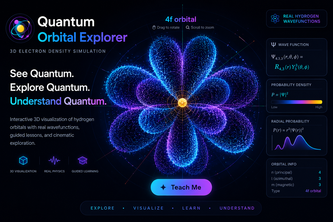
The company appears to be a solo educational technology project focused on interactive visualization of quantum mechanics concepts. The author states that Quantum Classroom is an interactive 3D platform for visualizing hydrogen atomic orbitals using real wavefunctions, with a "guided discovery" teaching mode. It was built as a web application and submitted to the OpenAI 2026 hackathon.
What changed
The project description shows an evolution from a simple visualization tool to a more structured educational experience that includes guided lessons and cinematic animations. The author claims to have transformed static textbook diagrams into interactive exploration.
The single most important open question
Is there evidence of any traction, user adoption or revenue generation beyond the hackathon submission? The description contains no information about customers, usage metrics, monetization, or market validation.
What The Product Actually Is
The description states that Quantum Classroom is an interactive educational platform for visualizing hydrogen atomic orbitals using real quantum mechanical wavefunctions. It allows users to:
- Explore hydrogen orbitals in fully interactive 3D
- Visualize electron probability density
- Experiment with all four quantum numbers
- Observe radial probability distributions
- View orbital energies and wavefunctions
- Understand radial and angular nodes
The application uses real hydrogen atom wavefunctions rather than pre-made 3D models. It also includes a "Teach Me" mode that provides cinematic guided lessons through synchronized camera movement, animations, and contextual explanations.
It was built as a web application using HTML5, CSS3, JavaScript (Vanilla), Three.js, and Firebase Hosting, with orbital geometry generated mathematically and electron density produced via Monte Carlo sampling of the probability density function.
Not evidenced No information about pricing, customer base, revenue, or commercial use beyond the hackathon submission.
Positioning & Claim Evolution
The author states that Quantum Classroom aims to "transform quantum mechanics from something students simply memorize into something they can actually explore, experience, and understand through interaction."
It positions itself as a tool that moves away from static textbook diagrams toward interactive learning experiences. The platform is described as offering:
- Cinematic guided lessons
- Synchronized camera movement and animations
- Educational overlays
- Interactive exploration of abstract concepts
The author also mentions that the project evolved to include features like responsive interface across devices, radial probability graphs, and educational visualization of nodes, probability density, and orbital energy.
Inference The positioning suggests an educational software product aimed at STEM students or educators looking for more engaging tools than traditional textbooks.
Target Customer & ICP
The description states that the platform is designed to help students learn quantum mechanics, particularly those studying hydrogen atomic orbitals. It targets users who are expected to "memorize orbital shapes, quantum numbers, and wavefunctions from static textbook diagrams without ever truly understanding what they represent."
It also mentions a future vision including:
- Classroom integration for teachers and students
- Interactive quizzes and assessments
- AI-powered tutoring
Not evidenced No specific customer segments, personas, or usage data are provided. The description does not indicate whether the tool is aimed at K-12, undergraduate, graduate, or professional learners.
Business Model & Pricing Evidence
The description makes no mention of pricing, monetization, or business model. It only describes the technical and educational aspects of the platform.
Not evidenced No evidence of revenue streams, subscription models, licensing, or commercial partnerships.
Technical & Delivery Signals
The application was built using:
- HTML5
- CSS3
- JavaScript (Vanilla)
- Three.js
- Firebase Hosting
It uses mathematical generation of orbital geometry instead of pre-made 3D models. Electron density is produced through Monte Carlo sampling of the probability density function.
Key technical features include:
- Fully interactive 3D visualization
- Cinematic camera choreography
- Synchronized UI updates and animations
- Responsive interface across desktop, tablet, and mobile devices
The author also mentions that the guided discovery system combines camera movement, animations, UI updates, and educational overlays.
Not evidenced No information about scalability, performance metrics, or technical infrastructure beyond the development stack.
Traction & Maturity Signals
The project was submitted to the OpenAI 2026 hackathon, indicating it is a prototype or early-stage product. The author states that it was built entirely by one person (Harshveer Singh).
There is no evidence of:
- User adoption
- Customer feedback
- Revenue
- Market traction
- Product usage metrics
The description includes a vision for future features such as multi-electron atoms, molecular orbitals, AR/VR experiences, and AI tutoring, suggesting this is an evolving platform.
Not evidenced No data on user engagement, retention, or commercial success beyond the hackathon submission.
Competitive Context
The description does not mention any direct competitors. However, it implies a space that includes:
- Traditional textbook-based quantum mechanics education
- Static orbital visualizers
- Other educational platforms for STEM subjects
It positions itself as an alternative to static diagrams and basic visualizations by offering interactive 3D exploration, real wavefunction modeling, and guided discovery learning.
Not evidenced No competitive landscape, market size, or differentiation analysis is provided.
Open Questions & Risks
- Solo development: The platform was built by one person, which raises questions about scalability, long-term maintenance, and team capacity.
- No commercial traction: There is no evidence of revenue, customers, or adoption beyond the hackathon submission.
- Unverified claims: All descriptions are self-reported and unverified; there is no independent validation of the educational effectiveness or technical accuracy.
- Limited scope: The current version only supports hydrogen atoms. Future plans suggest expansion but no indication of progress toward those goals.
Questions the description leaves open
- What is your plan for scaling beyond a single developer?
- Have you received any feedback from educators or students who have used the platform?
- Are there any pilot programs, partnerships, or early adopters in educational institutions?
- How do you intend to monetize this product if at all?
- What are the technical challenges you've faced in making it accessible across devices and browsers?
- How do you plan to validate that your approach improves learning outcomes compared to traditional methods?
Overall Assessment
Not evidenced: There is no information about funding, valuation, or investment interest. The project appears to be a personal or hackathon effort, with no indication of commercial viability or market traction.
The description shows an early-stage educational tool that addresses a real need for better visualization in quantum mechanics education. However, without evidence of adoption, revenue, or user engagement, it is difficult to assess its potential for investment or partnership.
This is a self-reported prototype, not a validated product with commercial momentum. The author's claims about transformation and innovation are compelling but unverified.
Confidence level: Low — based on the thinness of evidence provided.
User Stories BotA demo video on every pull request
Get a demo video on every new feature
GitHub App that watches your pull requests and records a narrated, captioned demo.
Save time on demo prep and make informed decisions faster with a video walkthrough of every new feature.
Source
Submitted to the OpenAI 2026 hackathon on Devpost. Project home on Devpost. Back to the full gallery on Devpost.
This competitive analysis was produced by top-founders.com (opens in a new tab)
Generated by a language model from this project's public Devpost page — its tagline, the author's own write-up and any built-with tags listed there — as captured in August 2026. Short quotations are the author's words. It is an opinion on the idea as a business, not on the people behind it, and it reflects the description as published then. If the project has moved on, request a correction below. The analysis is not independent research and contains no verified traction, revenue or customer data.
An independent guide by KFG International LLC — not affiliated with, endorsed by, or connected to Devpost or OpenAI.