

Archive position — measured, not model output
0 likes on Devpost
2,263 of the 7,850 archived projects have more likes, and 5,587 share exactly 0 — so this project's #6,109 place in the like-ranked listing is a tie-break inside that group, not a ranking.
Projects (log scale)
Likes on Devpost. ▲ marks this project's group.
Show the figures
| Likes | Projects | Share of archive |
|---|---|---|
| 0 | 5,587 | 71.2% |
| 1 | 1,758 | 22.4% |
| 2 | 284 | 3.6% |
| 3–4 | 132 | 1.7% |
| 5–9 | 75 | 1.0% |
| 10+ | 14 | 0.2% |
 User Stories BotA demo video on every pull request
Get a demo video on every new feature
GitHub App that watches your pull requests and records a narrated, captioned demo.
Save time on demo prep and make informed decisions faster with a video walkthrough of every new feature.
Executive Summary
What the company appears to be
Promo Zone AI is a self-reported two-sided marketplace connecting businesses with social-media creators for promotional video campaigns. The platform uses GPT-5.6 to generate campaign briefs (Campaign Architect) and review creator submissions (Creator Coach), but maintains human control over key business decisions like payouts, approvals, and creator selection.
What changed
The project was built as a hackathon submission during Build Week, integrating AI into an existing marketplace baseline. It includes a mobile app (Flutter-based), a Laravel API backend, and structured use of GPT-5.6 for content creation and coaching workflows.
Single most important open question
Is there any evidence that businesses or creators are actually using this platform beyond the prototype? The description states no revenue, customers, or adoption data — only claims about functionality and design choices.
What The Product Actually Is
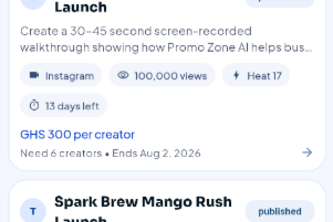
The description states that Promo Zone AI is a structured marketplace where businesses publish campaigns and creators apply to work on them. It supports:
- Publishing of campaign details including product info, platform, payout, target views, brand mentions, hashtags, content instructions, and restrictions.
- Creator workflow: discover campaigns, review requirements, apply, create videos, submit content, track approval/payment status.
- Business workflow: review applications, select creators, evaluate submissions, approve content, release payouts.
It also includes two AI features:
- Campaign Architect — powered by GPT-5.6, it turns basic business inputs into editable creator briefs.
- Creator Coach — powered by GPT-5.6, it evaluates creator drafts against campaign requirements and suggests improvements.
The system is built with Flutter (mobile), Laravel (API), and integrates OpenAI’s GPT-5.6 via structured outputs.
Not evidenced: actual usage, revenue, customer base, or product performance metrics beyond the self-reported development process.
Positioning & Claim Evolution
The description states that the company aims to connect businesses with both emerging and established creators, addressing inefficiencies in current informal partnership models. It positions itself as a structured alternative to scattered messages and informal agreements.
Key claims:
- Businesses need “authentic ways” to introduce products through creator videos.
- Creators struggle with discovering opportunities, understanding requirements, submitting work, and tracking payments.
- The platform offers a structured workflow for campaign management.
- AI is used to improve communication and preparation without replacing human authority.
The positioning evolved from a hackathon prototype into a full-stack product with mobile app, API, and AI features. However, no evidence of prior market traction or customer feedback exists beyond the author’s own account.
Inference: The platform may be attempting to solve a real problem in creator economy workflows, but this is not proven by any external data.
Target Customer & ICP
The description identifies two main user types:
- Businesses — seeking authentic promotional content from creators.
- Creators — looking for structured opportunities and clear campaign instructions.
It states that the platform targets both emerging and established creators, suggesting a broad ICP.
Not evidenced: specific customer segments, personas, or market size estimates.
Inference: The target is likely small-to-medium businesses with marketing budgets who want to engage creators in social video campaigns. But this remains unvalidated.
Business Model & Pricing Evidence
The description does not state any pricing model or monetization strategy.
It mentions:
- Businesses publish campaigns.
- Creators submit content and are paid via a structured workflow.
- Payouts are handled through ledger-backed transactions.
- The platform supports wallet holds and payouts.
No information is provided on how the business makes money — whether it charges fees, takes commissions, or uses freemium models.
Not evidenced: revenue model, pricing tiers, transaction costs, or monetization strategy.
Technical & Delivery Signals
The project was built using:
- Mobile app: Flutter, Dart, Riverpod, GoRouter
- Backend API: Laravel
- AI integration: GPT-5.6 via OpenAI Responses API and Structured Outputs
- Database: MySQL
- Development tools: Codex for code auditing, API research, testing, deployment
Key technical design decisions:
- AI-generated content is treated as untrusted input.
- Business-controlled values (payouts, approvals, payments) are not influenced by the model.
- OpenAI API key remains server-side.
- Structured outputs improve safety and validation of AI responses.
The team deployed a live production API, built a public Android app, tested on real devices, and published source code under MIT license.
Not evidenced: performance data, scalability, or infrastructure details beyond build process.
Traction & Maturity Signals
The description states that the project was submitted to the OpenAI 2026 hackathon, indicating it is a prototype or proof-of-concept built during Build Week.
Accomplishments listed:
- Working mobile app and API
- Live deployment
- Public Android build
- Source code published with documentation
- Testing on emulator and physical devices
However, there is no evidence of:
- Real users or customers
- Revenue generation
- Product adoption metrics
- Customer feedback or retention data
Inference: This is a pre-product stage, likely not yet in production use by real businesses or creators.
Competitive Context
The description does not mention any competitors or competitive landscape.
It implies that the platform addresses inefficiencies in current creator-to-business workflows, but no direct comparison with existing tools (e.g., AspireIQ, CreatorIQ, TikTok for Business, etc.) is made.
Not evidenced: market analysis, competitive positioning, or differentiation from other platforms.
Open Questions & Risks
- No traction or revenue evidence: The platform appears to be a prototype without any demonstrated customer base or monetization.
- AI dependency without clear value validation: While AI features are implemented, there is no indication that they add measurable value beyond the basic workflow.
- Unproven business model: No pricing, fee structure, or monetization strategy is described.
- Single-founder team: The team size is listed as one person (Fuad Lamin), which may limit execution capacity.
- Self-reported only: All claims are unverified and based on the author’s own account.
Inference: If this remains a prototype, it may not yet be ready for commercial use or investment.
Questions the description leaves open
- Has anyone actually used this platform beyond the prototype?
- What is your plan to validate demand from businesses and creators?
- How do you intend to monetize this product?
- Are there any existing partnerships or pilot users?
- What are the key assumptions about user behavior that you’re testing?
- How does the AI integration improve outcomes compared to manual processes?
- What is your go-to-market strategy for reaching businesses and creators?
- Have you considered legal or compliance issues around creator contracts, payments, or content ownership?
Overall Assessment
The description presents Promo Zone AI as a hackathon prototype with functional AI features integrated into a marketplace framework. It includes a mobile app, API, and structured AI workflows but lacks any evidence of traction, revenue, or real-world adoption.
This is not a product yet — it is a conceptual solution in early development, likely not ready for investment or partnership unless further validated by user testing, customer feedback, or pilot programs.
Confidence: Low. The entire basis of this analysis is self-reported and unverified. No evidence supports commercial viability or market readiness.
User Stories BotA demo video on every pull request
Get a demo video on every new feature
GitHub App that watches your pull requests and records a narrated, captioned demo.
Save time on demo prep and make informed decisions faster with a video walkthrough of every new feature.
Source
Submitted to the OpenAI 2026 hackathon on Devpost. Project home on Devpost. Back to the full gallery on Devpost.
This competitive analysis was produced by top-founders.com (opens in a new tab)
Generated by a language model from this project's public Devpost page — its tagline, the author's own write-up and any built-with tags listed there — as captured in August 2026. Short quotations are the author's words. It is an opinion on the idea as a business, not on the people behind it, and it reflects the description as published then. If the project has moved on, request a correction below. The analysis is not independent research and contains no verified traction, revenue or customer data.
An independent guide by KFG International LLC — not affiliated with, endorsed by, or connected to Devpost or OpenAI.