

Archive position — measured, not model output
0 likes on Devpost
2,263 of the 7,850 archived projects have more likes, and 5,587 share exactly 0 — so this project's #6,030 place in the like-ranked listing is a tie-break inside that group, not a ranking.
Projects (log scale)
Likes on Devpost. ▲ marks this project's group.
Show the figures
| Likes | Projects | Share of archive |
|---|---|---|
| 0 | 5,587 | 71.2% |
| 1 | 1,758 | 22.4% |
| 2 | 284 | 3.6% |
| 3–4 | 132 | 1.7% |
| 5–9 | 75 | 1.0% |
| 10+ | 14 | 0.2% |
 User Stories BotA demo video on every pull request
Get a demo video on every new feature
GitHub App that watches your pull requests and records a narrated, captioned demo.
Save time on demo prep and make informed decisions faster with a video walkthrough of every new feature.
Executive Summary
What the company appears to be
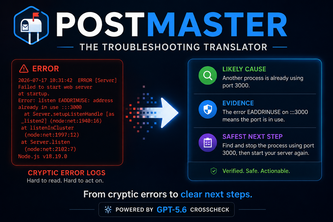
PostMaster: The Troubleshooting Translator is a self-reported tool that translates technical error messages into structured, evidence-backed diagnostic reports. It uses a deterministic engine for initial diagnosis and integrates GPT-5.6 as an adversarial reviewer to check the validity of that diagnosis without overwriting it.
What changed
The project was extended for OpenAI Build Week with integration of GPT-5.6 CrossCheck, which acts as a second opinion on the deterministic diagnosis. This change introduces adversarial review but maintains separation between evidence and inference.
Single most important open question — the commercial due-diligence read
Is there a viable market need for a troubleshooting translator that separates diagnosis from repair, especially in developer or system-administration contexts? The description does not indicate any traction, revenue, or customer data to support this claim.
What The Product Actually Is
The description states that PostMaster is a troubleshooting translator that accepts technical symptoms, error messages, logs, and structured traces and converts them into readable diagnostic reports. It includes:
- Issue category
- Confidence score
- Severity and risk level
- Matched error patterns
- Likely cause
- Supporting evidence
- Alternative findings
- Safe next steps
- Unsafe actions to avoid
- Structured AHP diagnostic packet
It is built as a TypeScript monorepo using npm workspaces, with components including:
- A deterministic classification and troubleshooting engine
- A command-line interface (CLI)
- A local web application and JSON API
- An MCP server
- Automated tests and reusable fixtures
The system intentionally separates diagnosis from repair. It does not perform actions like deleting files or terminating processes.
Not evidenced There is no indication of actual deployment, usage, or adoption beyond the author’s own account.
Positioning & Claim Evolution
The description states that PostMaster was inspired by the need for something different: a troubleshooting translator that converts cryptic technical failures into clear, evidence-backed explanations and safer next steps.
It positions itself as an alternative to tools that either return more technical information or ask AI models to generate confident answers from incomplete evidence. The key claim is that it provides:
- Evidence-backed explanations
- Safe next steps
- Separation of diagnosis from repair
The project evolved during OpenAI Build Week with the addition of GPT-5.6 CrossCheck, which reviews the deterministic diagnosis rather than replacing it.
Inference This suggests a shift toward combining deterministic logic with adversarial AI review, aiming for trustworthiness over confidence.
Target Customer & ICP
The description does not explicitly name target customers or define an ideal customer profile (ICP). However, based on the product’s function and context:
- It is designed for developers or system administrators who encounter technical errors.
- The tool supports CLI, web app, API, and MCP access, suggesting a developer-oriented audience.
It also mentions potential future integrations with IDEs and CI pipelines, implying it may target developer workflows.
Not evidenced No specific customer segments, personas, or use cases are detailed beyond the general technical troubleshooting context.
Business Model & Pricing Evidence
The description does not provide any information about a business model or pricing strategy. It only describes how the tool works and its architecture.
Not evidenced There is no mention of monetization, licensing, subscriptions, or pricing tiers.
Technical & Delivery Signals
The project is built using:
- TypeScript
- npm workspaces
- Command-line interface (CLI)
- Local web application
- JSON API
- MCP server
- Automated tests and fixtures
It uses a deterministic engine that can function without an OpenAI API key. GPT-5.6 is used for adversarial review, not primary classification.
Key technical decisions include:
- Deterministic evidence must remain visible and unchanged
- AI acts as reviewer, not classifier
- AI statements distinguish evidence, inference, and uncertainty
- Diagnosis remains separate from automated repair
- Fully functional deterministic-only mode preserved
Inference The architecture suggests a focus on safety, transparency, and local-first AI principles.
Traction & Maturity Signals
The description does not provide any data on traction or maturity. It only describes the current state of development:
- A working diagnostic system with:
- Deterministic classification
- Evidence extraction
- Confidence scoring
- Severity and risk levels
- Alternative findings
- Safe/unsafe action guidance
- Structured AHP packets
- CLI, web, API, MCP access
- Automated tests and reusable fixtures
It also mentions future development plans such as:
- Additional diagnostic categories
- IDE and CI integrations
- Privacy-preserving local model support
- Evaluation datasets for accuracy and safety
- Optional repair workflows with approval gates
Not evidenced No evidence of users, customers, revenue, or adoption metrics.
Competitive Context
The description does not mention specific competitors or a competitive landscape. It positions PostMaster as an alternative to generic troubleshooting tools that either return more technical information or generate AI-generated answers from incomplete data.
It emphasizes the difference in its approach: separating diagnosis from repair and using adversarial review to validate evidence.
Not evidenced No comparison with existing tools, market size, or competitive positioning is provided.
Open Questions & Risks
- No traction or revenue: The project is described as a hackathon submission with no evidence of real-world usage or monetization.
- Unproven market need: While the idea of a troubleshooting translator is presented, there is no indication that developers or system administrators actually need this tool or are willing to pay for it.
- Limited scope: It appears to be a proof-of-concept or early-stage prototype with no indication of scalability or enterprise readiness.
- Dependency on AI integration: The addition of GPT-5.6 introduces complexity and potential failure points, especially if the AI is not fully reliable or secure.
- Self-reported nature: All claims are self-reported and unverified; there is no third-party validation.
Questions the description leaves open
- What specific technical errors or systems does PostMaster currently support?
- How many developers or system administrators have tested or used the tool in practice?
- Is there a plan to monetize this product, and if so, what is the business model?
- How do you intend to scale beyond the current prototype and hackathon-level development?
- What are the risks associated with integrating GPT-5.6 into the diagnostic process, especially around hallucinations or unsafe recommendations?
- Are there any known limitations in how well the deterministic engine handles complex or novel error types?
- How do you plan to ensure data privacy and security, particularly when handling logs and system traces?
Overall Assessment
Not evidenced.
The description provides no information on financials, traction, or customer validation. It is a self-reported hackathon project with no indication of commercial viability or market demand.
Confidence level Low This analysis is based entirely on the author’s own account and lacks any external corroboration or evidence of product-market fit, revenue, or adoption.
Conclusion
PostMaster: The Troubleshooting Translator appears to be a conceptually interesting prototype that attempts to combine deterministic logic with adversarial AI review in a troubleshooting context. However, there is no evidence of traction, customers, or commercial viability. It remains unclear whether this addresses a real market need or if it is merely an experimental idea.
User Stories BotA demo video on every pull request
Get a demo video on every new feature
GitHub App that watches your pull requests and records a narrated, captioned demo.
Save time on demo prep and make informed decisions faster with a video walkthrough of every new feature.
Source
Submitted to the OpenAI 2026 hackathon on Devpost. Project home on Devpost. Back to the full gallery on Devpost.
This competitive analysis was produced by top-founders.com (opens in a new tab)
Generated by a language model from this project's public Devpost page — its tagline, the author's own write-up and any built-with tags listed there — as captured in August 2026. Short quotations are the author's words. It is an opinion on the idea as a business, not on the people behind it, and it reflects the description as published then. If the project has moved on, request a correction below. The analysis is not independent research and contains no verified traction, revenue or customer data.
An independent guide by KFG International LLC — not affiliated with, endorsed by, or connected to Devpost or OpenAI.