

Archive position — measured, not model output
0 likes on Devpost
2,263 of the 7,850 archived projects have more likes, and 5,587 share exactly 0 — so this project's #7,718 place in the like-ranked listing is a tie-break inside that group, not a ranking.
Projects (log scale)
Likes on Devpost. ▲ marks this project's group.
Show the figures
| Likes | Projects | Share of archive |
|---|---|---|
| 0 | 5,587 | 71.2% |
| 1 | 1,758 | 22.4% |
| 2 | 284 | 3.6% |
| 3–4 | 132 | 1.7% |
| 5–9 | 75 | 1.0% |
| 10+ | 14 | 0.2% |
 User Stories BotA demo video on every pull request
Get a demo video on every new feature
GitHub App that watches your pull requests and records a narrated, captioned demo.
Save time on demo prep and make informed decisions faster with a video walkthrough of every new feature.
Executive Summary
What the company appears to be
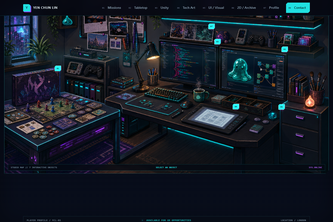
Work, Made Playable is a self-reported prototype for a game-native career portfolio that translates real professional experience into an interactive, animated studio and character-based interface. The author describes it as a personal project built around their own career, with ambitions to become a reusable system for multidisciplinary creators.
What changed
The project evolved from a basic portfolio idea into a more structured, playable prototype using HTML5, CSS3, JavaScript, Python, Pillow, and AI tools like Codex and GPT-5.6. It includes interactive elements such as pixel-art studios, animated character loadouts, and a mission board for browsing projects.
Single most important open question
Is there evidence of traction or commercial interest in the concept beyond the author’s personal use? The description does not indicate any revenue, customers, or adoption — only a self-reported prototype with no external validation.
What The Product Actually Is
The description states that Work, Made Playable is a game-native career portfolio built around real professional experience. It features:
- A pixel-art studio containing interactive objects connected to parts of the author’s work (e.g., game design, technical art, UI/visual design).
- A character loadout interface, where different professional roles are represented through animated scenes.
- A Mission Board for browsing projects by discipline.
- The system uses structured data to render multiple disciplines and project types.
- It is built as a static website using HTML5, CSS3, JavaScript, Python, Pillow, and AI tools like Codex and GPT-5.6.
The author notes that this is an early prototype, not yet a universal tool or platform.
“The current project is intentionally built around my own career. It is the first working example, not yet a universal portfolio generator.”
Positioning & Claim Evolution
The author positions Work, Made Playable as a way to translate real professional experience into play without losing honesty or clarity. The core idea is to make a person’s identity easier to understand at a glance through visual storytelling.
Key claims include:
- The project aims to help people express their work in ways that conventional CVs cannot.
- It allows users to represent skills and projects through relevant props, environments, and short animations.
- It is intended to be a personalised, interactive introduction website, not a replacement for the CV.
There is no indication of prior positioning or evolution beyond this single self-reported version. The author does not describe any market research, user feedback loops, or product iterations beyond their own use case.
“Instead of asking visitors to begin with a conventional CV, I wanted them to enter a space, discover objects, select different professional roles and gradually understand what kind of designer I am.”
Target Customer & ICP
The description does not clearly define target customers or an ideal customer profile (ICP). However, the author implies that the system could be useful for:
- Multidisciplinary creators
- Career changers
- People whose work is hard to explain via a traditional CV
It is unclear whether the author has identified specific personas or tested with real users beyond themselves.
“The larger idea could become a reusable system for multidisciplinary creators, career changers and other people whose work is difficult to explain through a conventional CV alone.”
Business Model & Pricing Evidence
There is no evidence of a business model or pricing structure in the description. The author describes the project as a personal prototype, not yet a commercial offering.
“The current project is intentionally built around my own career. It is the first working example, not yet a universal portfolio generator.”
No mention of monetization, subscriptions, licensing, or any revenue-generating mechanism.
Technical & Delivery Signals
The author reports building the prototype using:
- HTML5
- CSS3
- Vanilla JavaScript
- Python and Pillow for animation processing
- OpenAI Codex and GPT-5.6
- GitHub Pages
It is a static website, with no runtime framework or package dependencies.
The system uses a layered asset system for interactive objects, and includes:
- Day/night presentations
- Animated hover states
- Responsive design alternatives
- Structured data storage to support multiple disciplines
“Project and case-study content is stored as structured data so the same components can render multiple disciplines and project types.”
Traction & Maturity Signals
There is no evidence of traction, customers, or adoption beyond the author’s own use. The project is described as:
- A personal prototype
- Not yet a universal portfolio generator
- Built for self-use only
No metrics, user feedback, or usage data are provided.
“The current project is intentionally built around my own career. It is the first working example, not yet a universal portfolio generator.”
Competitive Context
There is no evidence of competitive analysis or awareness of existing tools in this space. The author does not reference competitors or similar platforms.
“No mention of existing tools or platforms that do something similar.”
Open Questions & Risks
- Lack of external validation: No customers, users, or third-party feedback.
- Unproven commercial viability: The system is described as a prototype, not a product.
- Limited scalability assumptions: No indication of how it would scale beyond one individual’s use case.
- Self-reported nature: All claims are unverified and based on the author's own account.
“Everything above is the authors' own account. It is not independently verified.”
Questions the description leaves open
- What specific problem are you solving, and how does this solution differ from existing portfolio tools?
- Have you tested the prototype with real users beyond yourself?
- Are there any early adopters or potential customers who have expressed interest in using this system?
- How do you plan to transition from a personal prototype to a scalable product?
- What is your roadmap for monetization, if any?
Overall Assessment
There is no evidence of commercial traction, revenue, or customer adoption. The project is described as a personal prototype, not a product or platform.
The author has not demonstrated:
- Any revenue model
- Customer base
- Market demand
- Product-market fit
Given the lack of external validation and the self-reported nature of the description, this appears to be an early-stage idea with no clear path to commercialization or investment readiness.
“This is a personal prototype with no external validation.”
User Stories BotA demo video on every pull request
Get a demo video on every new feature
GitHub App that watches your pull requests and records a narrated, captioned demo.
Save time on demo prep and make informed decisions faster with a video walkthrough of every new feature.
Source
Submitted to the OpenAI 2026 hackathon on Devpost. Project home on Devpost. Back to the full gallery on Devpost.
This competitive analysis was produced by top-founders.com (opens in a new tab)
Generated by a language model from this project's public Devpost page — its tagline, the author's own write-up and any built-with tags listed there — as captured in August 2026. Short quotations are the author's words. It is an opinion on the idea as a business, not on the people behind it, and it reflects the description as published then. If the project has moved on, request a correction below. The analysis is not independent research and contains no verified traction, revenue or customer data.
An independent guide by KFG International LLC — not affiliated with, endorsed by, or connected to Devpost or OpenAI.