

Archive position — measured, not model output
1 like on Devpost
505 of the 7,850 archived projects have more likes, and 1,758 share exactly 1 — so this project's #1,680 place in the like-ranked listing is a tie-break inside that group, not a ranking.
Projects (log scale)
Likes on Devpost. ▲ marks this project's group.
Show the figures
| Likes | Projects | Share of archive |
|---|---|---|
| 0 | 5,587 | 71.2% |
| 1 | 1,758 | 22.4% |
| 2 | 284 | 3.6% |
| 3–4 | 132 | 1.7% |
| 5–9 | 75 | 1.0% |
| 10+ | 14 | 0.2% |
 User Stories BotA demo video on every pull request
Get a demo video on every new feature
GitHub App that watches your pull requests and records a narrated, captioned demo.
Save time on demo prep and make informed decisions faster with a video walkthrough of every new feature.
Executive Summary
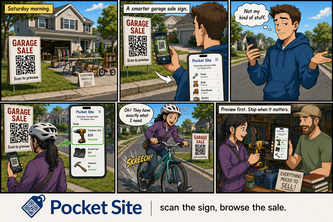
What the company appears to be: Pocket Site is an Android app built as a single-person hackathon project that allows users to create temporary, local QR-accessible catalogs for physical garage sales. The app enables hosts to list items with descriptions and prices, make them browsable by visitors via QR code or WiFi, and then delete all data after the sale ends.
What changed: This is a self-reported product description from a hackathon submission. No evidence of prior development, funding, traction or commercial activity exists beyond the author's own account.
The single most important open question: Is there any evidence that this concept has traction or demand in the real world? The description states no revenue, customers or adoption data — only an idea and a prototype.
What The Product Actually Is
- The description states Pocket Site is an Android app for creating temporary QR-accessible catalogs for physical garage sales.
- Hosts can add items with categories, prices, descriptions, and availability.
- When the sale is open, visitors can browse the catalog from another device using a QR code or local WiFi ("PocketWiFiSale").
- Visitors do not need to install an app, create an account, or make payments.
- The host can mark items as sold, close the sale, and delete all local data when the event ends.
- It is intentionally designed to be temporary by design — no marketplace, accounts, or persistent data.
Evidence: Self-reported. No independent verification of functionality or usage.
Positioning & Claim Evolution
- The description states that Pocket Site was inspired by a common problem: unclear garage-sale information leading to missed opportunities.
- It positions itself as a solution for previewing temporary physical sales without becoming a marketplace.
- The app is framed as a tool to help people "browse a temporary physical place" rather than replace discovery platforms.
- The author emphasizes that it avoids features like accounts, payments, messaging, reservations, and analytics — focusing on one narrow use case.
Evidence: Self-reported. No external validation or market positioning data provided.
Target Customer & ICP
- The description states the primary user is a "host" who organizes a garage sale.
- Visitors are described as passersby or attendees who scan the QR code to preview inventory.
- The app targets temporary physical events such as garage sales, school fairs, neighborhood swaps, and curbside setups.
- No specific customer segments beyond these use cases are mentioned.
Evidence: Self-reported. No data on actual users, personas, or segmentation.
Business Model & Pricing Evidence
- Not evidenced. The description does not mention any pricing model, monetization strategy, or business model.
- The app is described as a tool for personal use with no marketplace or transactional features.
- There is no indication of paid features, subscriptions, or revenue streams.
Evidence: Self-reported. No evidence of commercial structure or financials.
Technical & Delivery Signals
- Built using Kotlin and Jetpack Compose on Android.
- Uses foreground services to maintain local access during the sale.
- Includes QR/share functionality and PocketWiFiSale instructions for local networking.
- Designed around core concepts: sale lifecycle states, local item data, host editing view, read-only visitor catalog, QR/share screens, and destructive cleanup flow.
- The app avoids broad marketplace features to stay focused on one use case.
Evidence: Self-reported. No independent technical review or performance metrics provided.
Traction & Maturity Signals
- Not evidenced. There is no mention of users, downloads, usage data, or adoption.
- The project was submitted as a hackathon entry and described as a working prototype.
- No evidence of revenue, customers, or product-market fit beyond the author's own account.
Evidence: Self-reported. No traction or maturity indicators available.
Competitive Context
- Not evidenced. No mention of competitors, market size, or competitive landscape.
- The description does not reference existing tools for garage sales or temporary inventory management.
- No evidence of similar products or platforms in the space.
Evidence: Self-reported. No competitive analysis provided.
Open Questions & Risks
- No traction or adoption: The project is described as a hackathon prototype with no evidence of real-world usage.
- Single-person team: Only one developer (Gale Atwork) is listed, raising questions about scalability and long-term maintenance.
- Limited scope: The app avoids marketplace features but may miss opportunities for growth or monetization.
- Unproven demand: No evidence that users actually need this solution or would pay for it.
- Technical complexity: Android lifecycle behavior, foreground services, and local networking are complex and may not scale well.
Evidence: Self-reported. These risks are inferred from the lack of evidence rather than stated facts.
Questions the description leaves open
- What real-world problem are you solving, and how did you validate that it exists?
- Have you tested this with actual garage sale hosts or potential users?
- Are there any plans to expand beyond the current scope (e.g., add payments, marketplace features)?
- How do you plan to scale or monetize if demand emerges?
- What are the technical limitations of running a local catalog on Android devices?
- Is there any interest from third parties (e.g., local businesses, community groups) in using this tool?
Inference: These questions arise from the absence of evidence around user validation, scalability, and monetization.
Overall Assessment
- Not evidenced. No financials, traction, or commercial viability data are provided.
- The project is described as a hackathon prototype with no indication of market readiness or business potential.
- Without evidence of users, revenue, or product-market fit, it's difficult to assess whether this represents a viable investment or partnership opportunity.
Inference: Based on the lack of any commercial signals, there is insufficient basis for an investment or partnership decision.
User Stories BotA demo video on every pull request
Get a demo video on every new feature
GitHub App that watches your pull requests and records a narrated, captioned demo.
Save time on demo prep and make informed decisions faster with a video walkthrough of every new feature.
Source
Submitted to the OpenAI 2026 hackathon on Devpost. Project home on Devpost. Back to the full gallery on Devpost.
This competitive analysis was produced by top-founders.com (opens in a new tab)
Generated by a language model from this project's public Devpost page — its tagline, the author's own write-up and any built-with tags listed there — as captured in August 2026. Short quotations are the author's words. It is an opinion on the idea as a business, not on the people behind it, and it reflects the description as published then. If the project has moved on, request a correction below. The analysis is not independent research and contains no verified traction, revenue or customer data.
An independent guide by KFG International LLC — not affiliated with, endorsed by, or connected to Devpost or OpenAI.